
A working rectifier beneath Belsize Park
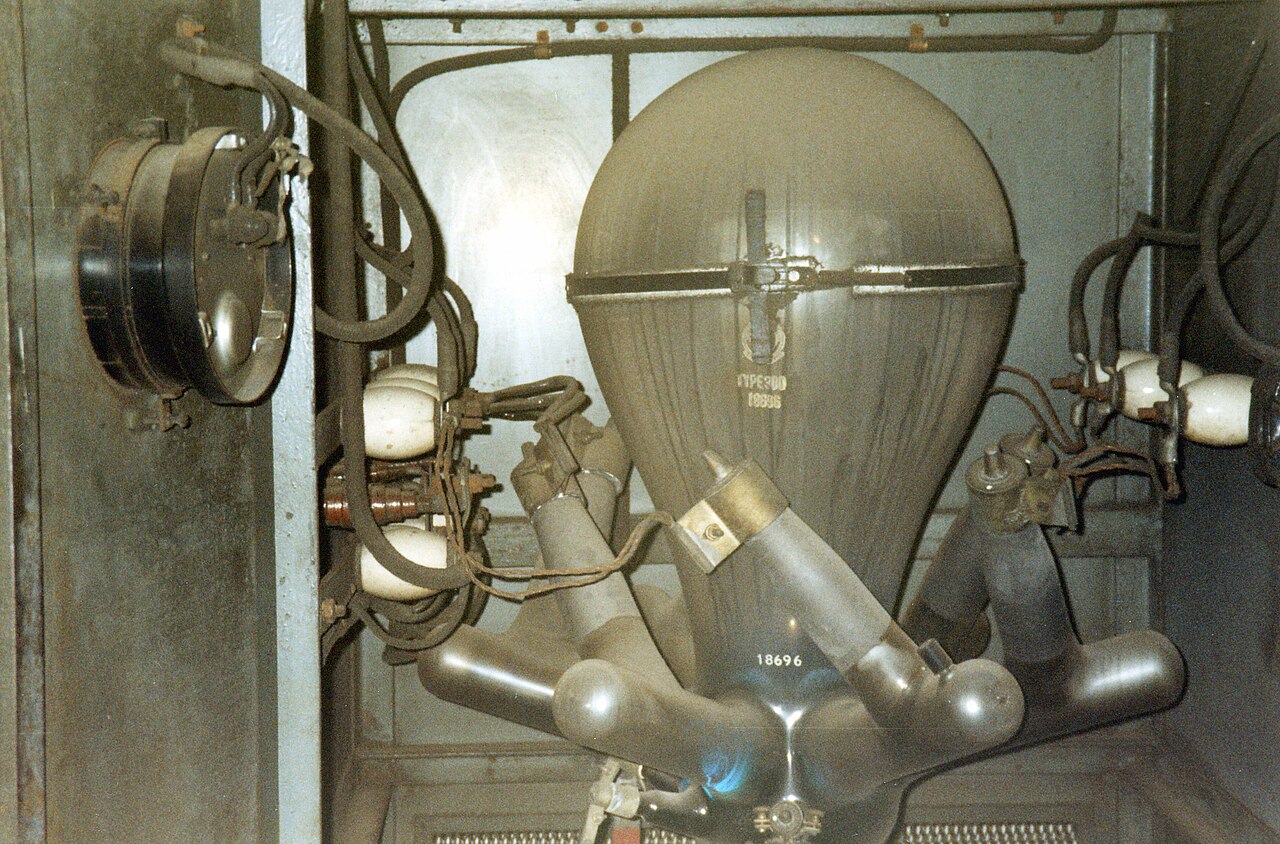
A functioning mercury rectifier in London’s Belsize Park deep-level shelter.

- Electrical task
- Rectification: converting AC into unidirectional current
- Key inventor
- Peter Cooper Hewitt
- Working medium
- Mercury vapour above a liquid-mercury cathode
- Historical settings
- Motor control, traction supply, workshops and technical colleges
The photographed apparatus
This photograph records a mercury-arc rectifier in the Belsize Park deep-level shelter in London. The Commons record identifies C. Ford, known as Secretlondon, as the photographer and gives 9 October 2005 as the original upload date. It also identifies the blue light at the lower centre as the liquid-mercury cathode spot, making this a record of an in-service device rather than simply an unpowered museum specimen.
The setting adds a different dimension to the electrical story. Mercury rectifiers were working infrastructure, embedded in buildings and power systems rather than designed only for demonstration. The photograph’s pipework, enclosure and connections help retain that practical scale. Its value in the ARC hive lies in making an unfamiliar historical technology concrete: an electrical process becomes visible through a vessel that looks almost sculptural. Read the source record carefully when dating it—the upload date is secure, while the exact manufacture and installation dates are not supplied there. This image belongs to the history of electrical supply, alongside rather than inside the history of violet-ray therapy.
A problem worth a glass monster
The spectacular vessel answers a very ordinary question: how can an alternating supply operate equipment that needs direct current? Alternating current was convenient to distribute and transform, while many motors and other loads had their own requirements. A rectifier allowed these electrical worlds to cooperate. Its achievement was not the production of energy, but a change in how supplied energy reached a load. Seen that way, the apparently otherworldly bulb belongs beside the transformer and switchboard: it is infrastructure with its interior unexpectedly on show.
A Science Museum Group specimen made by the Electric Construction Company is identified with coal-mining motor control. That modest catalogue description restores a whole working setting around the glass. A mine's electrical machinery did not require a theatrical effect; it required a dependable supply. The device's luminous personality was incidental to its usefulness. This is what makes the technology so compelling today. The same object can look like the centrepiece of an imaginary laboratory and have spent its working life helping familiar machinery do practical jobs. Its strange silhouette is a real answer to a real conversion problem.
It helps to separate two transformations that a complete installation may perform together. A transformer changes the relationship between alternating voltage and current; it does not, by itself, make the output keep one polarity. The rectifying valve supplies that directional selection. Combining them lets a system adapt both the electrical level and the direction of its delivered current. The distinction explains the otherwise puzzling mass of equipment around a bulb. The spectacular vessel performs one essential job within a coordinated machine, while iron cores, copper windings and controls perform others. Each part makes the remarkable discharge useful beyond its own glass envelope.
Hewitt's two inventions meet the public
A revealing moment survives in Nature's report of 15 January 1903. George Westinghouse had brought a small audience of railway and scientific visitors together in London to see two inventions by Peter Cooper Hewitt of New York. The guests first gathered at the Westinghouse offices in Norfolk Street, then reconvened at Claridge's. The pairing was a mercury lamp and a static converter. Illumination and power conversion were being presented as related possibilities of the same remarkable electrical medium.
That relationship is more interesting than a tidy story in which one finished invention abruptly produces another. A discharge has several properties at once: it conducts current, emits light, generates heat and behaves differently at different electrodes. The inventor's task is to decide which property can become the useful product and which must be managed. For a lamp, light is the purpose. For a rectifier, the desired product is electrical behaviour at the output. The blue-green spectacle can distract a modern viewer from that distinction, just as it must have helped hold an early audience's attention. Hewitt's apparatus made an invisible industrial process both usable and astonishingly visible.
The secret is in the unequal electrodes
The rectifying action begins with a purposeful imbalance. A mercury pool forms the cathode, while solid electrodes serve as anodes. Once the arc is established, electrons leave a concentrated active region at the mercury surface and travel through ionised vapour towards a suitable positive anode. The reverse half of the electrical cycle does not reproduce the same arrangement with the parts exchanged. The solid electrode does not readily become the equivalent emitting cathode. The vessel consequently favours conduction in one direction.
Charles Greeley Abbot explained a three-anode example in the Smithsonian's 1932 Great Inventions. Successive phases keep an appropriate electrode positive, allowing the discharge to continue while the output retains one direction. Think of several entrances serving a common exit, with each entrance becoming available in turn. This analogy explains the timing, although the real action is electrical rather than mechanical. There is no rotor inside the vessel selecting the phases. Materials, temperature and the state of the discharge do the selecting. Direct current here also does not mean a perfectly flat output: the succession of conducting intervals can leave ripple, which the surrounding power system must accommodate.
Getting the arc alive
A working discharge and an unstarted vessel are very different electrical objects. The quiet bulb cannot be understood simply as a permanent conducting path waiting for a switch. It has to enter a state in which the current can sustain the mercury-vapour arc. Hewitt's 1905 starting-device patent explicitly places lamps and rectifiers within the same general family and treats the first current flow as a separate design problem. One of the proposed ideas briefly uses moving liquid mercury to establish a conducting connection before the discharge takes over.
The important historical point is the transition, rather than a recipe for reproducing the mechanism. A discovery becomes practical when it can be started, stopped and restarted predictably. The dramatic instant of illumination hides that quieter achievement. It also explains why surviving rectifier installations contain more than their famous bulbs. Starting arrangements, auxiliary circuits and controls helped turn a striking laboratory effect into service equipment. Different designs solved the problem differently, so a particular starter should never be assigned to an unidentified museum vessel merely from its appearance. The patents reveal the range of problems inventors were working through, while the surviving machine tells us which solutions were actually embodied in that specimen.
Making a valve industrial
Hewitt's 1914 mercury-vapour rectifier patent opens a world of seals, insulating sections, metal containers and cooling passages. It is concerned with handling substantial current, and its detailed arrangements show why the basic electrical effect was only the beginning. Every conductor passing into an evacuated enclosure creates a materials problem. The joint must remain tight, mechanically secure and electrically appropriate while the apparatus warms in service. A converter is a negotiation between those requirements.
Heat gives that negotiation urgency. Useful power passes through the apparatus, but some energy remains as heat in electrodes and other parts. The device must dispose of it without losing the conditions that make rectification possible. Transparent glass bulbs reveal one branch of this engineering family; heavier constructions can hide much of the discharge within metal. Size alone therefore does not tell the entire history. Nor is the best-looking museum bulb necessarily the most advanced design. The patent record is exciting because it shows invention becoming cumulative: a better joint, a protected support or an improved cooling path could matter as much to reliable service as the original discovery of the electrical valve.
A machine that taught by showing its work
The Powerhouse collection preserves a particularly revealing later example: a six-phase Hackbridge and Hewittic teaching unit dated 1954. Its bulb is rated for 7.5 kilowatts of continuous operation and has six anode arms, two exciter arms and a cathode stem. The cabinet includes measuring instruments, controls and a cooling fan. Clear replacement side panels let students see inside. This was a working lesson in power conversion, rather than a disembodied bulb offered for visual admiration.
The institution records four decades of use supplying direct-current motors and other teaching equipment. Imagine learning electricity with an active discharge visible beside the quantities on the meters: the machine linked a schematic diagram to physical behaviour. Its eventual obsolescence also makes a useful historical point. Technologies often disappear as part of a system. A converter can lose its purpose when the motors and teaching arrangements around it change, even if its underlying physics remains sound. The surviving paperwork includes manufacturer instructions and diagrams, giving this specimen a richer identity than its date alone. Its manufacture date is supported by that specific record; it should not be borrowed to date other bulbs photographed elsewhere.
From stage machinery to a second working life
At Kempton Steam Museum, restored Hackbridge and Hewittic rectifiers connect electrical spectacle to an unusually vivid service history. They came from the Royal Opera House at Covent Garden. At the museum, a transformer and six-anode arrangement convert an incoming 415-volt three-phase supply into the conditions required to provide about 200 volts direct current for historic machinery. Following extensive refurbishment, the rectifiers were successfully loaded again on 29 June 2010. Their glow represents recovered operation as well as preservation.
This is the right setting in which to appreciate the gallery's photographs from Internal Fire, Belsize Park, Munich and Porto. They are witnesses to several specimens and several uses, rather than illustrations of one universal model. Some records establish installation dates or ratings; others establish only where and when a photograph was taken. The attraction survives those differences. Glass arms, a liquid-metal pool and a bright discharge make power conversion feel almost alive. What gives that impression lasting substance is the engineering behind it: an extraordinary-looking material effect was made dependable enough to serve motors, buildings and transport. In museum operation, that older electrical language becomes visible again.
The development timeline
1903 · A remarkable London demonstration
Nature reports George Westinghouse presenting Hewitt's mercury lamp and static converter to railway and scientific visitors.
1905 · Starting becomes an invention
Hewitt's US805293A describes a starting device applicable to mercury-vapour lamps and current rectifiers.
1914 · Engineering for heavy current
US1110557A addresses larger-current rectifiers, their containers, electrodes, seals and cooling.
1954 · A converter built to teach
A Hackbridge and Hewittic six-phase demonstration unit is supplied for technical education in New South Wales.
2010 · An industrial glow returns
Kempton's restored former Royal Opera House rectifiers are successfully loaded again on 29 June.