
Nagelschmidt’s early diathermy apparatus
A substantial early high-frequency instrument associated with Karl Franz Nagelschmidt.
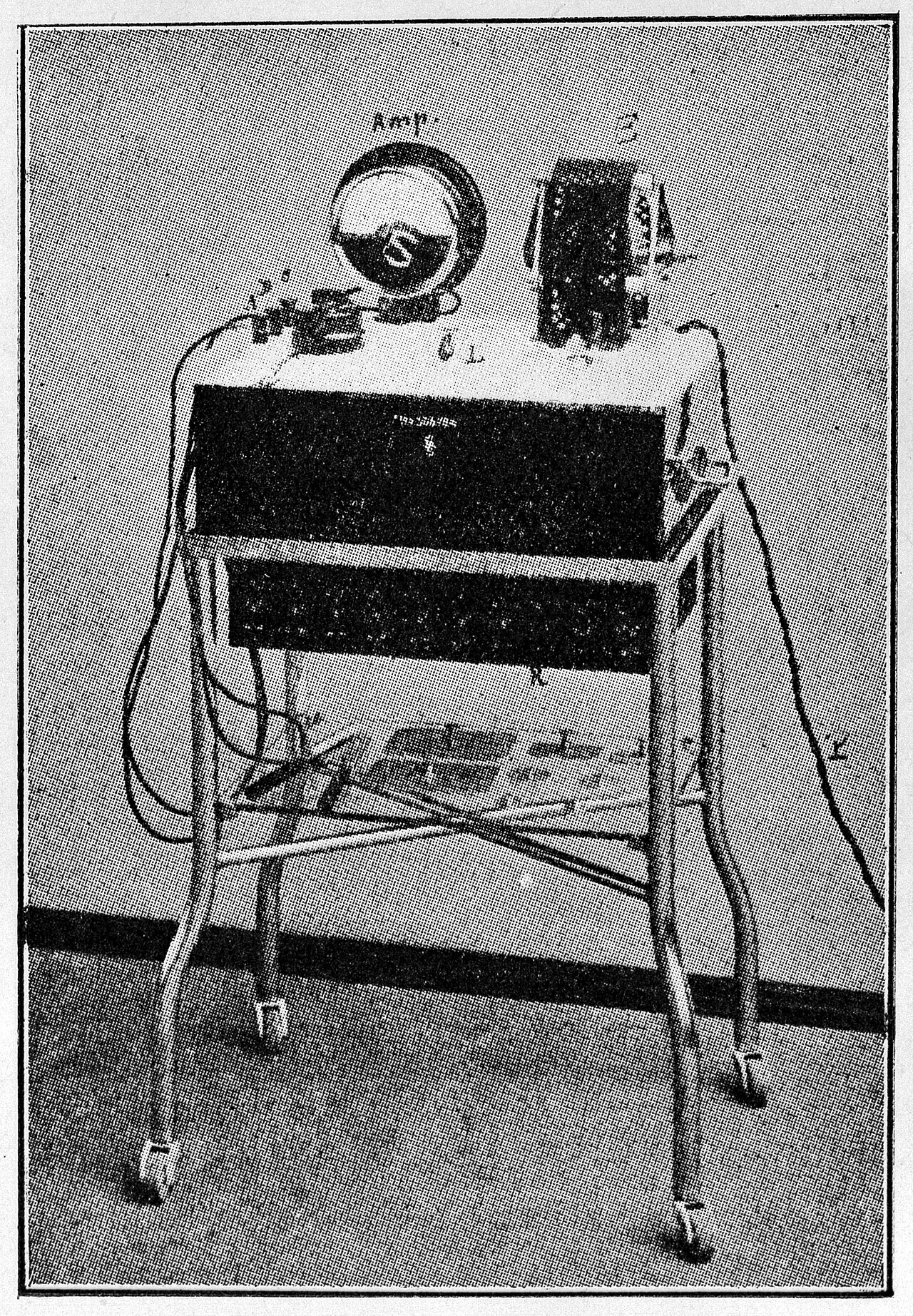

- Name associated with
- Karl Franz Nagelschmidt
- Central historical objective
- Heating tissue using high-frequency electrical energy
- Major early book
- Nagelschmidt's Lehrbuch der Diathermie, 1913
- Two important branches
- Therapeutic heating and surgical tissue effects
The photographed apparatus
The Wellcome image preserves an early diathermy apparatus associated with the German physician Franz Nagelschmidt. The current institutional catalogue identifies this particular item as a reproduction negative made in August 1956 from an illustration published in Henry Bordier’s Diathermie et diathermotherapie, Paris, 1925. Those dates describe the image’s publication and reproduction history, rather than establishing the machine’s manufacture date. Its tall cabinet, prominent upper components and measuring instrument show that high-frequency medicine included equipment far larger than a portable violet-ray case.
Diathermy developed around the use of high-frequency electrical energy for heating tissue. That aim and its apparatus should be distinguished from the visible gas discharge in a violet-ray electrode. The two histories share an interest in electrical conditions and the body, but that relationship does not make their circuits, working ends or effects identical. The photograph is most useful as a comparative plate: it shows how the same broad electrical era produced different instrument families and different therapeutic ambitions. In a gallery of extraordinary contraptions, the measuring and control hardware deserves as much attention as the dramatic cabinet.
The invention idea was heat
A hot-water bottle supplies warmth at the body's surface and relies on heat travelling inward. Diathermy proposed a different starting point: deliver energy electrically and generate heat within the tissue receiving it. That change of viewpoint gave early high-frequency medicine a concrete physical objective. The problem became how to produce, deliver and measure the desired heating, rather than simply how to expose a patient to an impressive electrical effect. It was an invention idea with consequences for the generator, the applicators and the way a practitioner described the procedure.
Karl Franz Nagelschmidt made the subject a sustained programme. His 1913 Lehrbuch der Diathermie runs to more than three hundred pages, moving from history and physics through experimental and physiological effects to medical and surgical applications. Its structure conveys the ambition of a field attempting to become systematic. Heat was a familiar agent, but electrical production offered a new technical language for it. The book's many disease chapters record what Nagelschmidt and his contemporaries investigated or advocated. They should be read as that period's programme, while the central engineering question remains immediately understandable: where does supplied energy become heat, and how can that process be controlled?
Several quantities have to be kept separate to understand the ambition. Frequency is the speed of alternation. Power describes the rate at which energy is supplied or absorbed. Duration affects the accumulated energy, while the applicator and the tissue determine its distribution. None of those quantities is a substitute for all the others. A higher frequency is not automatically a stronger exposure, and a powerful generator does not tell us the temperature at a particular internal point. The old cabinet becomes easier to read when its controls are understood as attempts to govern different parts of that chain, rather than as several ways of turning up one mysterious force.
Why frequency changed the possibilities
The early attraction of high-frequency current was connected with a change in bodily response. Electrical stimulation at lower frequencies can strongly excite nerves and muscles. Rapidly alternating energy can instead be delivered under conditions in which heating becomes the dominant intended effect. This does not mean that high frequency makes every electrical exposure harmless. It means that timing is one of the parameters governing the interaction. The waveform, power, route of delivery and local conditions remain important parts of the apparatus's behaviour.
The Science Museum Group's British diathermy set of about 1930 makes the transition tangible. It is a compact oak-cased instrument with a selection dial, leads and electrodes, a very different presence from the imposing early cabinet shown in the gallery. The museum discusses both tissue warming and surgical uses within the history of diathermy. The object illustrates how a striking experimental effect became an equipment category with controls and portable packaging. Its modest case is a reminder that electrical novelty can gradually become furniture. The technical challenge remains inside: an electrical supply has to be converted into a form suitable for a particular purpose and delivered in a defined arrangement.
Reading the Nagelschmidt cabinet
The apparatus associated with Nagelschmidt has the scale and posture of a serious installation. Its cabinet, upper electrical components, measuring instrument and accessories announce a technology whose operator needed to coordinate several functions. The image is especially useful beside a portable violet-ray set because it breaks the assumption that early high-frequency medicine was one standard device in different boxes. Here the intended story centres on electrical heating. The working end and the arrangement around the patient matter as much as the cabinet that generates the energy.
The photograph has a layered history of its own. Wellcome's present M0014868 record describes a reproduction of a photograph published in Henry Bordier's Diathermie et diathermotherapie in Paris in 1925. The archival reproduction negative is dated August 1956. Neither date, on its own, establishes the manufacture year of the depicted machine. That sequence adds depth: an experimental instrument was illustrated in a medical book, then photographed again as part of a historical collection. The gallery therefore gives us more than an old contraption. It gives us a piece of apparatus as later clinicians and curators chose to preserve and explain it, carrying an early electrical ambition through several generations of documentation.
The body is not a simple resistor
The word heating can make the problem sound deceptively straightforward. Living tissue is not a uniform block placed between two electrical connections. Skin, fat, muscle, blood and organs differ electrically and thermally; circulation carries energy elsewhere as the apparatus supplies it. A convincing account of deep heating therefore needs more than a warm surface or a calculation based on a simple container. It needs measurements that distinguish where heat is generated from where temperature eventually rises.
Carl Binger and Ronald Christie tackled that problem at the Rockefeller Institute in 1927. Their experimental study used specialised temperature measurement in animals and emphasised the difference between a living body and convenient laboratory substitutes. Their findings drew attention to circulation as a powerful part of the thermal picture. This is a particularly rewarding chapter in the history because it shows the machinery producing new questions rather than immediately settling them. The generator enabled an experiment; the experiment then demanded better instruments and a more sophisticated account of the subject. Diathermy belonged simultaneously to electrical engineering, thermal physics and physiology, and progress depended on keeping all three in view.
From spark machinery to field engineering
The apparatus family changed as electrical generators changed. A spark-excited circuit produces bursts of oscillation that decay. A valve oscillator can support a different form of sustained electrical generation. Wellcome's archive preserves a diagram identified as an early diathermy triode valve used as a source of undamped oscillations, with a 1925 source date in its title. The conceptual shift is important: the source could become a more continuously controlled oscillator rather than a succession of spark events.
Changing the source did not remove the problem of delivering energy to the intended region. The FDA's 1973 technical inspection guide explains radio-frequency diathermy through dielectric and inductive coupling and distinguishes microwave equipment. In one broad approach an alternating electric field dominates the coupling; in another a changing magnetic field induces currents. These are different ways of arranging the energy exchange, with different applicators and distributions. Read as a historical technical account, the guide shows how far the vocabulary had travelled from the spectacular cabinet. The field was increasingly described through coupling, frequency and average power. The visual theatre became less necessary as the engineering description grew more precise.
When heating became a surgical tool
The difference between warming tissue and deliberately changing it surgically is a difference of purpose, concentration and control. The Science Museum Group preserves a case of handles, needles and electrodes owned and used by Nagelschmidt, made in Berlin by Louis and H. Loewenstein and dated 1900–1933. These small working ends give the story a different scale. The generator may dominate a room, but the location and form of its interaction with tissue can be defined by an instrument held in the hand.
William T. Bovie's later electrosurgical patent, published in 1931, shows how the generator and hand instrument became parts of a coordinated system for surgical electrical effects. A fine active region can concentrate energy in ways that a broad warming arrangement is not intended to do. This helps explain the long branching history of the term diathermy: in one context it points towards physical treatment by heating, in another towards surgical cutting or coagulation. These branches share physical ancestry without being interchangeable devices. Their most compelling continuity is the pursuit of controlled energy at a particular place, with the shape of the applicator turning a general electrical effect into a purposeful instrument.
Heat, larger claims and a continuing argument
Nagelschmidt was still addressing the explanation of high-frequency effects in 1940. In a Nature letter he described the continuing controversy over whether heat alone accounted for the biological effects and stated that no other physical effect had then been proved in the application of high-frequency currents. That is a striking voice to hear from within the field. A technology could be accepted as an instrument for producing heat while the wider theories attached to it remained under argument. The apparatus had made a physical effect available; it had not supplied a universal explanation of medicine.
The later history is richer than a simple verdict that everything survived or everything disappeared. The Science Museum's Megatherm short-wave unit preserves another substantial machine in the lineage. Contemporary regulatory records also distinguish thermal and nonthermal short-wave device categories, showing that the vocabulary continued to develop. Those later categories do not validate the whole disease catalogue of an early manual. What the historical apparatus preserves is a particular moment of invention: the body was being understood as an electrically complex material in which energy could be deposited, measured and directed. The cabinet's strangeness becomes more rewarding once that idea is visible inside it.
The development timeline
Around 1908 · Nagelschmidt's early apparatus
The gallery image is associated with the early development of diathermy; it is not itself a photograph taken in 1908.
1913 · A substantial textbook
Nagelschmidt publishes Lehrbuch der Diathermie, organising physics, physiological observations and medical and surgical applications.
1925 · The illustrated apparatus enters Bordier's book
The current Wellcome record identifies Henry Bordier's Paris publication as the source of its apparatus photograph.
1927 · Heating is put under measurement
Binger and Christie publish experimental work on deep temperature and the role of circulation.
1940 · The mechanism remains debated
Nagelschmidt writes to Nature about claims for biological effects beyond heat.
August 1956 · A later photographic record
Wellcome dates its reproduction negative M0014868 to this month, separating archival photography from the original apparatus.