
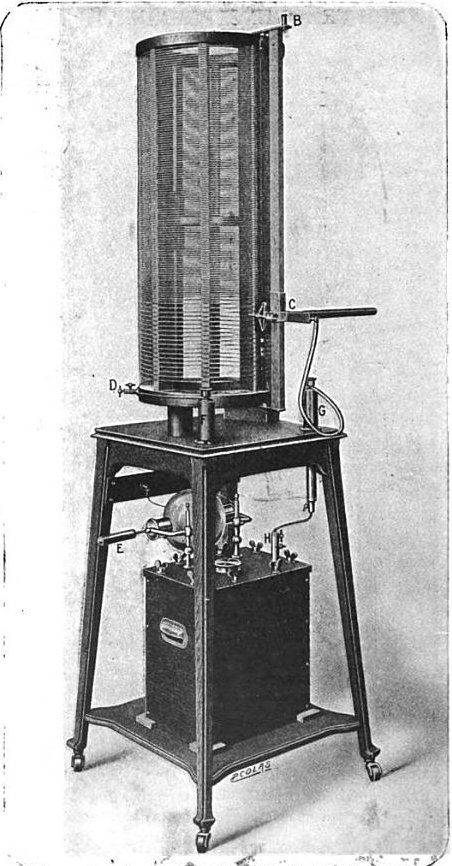
A large Oudin resonator, published in 1921
A tall resonant coil and its supporting electrical components in a contemporary medical-electricity text.

- Associated inventor
- French physician Paul Oudin
- Central idea
- Electrical resonance and a high-potential terminal
- Surviving museum example
- Oudin resonator with two Leyden jars, dated 1897–1910
- Historical setting
- High-frequency electrotherapy and electrical demonstration
The photographed apparatus
This historical image was published as figure 53 in the fifth edition of Elkin P. Cumberbach’s Essentials of Medical Electricity in 1921. It shows a large Oudin-coil apparatus, making the winding and its supporting components the centre of attention. The conspicuous vertical coil, base assembly and connecting hardware belong to the high-frequency instrument world from which many later accounts borrowed their visual language.
The object is worth examining as a complete machine. A large resonator has a physical presence quite different from the coil hidden inside a small handpiece, and the surrounding components help explain why a resonator should be studied in its installation rather than as an isolated shape. The original book supplies a contemporary description and places the image within the medical-electricity literature of its time. The scan is modest in resolution, so it is best used as an archival plate that can be opened alongside the source, rather than enlarged into a full-width photographic hero. It documents a historical design and its presentation, with the therapeutic claims remaining those of the period text.
The coil that is never really alone
The eye goes straight to the tall winding. It looks like the entire invention: a column of wire standing above a base, poised to deliver something extraordinary. Yet an Oudin resonator is most revealing when the frame widens. The Science Museum Group's example, dated 1897–1910, includes two Leyden jars on a wooden stand. The catalogue's glass, brass, wood and Bakelite describe a partnership of conductors and insulators. The working instrument exists in that partnership, and in its connections to a source.
This is an ideal object for learning to read an electrical machine as a sequence of functions. One part supplies energy, another stores it, a discharge initiates oscillation and the resonator develops a particular response. Separating these ideas makes the apparatus more impressive, because the visible form starts to make sense. The maker had to give each function a practical physical shape while preventing unintended paths between them. A tall winding also required support that would not defeat its electrical purpose. What first resembles an ornamental tower becomes a carefully arranged landscape of fields, surfaces and connections. Its physical presence is the beginning of the explanation.
The shape also has electrical consequences. A winding has inductance, while its turns and neighbouring objects have capacitance between them. Those relationships exist even when no separate component has been labelled a capacitor. Move a conductor or change its surroundings and the system's response can change. In a resonator, apparently empty space is therefore part of the working arrangement. This gives the surviving instrument an additional kind of beauty: the spacing is functional, the support is functional and the terminal's separation from nearby material is functional. The maker is arranging an electrical environment as well as assembling a visible object from wood and wire.
Oudin and the high-frequency question
Paul Oudin's name belongs to a particular development within a much wider investigation of rapidly alternating currents. Mihran Kassabian's period Röntgen Rays and Electro-therapeutics places the resonator in 1893 and discusses it alongside d'Arsonval's earlier physiological investigations and Tesla's electrical demonstrations. These researchers approached overlapping phenomena with different purposes. A physician interested in bodily response and an inventor interested in oscillating electrical systems could meet in the same experimental territory without asking precisely the same question.
The exciting idea was that changing the temporal character of a current changed what it could do. Electricity was no longer adequately described as something simply strong or weak. Frequency, potential, current and the way energy reached a subject all mattered. In that setting, Oudin's resonator offered a way to obtain a high-potential output within the high-frequency apparatus family. Period medical authors surrounded such instruments with ambitious claims about physiology. Those claims are part of the story of adoption, not established explanations of every disease named in a manual. The invention is substantial even before considering them: it made a controllable electrical response available in a form that practitioners and makers could explore.
What resonance meant at the bench
Sinclair Tousey's Medical Electricity, Röntgen Rays, and Radium provides a useful contemporary explanation. He describes the Oudin arrangement as developing from a connection between d'Arsonval solenoids, with an adjustable contact affecting the terminal discharge. At an appropriate position the output reached a maximum; moving away from it reduced the effect. This was called resonance. The useful idea is not that a coil creates energy, but that electrical conditions determine how energy supplied to the system accumulates and appears at its output.
A familiar analogy is pushing a swing at the right time. The comparison is helpful because it separates timing from brute force, although a real circuit exchanges energy between electric and magnetic fields rather than moving a seat. Resistance, radiation and the discharge consume energy, so the system needs replenishment. Tousey also distinguishes rapidly dying oscillations within a spark event from the slower repetition of those events. That distinction resolves much of the apparent mystery in period language. A machine can buzz or crackle at an audible rate while its individual electrical oscillations are far faster. The sound and visible discharge are accessible clues to processes taking place on quite different timescales.
A room built around current
Chisholm Williams's 1903 frontispiece is one of the best antidotes to imagining early high-frequency medicine as a solitary handpiece. Its caption identifies a switchboard with a dipper-break, an induction coil, an Oudin-Dean resonator and a couch for auto-condensation. These are coordinated pieces of an installation. Furniture, power control and electrical conversion occupy the same visual field. The practitioner appears as the operator of a room arranged around current, rather than simply the owner of an unusual accessory.
The image also captures a moment in the making of professional authority. A manual could display a complete outfit, name each component and invite the reader to understand the practice through its equipment. For someone accustomed to telegraph offices, workshops and new electrical lighting, that environment would have spoken the language of modern technology. Its material complexity was real even where therapeutic interpretations remained uncertain. Reading the frontispiece as an installation allows both aspects to remain visible. It documents what Williams presented to his readers in 1903; it does not tell us that every clinic had the same equipment, or that the illustrated methods achieved all the outcomes their advocates hoped for.
A name became a family of arrangements
Frederick Finch Strong's 1908 High-frequency Currents makes the field's internal disagreements unusually visible. Strong champions his own approach, compares it with those associated with Oudin and d'Arsonval, and discusses glass electrodes as a distinct development. His language is that of an advocate staking out an area of practice. It is valuable evidence of what a participant wanted colleagues to recognise, rather than a neutral final settlement of priority or clinical value.
This helps explain why surviving objects resist simple family trees. Makers adapted circuits, assembled combined outfits and offered different working ends. Authors sometimes used an inventor's name to identify a circuit arrangement, a kind of current or a treatment tradition. A later reader can therefore encounter an Oudin label without encountering an exact duplicate of the earliest resonator. The productive question is what the illustrated arrangement actually does. Where is energy stored? Which portion oscillates? Which terminal is being used? How does the applicator couple to the subject? Those questions preserve the ingenuity of variants. They also prevent every glowing glass electrode from being attributed to one inventor merely because the surrounding literature admired his resonator.
The neighbours in the electrical consulting room
Charles Warrenne Allen's period Radiotherapy and Phototherapy gives a revealing reason for including high-frequency currents in a book concerned with light and radiation. He notes the practical overlap of apparatus: equipment used for generating X-rays could also support high-frequency work when additional accessories were provided. He also reports contemporary interest in the rays and visible discharges associated with some applications. The consulting room was an experimental crossroads in which several newly accessible physical effects arrived close together.
That proximity encouraged imaginative connections, but it did not make the effects identical. An evacuated X-ray tube, a resonator terminal and a luminous glass applicator each involve a particular electrical arrangement and a different interaction with matter. The distinction becomes especially valuable in a collection whose visual language is so seductive. Similar glass, brass and sparks can conceal different purposes. The period practitioner's excitement came partly from being able to move between those possibilities within one installation. For us, the excitement comes from recovering the branching choices: an accessory could change the question being asked of the same source equipment, taking the room towards imaging, electrical discharge, physiological experiment or treatment as its author understood it.
The resonator's long afterlife
The large Oudin apparatus published in the 1921 fifth edition of Essentials of Medical Electricity shows that this visual world did not vanish after its first burst of enthusiasm. A contemporary review describes the handbook's fifth edition and praises its explanations of electrical phenomena, muscle and nerve testing, and diathermy. The resonator belonged to a broader professional literature that was continuing to organise and teach medical electricity. Its historical significance extends beyond its most flamboyant terminal discharge.
Later commemorative photographs add another layer. Wellcome records reproductions of photographs published for d'Arsonval's 1933 jubilee, including an Oudin resonator attached to his high-frequency apparatus. Here an instrument has become part of how a scientific career is remembered. In the present gallery, the 1903 installation and 1921 large-coil plate offer two points of entry into that history. Their publication dates are secure; they are not automatic manufacture dates for every component depicted. What endures is a remarkably fertile invention idea: tune a collection of electrical parts so their behaviour becomes available at a purposeful terminal. That idea links the resonator to a much larger history of oscillators, measurement and controlled electrical energy.
The development timeline
1893 · Oudin's resonator enters the period account
Early twentieth-century medical-electricity literature dates Oudin's resonator to 1893, within the developing high-frequency field.
1897–1910 · A surviving object anchors the story
The Science Museum Group dates its resonator with two Leyden jars to this range.
1903 · An installation is published
Chisholm Williams illustrates an Oudin-Dean resonator as part of a complete clinical high-frequency outfit.
1908 · Competing interpretations fill the manuals
Frederick Finch Strong publishes High-frequency Currents, describing apparatus and advancing his own therapeutic approach.
1921 · The large coil remains in print
The fifth edition of Essentials of Medical Electricity includes the large Oudin apparatus reproduced in this gallery.