
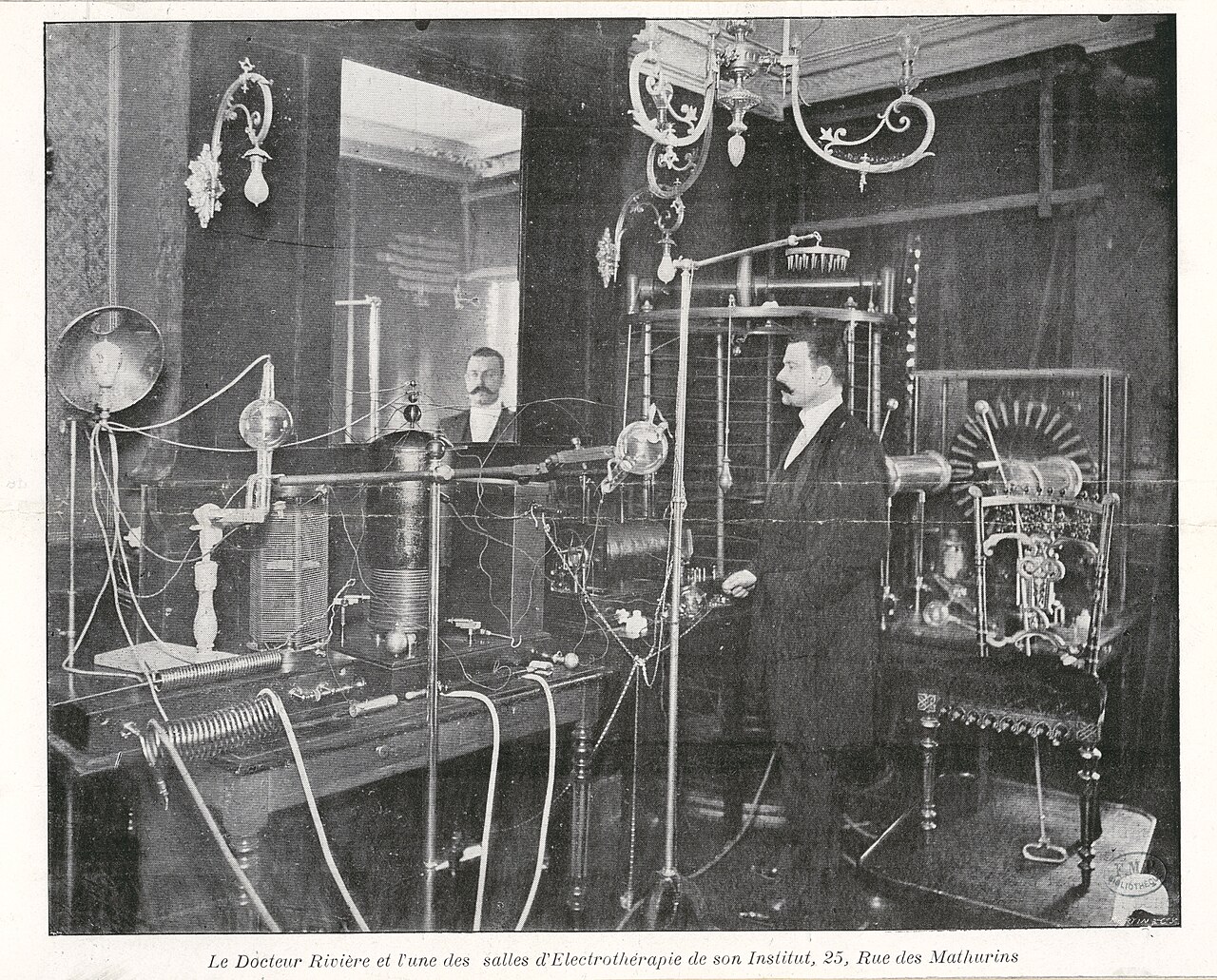
Dr Rivière and an electrotherapy room
A historical room-scale view preserved in the BIU Santé collection.

- Historical umbrella
- Electrotherapy included several distinct electrical methods
- Principal apparatus families
- Galvanic cells, induction and magneto machines, static machines and high-frequency generators
- Important distinction
- Generating current, measuring it and applying it are separate functions
- Gallery photograph
- Dr Rivière's institute; exact photograph date unestablished
The photographed apparatus
This historical reproduction identifies Dr Rivière with one of the electrotherapy rooms of his institute. It comes from the collections of the Bibliothèque interuniversitaire de santé, shared with Wikimedia through its institutional partnership. The supplied source record does not establish a date, so the image should remain undated rather than acquiring a confident year from the appearance of the apparatus or clothing.
The room-scale view is the important feature. Electrical medicine was organised around spaces, furniture, practitioners and assemblies of equipment, not only around isolated instruments. A photograph or historical reproduction of an installation can therefore reveal how devices were presented and how a specialist practice represented itself. It also invites careful comparison with the contemporary manuals: identify only what can actually be seen or supported by the accompanying record. For the ARC hive, the image complements the more tightly identified Oudin installation and Nagelschmidt apparatus, widening the view from a single machine to an electrical treatment environment.
A room full of possibilities
The photograph identifying Dr Rivière with a room in his institute changes the scale of the story. An isolated electrode can look like a curious object with a forgotten purpose. A room reveals a working culture: furniture, machines, connections, practitioners and a place arranged for encounters between them. The electrical installation was an environment. Its many parts could signal technical command to a visitor while giving its operator access to several forms of electrical behaviour.
The image comes through the Bibliothèque interuniversitaire de santé's institutional contribution to Wikimedia. Its supplied record does not establish an exact date, and the visible room should not acquire one from the style of the clothing or cabinets. What it does preserve is the ambition of an electrical practice large enough to be photographed as a place. That is the most useful entry into electrotherapy. It was an umbrella under which different generators, currents and applications could coexist, sometimes with sharply different explanations. The photograph invites us to reconstruct those distinctions: which part supplies energy, which shapes it, what can be measured and where the interaction with the patient occurs? Every answer makes the room more legible.
Chemistry inside the electrical box
Before the wall socket became an ordinary feature of a consulting room, the source of electricity could itself be a conspicuous piece of equipment. A galvanic cell used chemical reactions to maintain an electrical potential. Several cells could be assembled as a battery. The arrangement made direct current available, but also brought containers, electrodes, liquids and maintenance into the practice. The apparently electrical room was partly a chemical workshop, with its supply depending on materials that could be consumed, renewed or contaminated.
The Science History Institute preserves illustrations of Alfred Smee's cell and battery in a nineteenth-century educational volume. The plate makes the essential idea accessible: metals and electrolyte are arranged to make electrical work possible outside the cell. Its significance for medical apparatus is the controllable source, not a special healing substance inside the jar. With a source available, designers could add selectors, regulating components, conductors and working ends. A box of cells was therefore the start of a chain of decisions. This helps recover the practical ingenuity behind a polished instrument case. What looks like a finished medical machine may contain a supply technology that its owner had to understand as thoroughly as the visible electrodes.
A changing current from a turning handle
Electromagnetic induction offered another route. Faraday's 1831 work showed that changing magnetic conditions could induce an electrical effect in a circuit. A later magneto machine could exploit relative motion between magnetic and conducting parts, allowing mechanical effort at a handle to supply a changing electrical output. The operator's hand and the mechanism inside the case were therefore part of the source. A magneto instrument had a different practical character from a battery, even before considering the application attached to it.
The Powerhouse collection holds a Joseph Gray and Son example made in Sheffield in 1885. Its wooden box contains a horseshoe magnet and electromagnetic components, with two brass handles connected by fabric-covered wires. The institution relates the form to machines originally designed by Davis and Kidder in the United States. The packaging is revealing: a complete electrical encounter could be presented as a portable kit, with its own source, controls of a mechanical kind and ready-made human interfaces. It also gave an immediate, tangible demonstration that the mechanism did something. Feeling a current helped make the apparatus persuasive, although producing a sensation and proving the advertised medical benefits remained different achievements.
The coil that broke up the supply
An induction apparatus could give a battery another role. Rather than using its direct current only as the final output, a contact-breaker made that current change repeatedly. The changing magnetic field in a coil then induced an electrical response in another winding. This is the engineering territory behind much period talk of faradic currents. The essential distinction is temporal: the apparatus shapes how current varies, and that variation can change the response of nerves and muscles. A battery-and-coil set therefore contains both an energy source and a converter.
A surviving Grigg electromagnetic machine in the Science Museum Group collection brings the mechanism into focus. Made by Chislett of Plymouth around 1880–1890, it combines an induction coil with an electromagnetic contact-breaker, silvered contact and terminals. Brass and walnut can make such equipment look reassuringly still in a museum case, while the contact-breaker points to the motion once at its heart. Repeated interruption was an active process, with wear and adjustment among its practical concerns. The object rewards looking beyond its handles. Its apparently simple output depended on a sequence in which chemical energy, magnetic change, mechanical movement and induced electrical pulses were coordinated inside the same compact instrument.
Portability, instruction and professional display
Portability was a technical achievement and a commercial argument. In February 1870 the British Medical Journal described a Schmidt and Robinson galvanic apparatus housed in a box approximately ten inches long. The report discussed a battery, coil and sponge-bearing conductors and relayed the inventors' claims about readiness, duration, quiet operation and easy carriage. The little case promised that electrical treatment could travel with the practitioner. Its appeal depended as much on convenience and reliability as on the novelty of electricity.
By 1902 Samuel Howard Monell's large illustrated instructional work offered a different kind of portability: a photographic curriculum for postgraduate home study. Its scope joined X-rays with light, hot air, vibration and high-frequency currents, addressing several medical and dental audiences. The consulting room was becoming reproducible in images and explanatory text. These publications show two ways apparatus travelled: physically, in a fitted case, and professionally, through a plate, caption or manual that taught readers how to understand an installation. That circulation helped electrical methods acquire familiar forms. A machine could arrive with an account of its purpose already attached, making the book and the cabinet complementary parts of the historical practice.
The patient inside a coil
Among the most extraordinary surviving objects is the d'Arsonval cage associated with Dr J.-A. Rivière, made by Richard Heller of Paris and dated 1890–1910. The Science Museum Group describes an octagonal wooden frame whose user remained insulated from the current-carrying wire. This was an arrangement for auto-conduction, placing the person within the field of a large high-frequency coil. The room-scale machine gave an electrical idea a literal architecture around the body.
The collection also preserves a hand-held coil with a lamp socket for demonstration: within the energised arrangement, the receiving coil could light a bulb. That is a wonderful explanatory accessory. It allowed an otherwise invisible relationship to announce itself through an ordinary, visible result. The demonstration illustrates energy transfer to that receiving circuit; it does not by itself establish every physiological claim attached to the cage. Its historical interest is nevertheless immense. The patient, the large winding and the small lamp experiment were all ways of exploring the same field-filled space. Rivière's association with a surviving object adds material depth to the undated room photograph without proving that the photographed room contains this exact specimen in its original arrangement.
Promise, packaging and the violet ray
Electrical medicine also entered a vigorous marketplace of remedies. The Science Museum Group's galvanic apparatus in a Pulvermacher-belt box, dated 1870–1910, is accompanied by an expansive historical claim about nervous, chronic and functional diseases. The gap between an identifiable electrical effect and such a broad promise is central to the collection's history. A real current did not make every proposed explanation or advertised outcome real. The physical invention and the sales story could travel together while deserving separate examination.
Portable violet-ray equipment made another powerful package: a fitted case, a handpiece and an assortment of glass working ends, with a discharge visible to the user. The University of Texas Health Science Center's historical collection places violet-ray apparatus beside combined galvanic and faradic battery equipment and records the varied ailments for which it was promoted. The contrast shows why electrotherapy should remain a plural subject. The devices differed in supply, waveform, interface and ambition even when sellers borrowed the same language of vitality or stimulation. Their beauty is part of the evidence. A glowing applicator made an invisible process tangible, and its dramatic appearance helped carry therapeutic expectations far beyond what the appearance itself could demonstrate.
What survived the electrical room
The long story does not end with a single judgment on everything in the room. Modern medicine still measures the body's electrical activity and uses electrical energy for particular purposes. The continuity is easiest to understand at the level of defined instruments and aims. A device intended to stimulate nerves for temporary pain relief addresses a different question from a cabinet sold as a general answer to chronic illness. Shared use of electricity does not make them the same treatment, just as shared use of heat does not make every thermal instrument identical.
The NHS describes TENS as a small device that passes a weak electrical current to nerves and may provide temporary pain relief, while explicitly noting that it does not work for everyone. That limited, specific description is useful beside the sweeping language in some historical catalogues. It shows how an electrical method can be described through a stated purpose and an acknowledged range of response. Return now to Rivière's room: its cabinets contain an earlier, less settled organisation of possibilities. The fascination lies in recovering those possibilities one by one. Chemical cells, changing magnetic fields, oscillating circuits, physiological observations and commercial hope all left physical traces, and together they made the electrical consulting room one of the most visually remarkable spaces in medical history.
The development timeline
1831 · Induction opens a route
Faraday's discovery of electromagnetic induction supplies a fundamental principle later used in medical electrical machines.
1870 · Portability becomes a selling point
The British Medical Journal describes a boxed battery-and-coil apparatus advertised for medical use.
1885 · The hand-driven instrument
A Joseph Gray and Son magneto machine now in the Powerhouse collection illustrates a familiar portable form.
1890–1910 · The room itself becomes an instrument
The Science Museum Group dates its Rivière-associated d'Arsonval cage to this period.
1902 · A photographic curriculum
Samuel Howard Monell publishes a large illustrated system covering electrical and other physical treatments.