
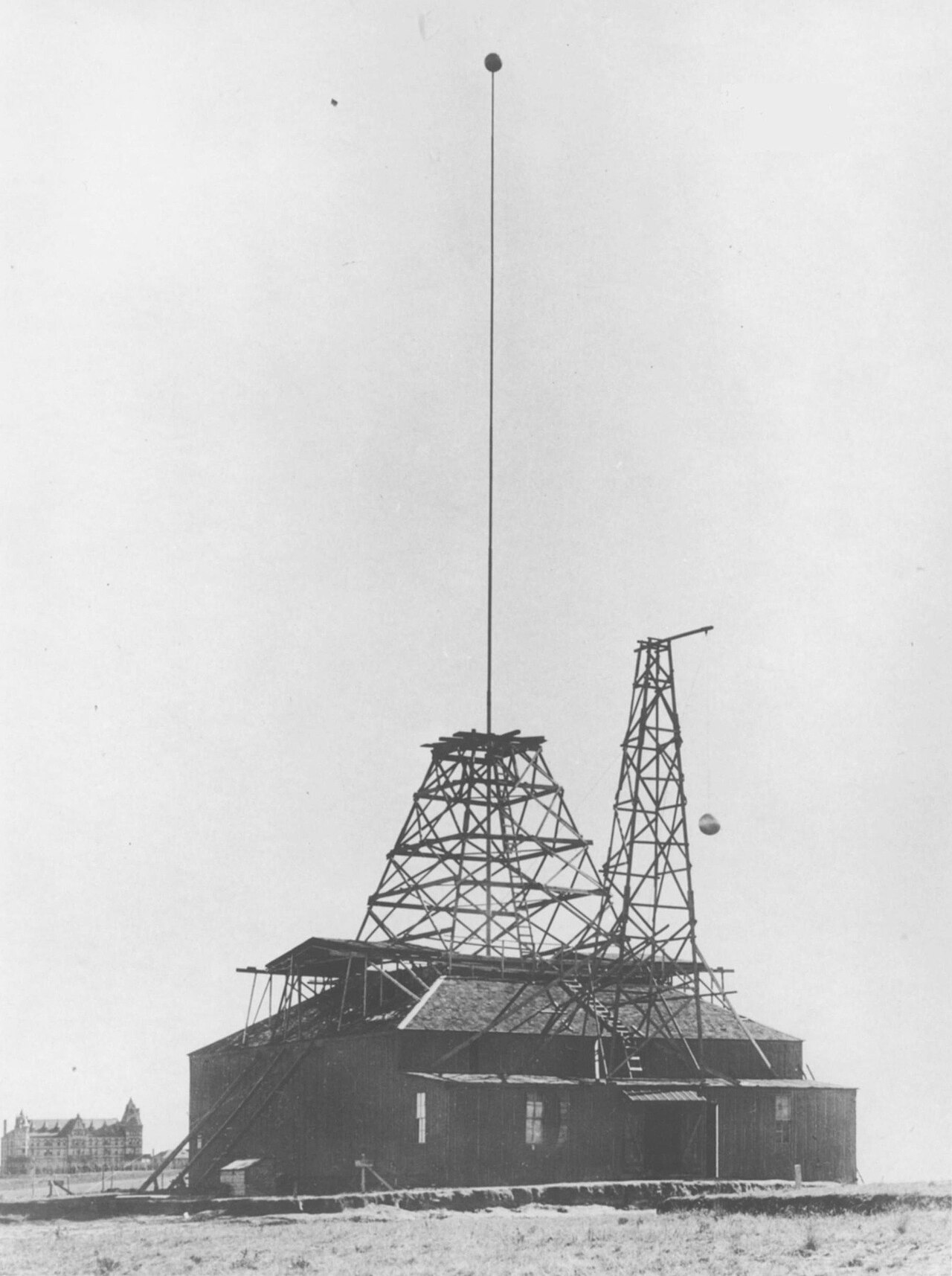
Outside the Colorado Springs laboratory
The temporary laboratory and tall mast behind Tesla’s 1899 experiments.

- Electrical family
- High-frequency oscillators and resonant transformers
- Central idea
- Store energy, set it oscillating and couple it into another circuit
- Historical focus
- Tesla’s 1890s lectures and Colorado Springs work of 1899–1900
- Gallery views
- Receiving loop and lamps; magnifying transmitter; laboratory exterior
The photographed apparatus
This exterior view places the Colorado Springs experiments back into a real building and landscape. The file record dates the image to December 1899 and credits Charles Alley as photographer. Tesla worked at the station during 1899–1900, investigating high-frequency oscillation and wireless electrical transmission. The building’s long roofline and conspicuous mast offer a different impression from the famous interior discharge photographs: an experimental programme needed space, structures, supplies and a relationship with its surroundings.
The picture was reproduced with Tesla’s account of electrical transmission in Scientific American Supplement in June 1904. That publication history gives readers a route from the image to Tesla’s own later explanation of the work. It is useful in a biography because it restores setting and chronology, rather than leaving the inventor suspended in a timeless scene of lightning. The exterior can also be paired with the lamp-loop experiment and interior transmitter photograph to distinguish the station, the generating apparatus and a particular reported test. Its historical value is concrete: it shows where a famous sequence of experiments took place.
The invention was a way of organising energy
Begin with a surprisingly simple ambition: make electricity change direction much faster, and discover what that change makes possible. Tesla’s high-frequency apparatus grew from a period when electric lighting, alternating-current power and electromagnetic research were developing together. His 1891 lighting patent describes currents of high frequency and high potential; the following years brought a succession of arrangements rather than one permanently fixed machine. The familiar name Tesla coil now covers a family of resonant transformers. Behind the name sits a more fertile idea: the behaviour of an electrical system can be transformed by arranging how it stores and exchanges energy.
That is why a history told entirely through lightning photographs misses so much of the invention. A coil can be an inductor, a transformer winding, part of a tuned circuit or a participant in several of these roles. A glass vessel can make a faint electrical process visible. A terminal can influence capacitance as well as provide an impressive silhouette. Tesla’s work connected such components through timing and relationship. There is a beautiful economy to that approach: the important event is distributed through the apparatus. Follow the energy and the machine stops looking like a single mysterious source. It becomes an ensemble whose separate parts can be questioned, compared and changed.
The patents preserve successive proposals in the inventor’s own language and drawings. They establish what Tesla described and claimed; practical performance remains a separate question for experiment.
The hidden pendulum: inductance and capacitance
The letters L and C are compact names for two complementary electrical properties. Capacitance describes how much charge a system holds for a given voltage. Inductance describes the relationship between changing current and the magnetic field associated with it. Together they can support oscillation. Charge initially stored on a capacitor begins to move through an inductor; the growing current establishes magnetic energy. Later, the declining magnetic field keeps current flowing and charges the capacitance in the opposite direction. The process can repeat, with energy passing between two forms of storage.
A swinging pendulum offers a useful comparison: energy alternates between height and motion. The electrical version has no swinging weight, yet it also has a preferred rhythm. In an ideal simple circuit, increasing either inductance or capacitance lowers its natural frequency. Real apparatus adds resistance, leakage and more complicated distributions of capacitance. Consequently, the neat textbook circuit is a starting model. A large winding, its terminal and its surroundings can behave as a distributed system, with electrical conditions differing along the structure.
This gives old adjustments a new significance. Changing a connection or moving a terminal could alter the system’s rhythm, as well as its appearance. Tesla’s 1896 patent explicitly treats self-induction and capacity as determinants of discharge frequency. The governing principle is wonderfully concrete: material, geometry and connection become timing. The huge installation and the modest diagram belong to the same intellectual story because both concern the controlled exchange of stored energy.
Two circuits learning the same rhythm
Oscillation alone does not explain a Tesla transformer. Energy must also pass between interacting parts. A changing current in a primary winding creates changing magnetic flux; some of that flux links a secondary winding and induces an electrical response. Coupling describes the strength of that relationship. It depends on the geometry and positioning of the windings, so two coils with the same turn counts can behave differently when their relationship changes. The transformer is a spatial arrangement as well as an electrical one.
Resonance adds another layer. A circuit responds particularly strongly near a natural frequency, much as a repeated push can build a swing’s motion when its timing is suitable. In coupled electrical circuits the source, receiver and load interact, and energy can move back and forth between them. A large secondary voltage therefore cannot be understood simply by counting turns, as though every high-frequency apparatus were an ordinary power transformer. Resonant energy accumulation, losses, loading and coupling all help determine the outcome.
Tesla’s transmission patents emphasise tuned transmitting and receiving arrangements. Resonant response can be examined in a defined experiment; a long-distance power scheme must additionally establish its path, losses and delivered output. The tuned receiver’s selectivity is captivating: an apparently quiet object can respond vigorously when the surrounding electrical conditions suit it.
What the spark does—and what it cannot tell us
A photograph makes electrical activity look instantaneous and complete. Its waveform has disappeared. Yet waveform is central to understanding an oscillator. In a traditional spark-excited arrangement, stored energy can be released as a burst of rapid oscillations whose amplitude falls as energy is dissipated or transferred. Repeated excitation produces repeated bursts. The frequency of the rapid oscillation and the rate at which bursts recur are different quantities. An audible buzz, a camera exposure and the underlying electrical reversals consequently tell different stories about time.
Voltage, current and electric field also describe different things. Voltage is a difference in electric potential; current is a rate of charge flow. The local electric field concerns the force a charge would experience at a particular position. Around a terminal, shape helps determine field concentration. When the field in air becomes sufficient for ionisation to develop, luminous discharge can trace branching paths. Those paths are real physical events, but their length and brightness do not by themselves provide a complete measurement of energy delivered to a remote receiver.
Tesla’s later transmitter patent examines terminal curvature and leakage. A dramatic discharge can demonstrate electrical activity while representing energy leaving the intended circuit. The performance question depends on purpose: visible light is central to a display, while a power-transfer study needs to establish the energy’s destination.
Colorado Springs: a machine large enough to enter
The exterior photograph restores an essential fact: these experiments occupied a building in a landscape. Its source record dates that view to December 1899. The roof, mast and open surroundings turn a familiar electrical icon back into an installation that required space, connections and people. Tesla arrived in Colorado Springs in 1899 and worked there into early 1900. His later account identifies the investigation with powerful transmitters, selective reception and the behaviour of electrical disturbances in the earth and atmosphere.
The magnifying transmitter developed beyond the simplest two-coil picture. Tesla’s notes discuss primary, secondary and an additional coil, together with adjustments intended to bring their electrical behaviour into agreement. A September entry records changes to the secondary and the position of a terminal while seeking resonance. Such passages are an excellent antidote to the idea of invention as a single revelation. Here is experimental work in motion: change, compare, interpret, then change again. The dimensions are extraordinary, but the reasoning has the recognisable shape of a laboratory notebook.
Reading a notebook also means distinguishing an observation from the author’s explanation of it. A registered disturbance at a distance, a striking discharge and a proposed global transmission mechanism are separate levels of claim. Tesla’s records preserve his evolving interpretation, while later commentary can examine its limits. This layered reading makes the station more compelling. The building held a working investigation whose questions remained open, and its imposing apparatus was a means of asking them.
The receiving loop: let the lamps answer
The lamp-loop photograph rewards close attention because it shows a receiver doing a recognisable job. Tesla published the image in his June 1900 Century article, The Problem of Increasing Human Energy. His caption describes three incandescent lamps in a large wire loop, a condenser included in that loop, and an arrangement tuned to the oscillator. It reports illumination by induced currents at a stated separation from the energised primary. These are Tesla’s contemporary descriptions of the test, and they give the picture a much more specific meaning than the phrase wireless electricity alone.
The condenser matters because the receiving loop has an electrical response of its own. A changing magnetic flux through a loop can induce a voltage; the resulting current depends on the loop’s impedance and its load. Capacitance and inductance can tune that response. The lamps consume energy and therefore participate in the experiment: their resistance affects the receiver while their light indicates that energy has reached them. The apparently passive loop is a deliberately arranged second system.
A modern investigation of the same broad question would distinguish input energy, delivered lamp power, geometry and losses, then examine how the result changes with distance or tuning. That is an interpretive framework for reading the historical image, rather than a set of measurements recoverable from it. The photograph records an illustrated experiment and a published claim. Its enduring appeal lies in the wonderfully ordinary witness at its centre: a small lamp makes an invisible relationship visible.
An electrical portrait made in two exposures
The seated Tesla and the immense discharge belong to one of science’s most arresting compositions. They were recorded in separate exposures. The photographic record identifies Dickenson V. Alley as the photographer and describes the deliberate double exposure: the electrical display was photographed, then the plate was exposed again with Tesla seated and the machine inactive. This is a historical act of image-making, and understanding it adds another kind of ingenuity to the scene. The photograph combines an apparatus demonstration with a portrait of the inventor.
The composition asks the eye to move between incompatible scales. An individual sits with apparent composure inside an environment of overwhelming electrical activity. Furniture and clothing provide familiar measures, while the winding and branching discharge seem to exceed them. The resulting image does persuasive work: it gives the experimental programme a protagonist and makes an unfamiliar technology emotionally legible. Its later reputation owes much to this visual argument, which can be studied alongside the electrical one.
The three gallery views have complementary roles. The exterior locates the programme, the transmitter communicates scale, and the lamp-loop photograph presents a receiving experiment. Each retains its own date and circumstances. Exact operating voltage or frequency belongs to an identified experiment and cannot be recovered from a spark’s apparent size.

The legacy is richer than a lightning bolt
Tesla’s 1893 lecture connects illumination, resonance and electrical experimentation with remarkable confidence. His later transmission writings extend that confidence into a vision of far-reaching communication and power. Those texts deserve to be read in their historical voice: they show how the inventor framed the possibilities he was pursuing. They do not turn every proposal into a completed system. The distinction leaves plenty to admire, especially the ingenuity of treating frequency, coupling and electrical geometry as variables that could be deliberately shaped.
The same concepts now help readers understand many kinds of electrical apparatus, although shared principles do not make later devices direct copies of Tesla’s machines. Resonance concerns selective response. Coupling concerns interaction. Loading concerns what happens when a system supplies something useful. Loss concerns where energy goes. Once these questions become visible, the old machine becomes a remarkably good teacher. It offers a vocabulary for examining technology whose important actions are usually hidden inside an enclosure.
Its place beside violet-ray equipment is therefore especially rewarding. Both invite attention to coils, high-frequency electrical activity and luminous glass, while their purposes and circuit arrangements need individual identification. The appeal is partly aesthetic: gleaming terminals, generous windings and darkness interrupted by light. It is also intellectual. A spark can be beautiful on first encounter; understanding the oscillation, the receiver and the experiment makes the second encounter better. Tesla’s apparatus keeps that passage from amazement to investigation unusually close to the surface.
The development timeline
1891 · High frequency becomes an engineering programme
Tesla’s US454622 patent presents a lighting system using currents of high frequency and high potential. His related November patent develops conversion through condenser discharge.
1892–1893 · The lecture room becomes a laboratory
London, Philadelphia and St Louis audiences encounter Tesla’s demonstrations of oscillation, electrical resonance and unfamiliar forms of illumination.
1896 · A continuing search for workable apparatus
Patent US568176 describes compact arrangements for converting an existing direct-current supply into high-frequency electrical activity.
1899–1900 · Colorado Springs
Tesla develops and tests a large experimental installation. His notes record adjustment, observation and repeated attempts to bring interacting circuits into resonance.
1900–1904 · Experiments become a public vision
The Century essay of 1900 and Tesla’s 1904 wireless-transmission article connect particular experiments with his much broader ambitions for electrical transmission.