
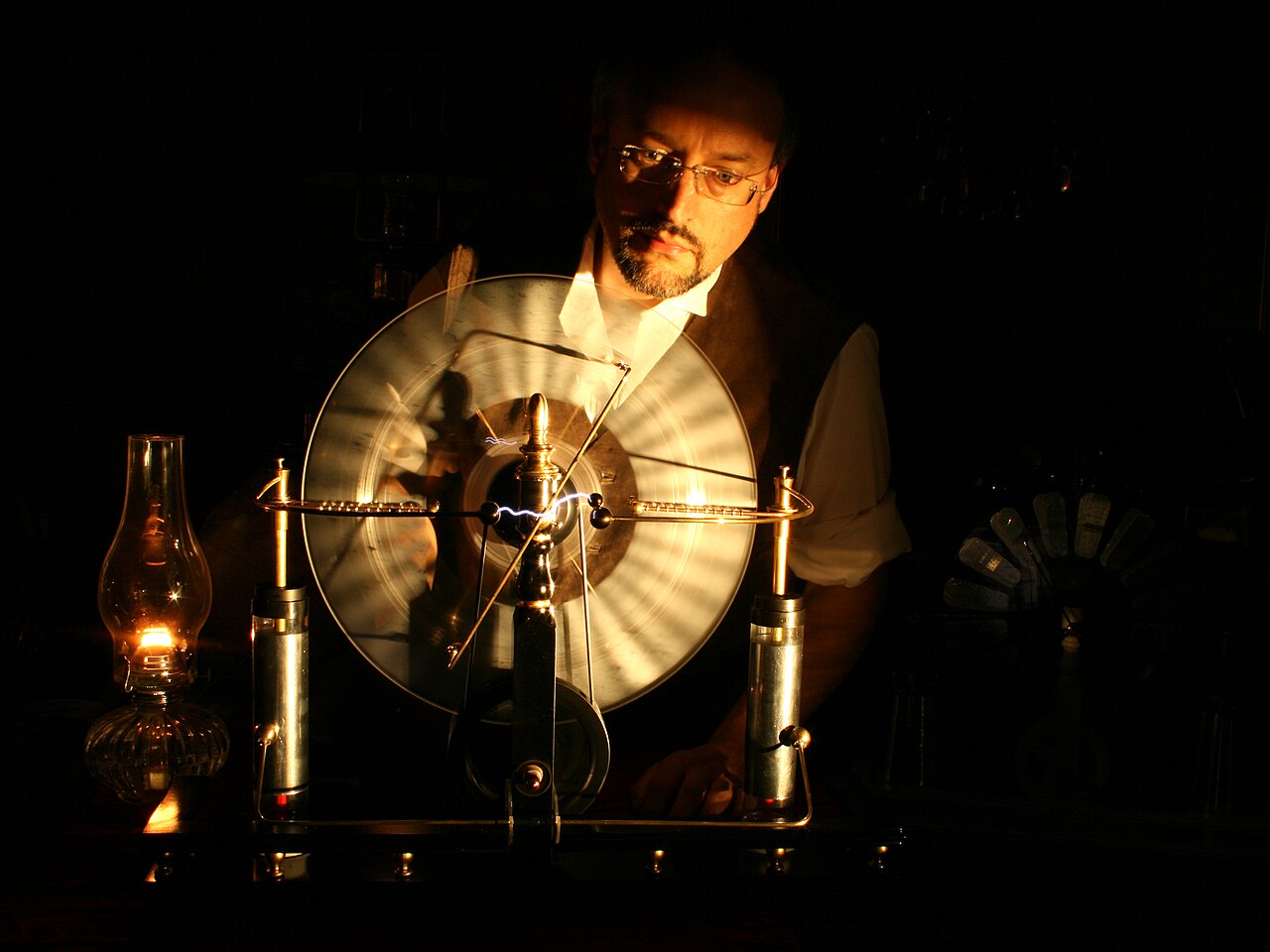
The Wimshurst machine in operation
Real sparks from a rotating electrostatic influence machine.

- Electrical family
- Electrostatic influence machine
- Central idea
- Use induction and mechanical motion to reinforce charge separation
- Historical anchor
- The Science Museum preserves an original machine made by James Wimshurst in 1882
- Gallery photograph
- Modern apparatus in operation, photographed by Jake von Slatt on 30 September 2008
The photographed apparatus
Jake von Slatt’s photograph shows a Wimshurst machine in operation, captured on 30 September 2008. The visible discharge brings the electrostatic influence machine out of the catalogue and into an actual electrical event. Its counter-rotating discs, metal sectors and collection terminals belong to a different generating principle from the induction coils and high-frequency oscillators used in many violet-ray sets. This is a modern photograph of the machine type, not an image of James Wimshurst’s original apparatus.
The Science Museum preserves an original influence machine made by Wimshurst in England in 1882, providing a useful historical anchor for the design family. Other surviving examples moved between demonstration, teaching and electrotherapeutic settings. Looking across those records reveals how a single electrical principle could acquire different cases, scales and audiences. In this gallery, the photograph’s chief role is to show electrostatic discharge clearly while the linked museum records provide the chronology. It also offers a reminder to identify the machine before interpreting a spark: similar-looking light can arise from quite different arrangements.
A modest handle and an extraordinary result
Few electrical machines explain their own physical presence so generously. The Wimshurst machine offers discs, belts, metal sectors, brushes and terminals almost as a diagram in three dimensions. A handle provides familiar mechanical motion; a spark supplies the astonishing result. Between them lies an arrangement that separates charge and accumulates electrical energy. The source of that energy is the work driving the mechanism. The machine’s achievement is to organise that work into an unusually high electrical potential difference.
James Wimshurst came to this problem from an engineering life closely connected with ships. The Science Museum records his apprenticeship at the Thames Ironworks, work as a surveyor and appointment as chief shipwright surveyor at the Board of Trade. His electrical experiments developed alongside that career. It is an appealing combination: the judgement of a practical engineer meets a phenomenon whose decisive actions occur in fields that the eye cannot see. The apparatus gives those invisible relationships a mechanically intelligible form.
The Science Museum preserves a machine invented and made by Wimshurst in 1882. That object supplies a sound historical anchor for the name, while the gallery’s working example belongs to a later continuation of the design family. Across that distance, the same visual argument remains effective. Motion, insulation and repeated electrical influence are arranged so that a small initial imbalance can become a clearly perceptible event.
A fresh arrangement within an older electrical tradition
Wimshurst worked within an established tradition of influence machines. Earlier experimenters had already developed ways to use induction, movement and insulating surfaces to accumulate electrical charge. His contribution belongs to that continuing sequence of designs and practical improvements. The near-contemporary biographical account describes his experiments with existing Holtz and Carré machines before the familiar counter-rotating arrangement emerged. The historical interest lies in what a changed arrangement could make more dependable and more convenient for the experimentalist.
The 1883 Scientific American report shows the machine entering public technical discussion. Its description distinguishes the two rotating discs, radial metal sectors, collecting combs and neutralising contacts. These details matter because they identify the functional relationships behind the finished silhouette. The two discs do more than double the moving area: they repeatedly bring charged and conducting regions into useful positions relative to one another. An elegant layout makes a regenerative process possible.
The design then travelled through instrument makers, laboratories and teaching collections, acquiring changes in size, support, drive and number of discs. A machine bearing the Wimshurst name therefore needs its own object history. An early inventor-made example, a commercial teaching instrument and a modern workshop reconstruction can share a principle while differing in materials and performance. The family resemblance is strong enough to recognise instantly; the individual differences are what make a gallery of real instruments worth exploring closely.
Why the sectors and neutralisers belong together
A metal sector contains mobile charge. In an external electric field, that charge can redistribute even when the sector’s total charge has not yet changed. One region becomes relatively positive and another relatively negative. Electrostatic induction names this influence at a distance. When a conducting connection briefly gives charge somewhere else to move, the redistributed state can become a net charge on the separated conductor. The sequence of influence, connection and separation is the heart of many electrostatic devices.
The Wimshurst machine repeats that sequence around rotating discs. The metal sectors are separated by insulation, while brush-ended neutralising rods connect selected sectors as they pass. Charge on the other disc influences the redistribution. Rotation then carries the newly arranged charges away, bringing other sectors into the process. A small residual imbalance can be reinforced over successive cycles. The neutralisers are therefore essential electrical participants, even though their delicate rods can look like minor fittings beside the large discs.
This is feedback made mechanical. Existing charge helps establish the conditions that produce further separation, and movement keeps the process going. The growing electrical energy still requires mechanical work. Charge is rearranged and transported rather than conjured into existence. Once this relationship becomes clear, the machine’s symmetry becomes particularly satisfying: what looks ornamental is a carefully repeated sequence, with each sector returning to a role in an ongoing electrical cycle.
The collectors gather; the Leyden jars remember
The collectors and neutralisers perform different jobs. Neutralisers support redistribution on the rotating assembly. Collectors transfer charge to the output conductors, allowing the terminal potential difference to grow. Sharp collecting points encourage exchange with the nearby charged sectors through strong local fields and ionisation of the surrounding air. The arrangement gathers the effect of many small moving regions into two accessible electrical outputs. That transformation is part of the machine’s visual clarity: a busy circular process ends in a simple pair of terminals.
Leyden jars add another chapter to the energy story. A jar is a capacitor: conducting surfaces separated by an insulating dielectric provide a capacity to store separated charge and energy. In historical examples the vessel’s glass is part of that separation. Extra capacitance means more charge is associated with a given voltage, and the stored energy increases with both capacitance and the square of voltage. The jars can therefore alter how much energy a discharge releases, as well as the interval over which it accumulates.
Generation and storage should be imagined as separate actions. The discs continually perform charge-separating work while they turn; the connected capacitance accumulates an electrical state between discharge events. That distinction makes the glass jars far more than decorative accessories. They give the apparatus a kind of electrical memory, gathering a succession of small contributions into the possibility of one emphatic spark.
A slow build and a fast electrical event
The spark is the meeting point of two very different timescales. Charge can accumulate gradually as the discs turn, then discharge through an ionised air path in a much shorter interval. Before breakdown, the air gap conducts poorly. As the electrical conditions develop, ionisation can grow into a conducting channel and release stored energy rapidly. Light, sound and heat make that change obvious. The spectacular instant has been prepared by the quieter work that precedes it.
A spark photograph consequently records a release of stored energy, with an exposure time that may gather details the eye experiences differently. It cannot supply a complete electrical waveform. The average charge supplied over time and the brief discharge current are different quantities. A high potential difference, a bright spark and a large continuous power output are also distinct properties. Keeping these concepts separate lets the apparatus explain something important about electricity: a system can accumulate energy slowly and release it quickly.
The counter-rotating discs do not by themselves make the output an alternating-current supply. A conventional influence machine gathers charge of opposite signs at its terminals; discharge interrupts the accumulating electrical state. The fast transient can involve the capacitance and inductance of the particular arrangement, but its behaviour needs its own measurement. This gives the Wimshurst and Tesla displays a productive relationship in the gallery: both produce luminous discharge while organising energy through different generating principles.
From lecture table to early X-ray work
A controllable source of high electrical potential offered experimenters more than a striking spark. Influence machines could support studies of attraction, repulsion, discharge and electrical storage. They also became useful in early X-ray work, where a suitable high-voltage source had to energise a discharge tube. The generator and the tube remained distinct apparatus: one supplied electrical conditions, while the other converted some of the electrons’ energy into radiation. Their partnership is a good example of an established instrument acquiring a new application.
Oxford’s History of Science Museum preserves a particularly concrete story. E. G. Spencer-Churchill bought its machine in 1898 and later took it to South Africa. The museum records use between 1900 and 1902 with a Jackson-type X-ray tube and fluorescent screen to help locate bullets, shrapnel and fractures. That is the history of the Oxford instrument. It supplies evidence for a real application without assigning the same career to every machine of similar appearance.
This wider use changes the atmosphere of the object. The same geometry that attracts a lecture audience could become part of an imaging arrangement with an urgent practical purpose. Historical records also place electrostatic machines in electrotherapeutic settings, where claims require their own evidence. The documented achievement here is the provision of electrical conditions for particular apparatus and investigations. Keeping the components identifiable makes the connection between electrical invention and medical technology more precise and more interesting.
Reading the operating photograph
Jake von Slatt’s photograph was made on 30 September 2008. It shows a modern example in operation, and the visible discharge gives the image its immediate energy. The historical anchor belongs elsewhere: the original 1882 machine preserved in the Science Museum establishes the design’s early development. Reading the two records together allows the image to be enjoyed as an active encounter with a continuing instrument tradition, with the modern photograph and historical invention each retaining their own date.
Start with the discs and follow their relationships. Repeated metal sectors, the counter-rotating drive, neutralising contacts and collecting conductors each belong to a different part of the electrical process. Then look at the output terminals and the spark between them. The image compresses a repeated mechanical cycle and a brief discharge into a single composition. Its beauty comes partly from that compression: a symmetrical arrangement supports an event whose branching detail appears fleeting and irregular.
Some questions remain outside the frame. Exact terminal voltage, delivered charge and waveform require measurements or an identified operating record. Surface leakage, surrounding air and insulation influence performance, so a design label cannot establish a universal output. These are invitations to think more carefully about an instrument, rather than obstacles to appreciating it. The photograph offers enough to trace the principle, while the source record keeps its particular moment securely attached to a maker, a camera and a date.
Why this machine still earns an audience
The Wimshurst machine survives as a teaching instrument because its important relationships remain unusually accessible. Mechanical input, repeated induction, collection, storage and breakdown can all be discussed around one object. Modern university demonstration collections continue to use the design for these purposes. It offers an especially good way to connect a static description of charge with a dynamic process: the charge distribution keeps changing while the underlying electrical principles remain the same.
Its appearance also preserves a different material language of technology. Insulating discs reveal their metal sectors; delicate brushes visibly meet moving surfaces; glass jars make storage feel tangible. The instrument invites a viewer to understand it through relationships between visible parts. Even when an electric field cannot be seen, the geometry that shapes it can. That makes the machine a satisfying companion to enclosed modern devices, whose physical organisation is usually harder to inspect at a glance.
Placed beside Crookes tubes and Tesla’s oscillator installations, it helps the gallery develop an electrical vocabulary. A hand-driven influence machine, a gas-discharge detector and a resonant transformer answer different questions about charge and energy. The recurring spark becomes a point of comparison rather than a complete explanation. The appeal of the Wimshurst lies in the encounter between patience and suddenness: orderly rotation gathers an invisible condition, and a brilliant moment reveals that something substantial has been accumulating all along. It is an old demonstration that continues to reward a very close look.
The development timeline
1832 · An inventor from the maritime world
James Wimshurst is born in Poplar, London. His professional career develops through shipbuilding and surveying before his electrical machines become widely known.
1882 · An original machine survives
The Science Museum dates its original Wimshurst electrostatic machine to 1882, giving the design family a firm surviving-object anchor.
1883 · The new machine enters the scientific press
Scientific American reports the counter-rotating design, describing its metal sectors, collecting combs and neutralising contacts.
1896–1898 · A new use and professional recognition
Influence machines serve early X-ray work; Wimshurst is elected a Fellow of the Royal Society in 1898.
1900–1902 · A documented medical field application
Oxford’s surviving machine is used with an X-ray tube and fluorescent screen in South Africa to help locate injuries during the Boer War.
2008 · The principle remains visible
The gallery’s operating photograph records a modern example of the machine type, continuing its long life as an electrical demonstration.