
Spinal / Twin-Prong Glass Electrode
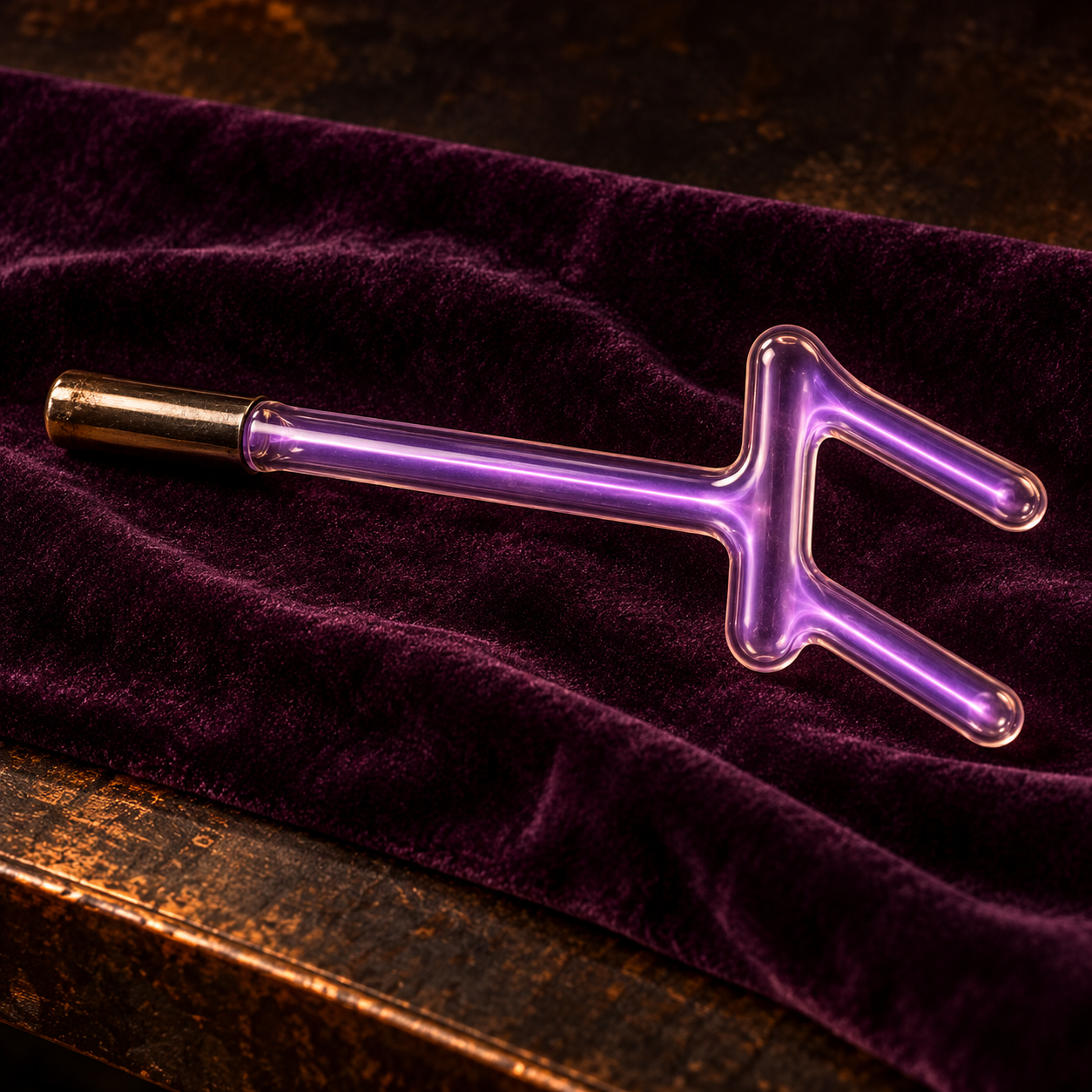
A branching glass yoke, made to bring two sides into the same unusual silhouette.
Enquire for current availability.
A closer look.
Two branches, one beautiful idea
The spinal form has a wonderful sense of intention. Its two rounded branches make the glass look less like a bulb and more like a small instrument in its own right. This is what keeps me fascinated by these cabinets: the makers were not content with one general attachment. They kept imagining another shape, another arrangement, another way to express their electrical thinking.
Its place in the old catalogue
The twin-prong design was catalogued for work beside the spinal column.
A small piece of a bigger machine
The glass belongs to a larger arrangement of generator, resonator and handpiece. The head gives each form its distinctive working geometry: a broad face, a small cup, a row of fingers or a carefully curved stem. For a collector, those differences are part of the engineering story as much as the glowing glass itself.
Finding the right example
The branch angle, separation and stem connection are useful identification details. A photograph from above is particularly helpful when comparing an incomplete set with an old catalogue.
Enquire about this form
Tell us the maker and model, add a photograph of your handpiece and the attachment you are trying to replace, and we can discuss identification, sourcing and availability. The exact example and connection details are agreed individually.
About the illustration
Generated illustration of this historical electrode form, created for Forgotten Frequencies; not an actual stock photograph. The violet glow is artistic. The supplied example, gas fill, dimensions, connector and availability are confirmed by enquiry.
Historical reference
Master No. 6; Renulife No. 15. The Master Violet Ray catalogue · Renulife Electric Company, 1919 manual