
B.E.L. Violet Ray — Blue-Lined Cased Apparatus
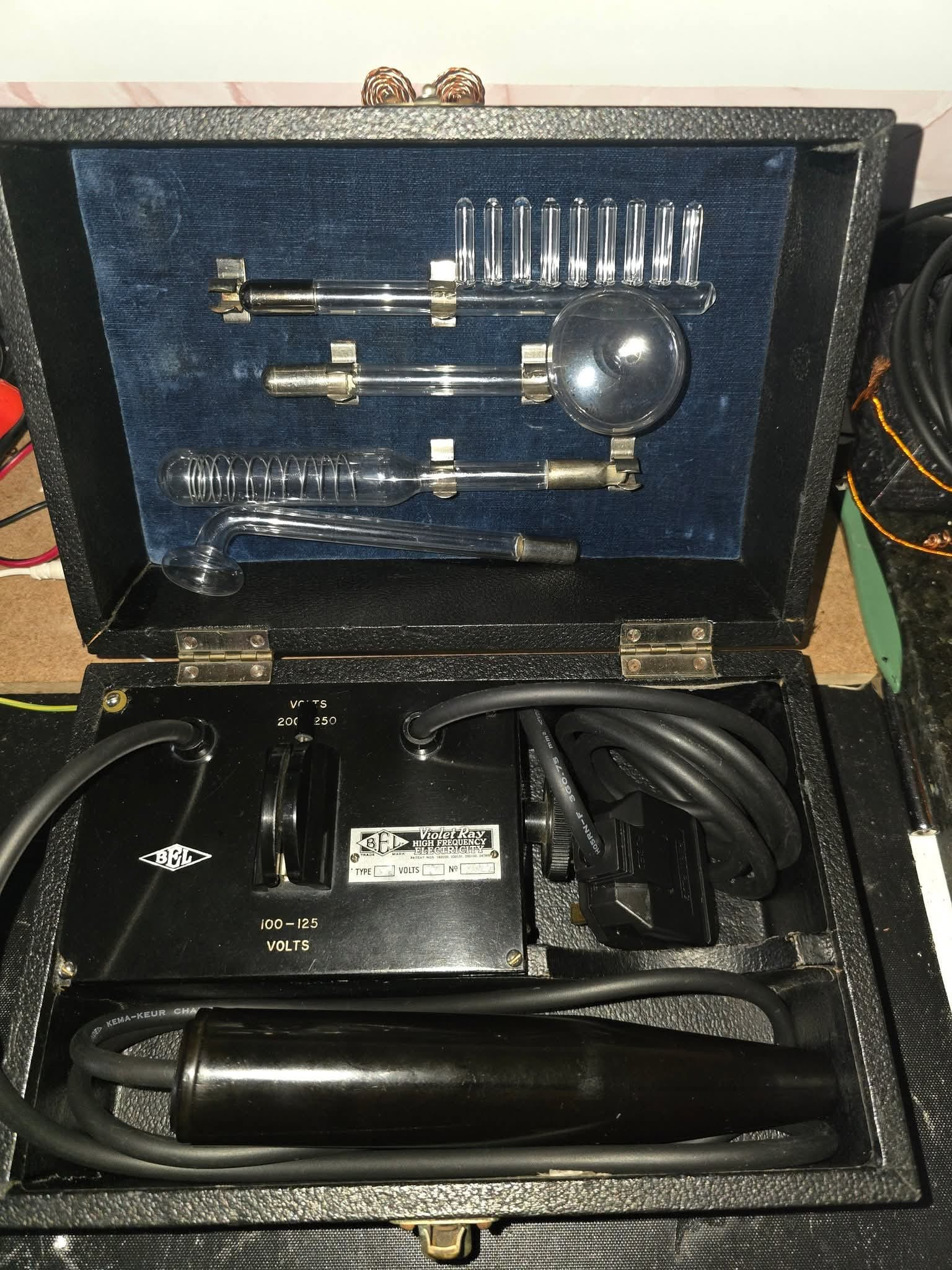
A black case opens onto deep blue lining, clear glass and B.E.L. lettering on the apparatus and handpiece. A distinctive high-frequency set preserved in our historical ARC hive.
Earlier listing — preserved for reference. Enquire about availability or similar devices.
A closer look.
A little theatre beneath the lid
There is a particular pleasure in a case that keeps its whole world together. Open this one and the deep blue lining gives every piece of glass a place of its own. The black exterior has a quiet presence; inside, the fitted lid turns the electrode collection into something worth studying slowly. It is the kind of arrangement that makes us stop scrolling and look again.
The B.E.L. name belongs to the visible apparatus and handpiece in the original photograph. The separate controls, the dark panel and that substantial handle give the set its character. Each part looks connected to the next: the cabinet houses the apparatus, the lead brings it to the hand, and the interchangeable glass completes the presentation.
The idea made tangible
The earlier Forgotten Frequencies account describes separate supply selection and intensity regulation, together with a selection of clear-glass electrodes. That separation is part of the fascination of these instruments: electrical adjustment becomes something the operator can see and feel through a physical control, while the electrode changes the shape presented at the handpiece. The original wording below preserves how this example was described at the time.
For us, the attraction is in that complete composition. Case, panel, handle and glass belong to one visual language. Even before considering the circuitry, this is a piece of practical design with enough detail to reward a long look.
In the ARC hive
We keep this B.E.L. presentation here so the name, its blue-lined case and its original description remain easy to find. Enquire about this model, share a matching example, or talk to us about bringing a restoration project back into the conversation.
Original Forgotten Frequencies description · captured 1 November 2026
The following is the original description of the illustrated example from our earlier Forgotten Frequencies page, preserved exactly as captured. Its restoration and electrical-character statements belong to that historical account.
B.E.L – VIOLET RAY HIGH FREQUENCY APPARATUS British Industrial Engineering • Field Stability • Clinical Authority Manufacturer: B.E.L (British Electric Ltd) Origin: England Era: Mid-20th century Voltage: Dual range (100–125V / 200–250V) Output: High-frequency, low-current electrical field Controls: Separate voltage selection & intensity regulation Electrodes: Original clear glass set (comb, mushroom, straight, curved, spiral) Handle: Heavy bakelite handpiece Case: Black textured case with blue velvet interior Restoration: Fully rebuilt electrically, capacitors replaced, output stabilised
B.E.L – VIOLET RAY HIGH FREQUENCY APPARATUS Overview The B.E.L Violet Ray is unapologetically industrial. This is not a novelty device. This is not decorative electrotherapy. This is British Electrical Authority, built to work all day, every day, without drift, instability, or theatrics. Electrical Character B.E.L machines are known for their: Rock-solid voltage stability Even discharge behaviour Strong but controlled field presence The output feels dense and grounded, not spiky or erratic. It produces a field that holds its shape — ideal for consistent, repeatable interaction. This is a machine that does not wander. Control System The layout reflects classic British engineering priorities: Clear voltage selection (no ambiguity) Independent intensity regulation Smooth, predictable dial response There’s no guesswork here. Every adjustment translates directly into field behaviour. This was built for operators who already understood what they were doing. Electrode Set & Field Geometry The original electrode set allows for precise field shaping: Comb electrode: Distributed surface diffusion Mushroom electrode: Broad, even interaction Straight & curved probes: Directional focus Spiral electrode: Oscillatory surface modulation Each electrode alters the geometry and density of the electrical field, not symbolically, but physically. That’s why these sets mattered. Handle & Cabling The bakelite handpiece is: Substantial Well balanced Electrically responsive It transmits energy cleanly without harshness, allowing controlled interaction across the full intensity range. Restoration Standard This B.E.L unit has been: Fully rebuilt electrically All capacitors replaced as standard Wiring inspected and renewed where required Output tested and stabilised under load The circuit remains true to original design, but reliability and safety are brought fully up to modern expectations. This is a complete restoration, not partial, not cosmetic. Case & Presentation The black case with deep blue interior gives this unit a distinctly clinical and professional presence. Everything about it says: “This was meant to be used — properly.” Why the B.E.L Matters B.E.L units sit in a sweet spot between: Clinical seriousness Industrial reliability Traditional high-frequency design They are often overlooked — and that’s a mistake. For those who understand field interaction, B.E.L machines are quietly formidable. Final Word The B.E.L Violet Ray High Frequency Apparatus is: Stable Disciplined Electrically confident Fully restored. True to design. Built to perform. No hype. Just pure British field authority ⚡
Enquire about this model, its history or a restoration project.