
Buchbinder Ltd London — Gold-Tone Hinged-Tray Set
Buchbinder Ltd London lettering, a gold-patterned fitted case and a two-control black panel give this historical set a character all its own. Original photograph and earlier description preserved.
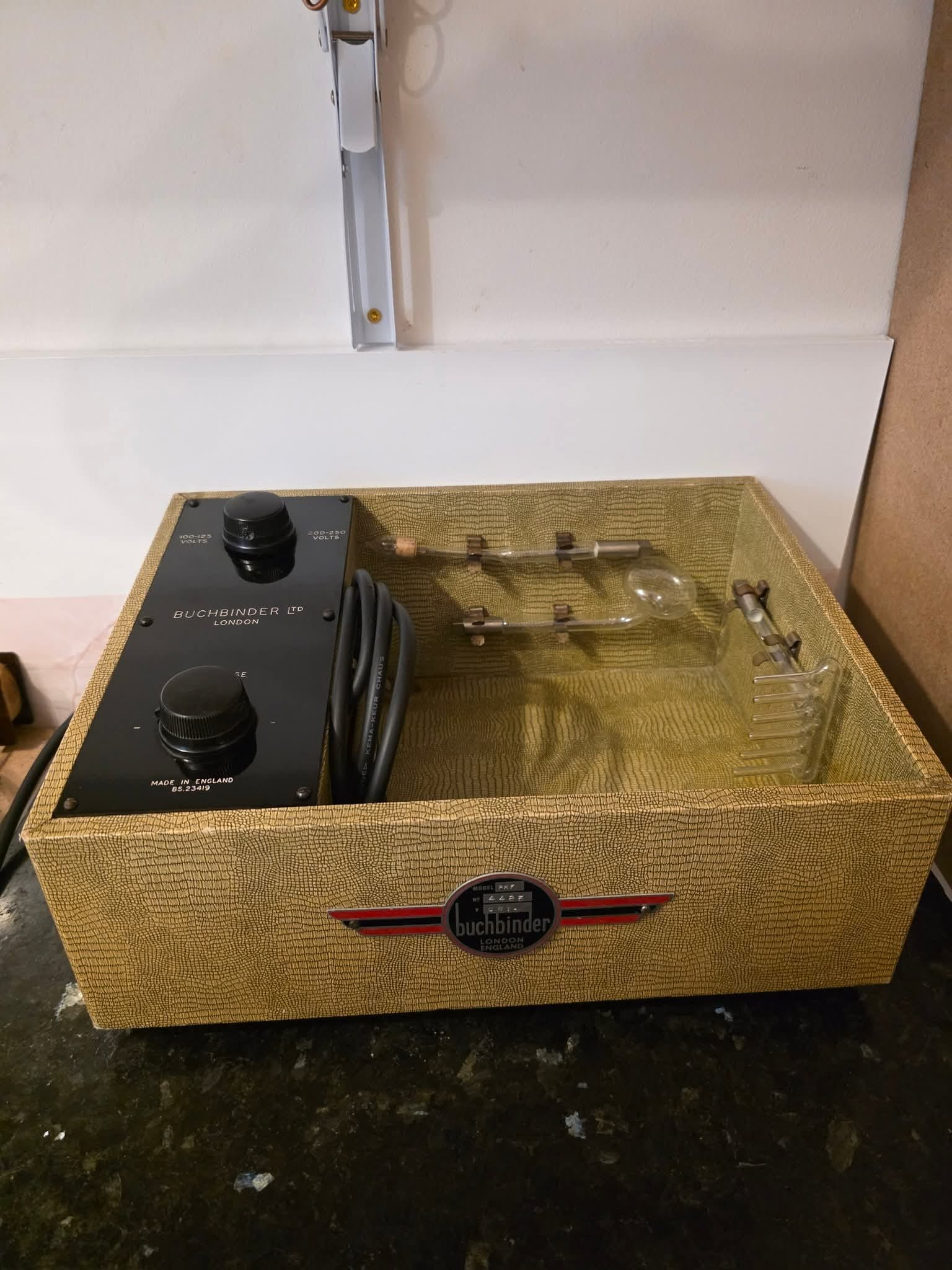
Earlier listing — preserved for reference. Enquire about availability or similar devices.
A closer look.
The case is part of the instrument
The gold-toned pattern is the first thing that catches the eye, then the layout begins to explain itself. A black panel sits to the left, its two controls set out clearly; the glass has its fitted space to the right. The hinged arrangement brings the whole collection into view without losing the feeling of a small, self-contained cabinet.
The visible Buchbinder Ltd London lettering is a lovely anchor for the story. It gives a name and a place to an object whose appeal is otherwise carried by texture, proportion and the care of its presentation. We love apparatus that still lets those details speak.
Two controls and a cabinet of glass
Our earlier page describes a dual-control arrangement separating supply selection from intensity regulation. Its original account also discusses the clear-glass mushroom, straight and comb forms. Those descriptions are kept intact below, together with the restoration and electrical character originally recorded for the pictured example.
Look at the set as a complete design and the relationship between storage and use becomes especially interesting. The glass is organised rather than scattered, the panel remains distinct, and the handpiece has its own presence. A portable instrument had to make room for all of these things, and this one makes that practical problem look rather elegant.
A London name worth keeping visible
This is our historical reference for the Buchbinder presentation shown in the original photograph. Enquire about the model, compare a cabinet or badge with your own, or discuss the restoration of an example that deserves another chapter.
Original Forgotten Frequencies description · captured 1 November 2026
The following is the original description of the illustrated example from our earlier Forgotten Frequencies page, preserved exactly as captured. Its restoration and electrical-character statements belong to that historical account.
BUCHBINDER – HIGH FREQUENCY APPARATUS British Engineering • Precision Output • Understated Authority Manufacturer: Buchbinder Ltd Origin: London, England Era: Mid-20th century Voltage: Dual-range (100–125V / 200–250V) Controls: Separate voltage selection & intensity regulation Electrodes: Original clear glass set (mushroom, straight, comb) Case: Textured gold-tone case with Buchbinder badge Handle: Classic British bakelite handpiece Restoration: Fully rebuilt electrically, capacitors replaced, output verified
BUCHBINDER – HIGH FREQUENCY APPARATUS Overview The Buchbinder represents a distinctly British approach to high-frequency technology. No excess. No theatrics. Just quiet authority and absolute control. This is a machine built for practitioners who valued consistency, reliability, and electrical discipline over spectacle. Electrical Character Buchbinder units are known for their: Exceptionally stable output Clean voltage transitions Controlled discharge behaviour The field produced is calm, even, and deliberate, making this machine ideal for precise, repeatable work. There is nothing erratic here — everything happens exactly where and how you expect it to. Control Layout & Philosophy The dual-dial arrangement allows true separation between: Supply voltage selection Output intensity control This gives the operator genuine command over the system’s behaviour rather than forcing everything through a single compromise dial. It’s engineering for people who understand electricity. Electrode Set & Field Shaping The original clear glass electrodes provide classic field profiles: Mushroom electrode: Broad, even surface interaction Straight probe: Directional focus and precision Comb electrode: Distributed surface diffusion Each electrode alters field density and geometry — not symbolically, but functionally, exactly as intended in traditional high-frequency practice. Case & Presentation The textured gold case with the Buchbinder London badge is understated but unmistakably professional. This was not a novelty device. It was built to sit in real treatment rooms, labs, and serious private practices. Everything about it says competence. Handle & Cabling The bakelite handpiece is: Well balanced Electrically responsive Comfortable for extended use Internally, the unit has been fully restored electrically, including: All capacitors replaced as standard Insulation checked and renewed where required Output tested and stabilised The circuit remains true to original design, but the reliability is brought fully up to modern expectations. Restoration Standard This Buchbinder has been: Fully rebuilt electrically Safety checked Output verified under load It is not a cosmetic restoration. It is not a partial refurbishment. It is restored to be used, confidently and correctly, while preserving its original electrical character. Why the Buchbinder Matters The Buchbinder doesn’t shout — and it doesn’t need to. It represents: British electrical discipline Functional elegance Trust earned through consistency For those who understand high-frequency interaction, this is a machine that simply does its job flawlessly. Final Word This Buchbinder High Frequency Apparatus is calm, precise, and unapologetically professional. Fully restored. True to design. Built for serious use. Quiet power, done right ⚡
Enquire about this model, its history or a restoration project.