
Everay — Two-Control Wooden-Case Presentation
Everay lettering, two controls, a wooden case and violet lining distinguish this historical presentation from the three-control clinic configuration already in our collection pages.
Earlier listing — preserved for reference. Enquire about availability or similar devices.
A closer look.
Wood violet lining and the Everay name
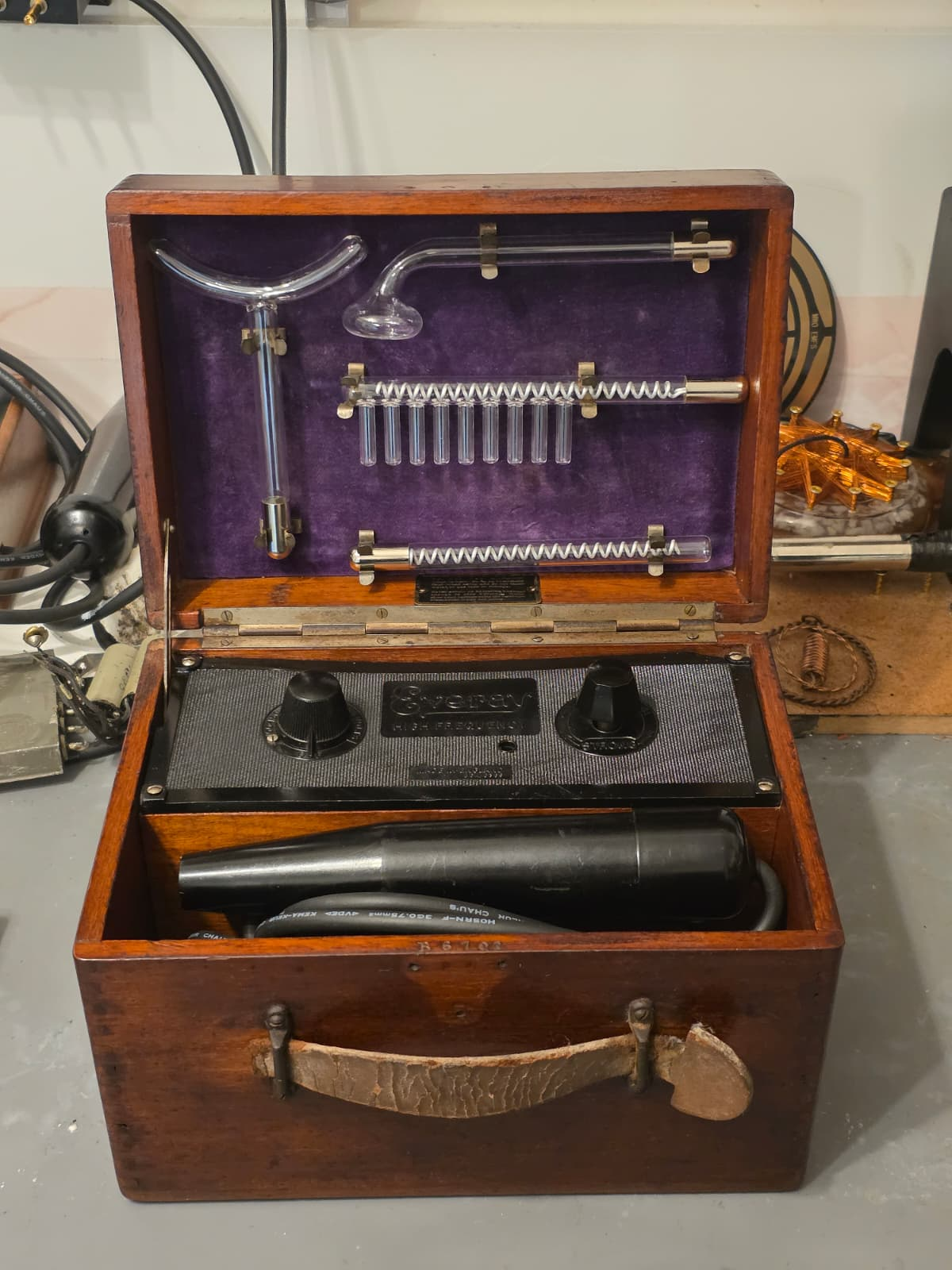
The wooden case gives this Everay a different visual rhythm from a dark clinic cabinet. The violet lining draws attention to the glass, while the two-control arrangement gives the apparatus a face of its own. The Everay lettering keeps the name attached to the whole composition.
This is a detail worth preserving. Our existing clinic presentation has three controls; the original photograph for this page shows two. Keeping that distinction visible makes the collection more useful and lets the different arrangements retain their individual character.
A measured presentation
The earlier Forgotten Frequencies page describes a dual-dial layout, a bakelite handpiece and a collection of clear-glass forms. It also gives its own account of restoration and output character for the pictured example. That original text is preserved below, with the photograph that accompanied it.
There is a quiet pleasure in a wooden carrying case that has been arranged around an electrical instrument. The material of the cabinet, the lining, the panel and the fragile tubes all have to live together. It is a meeting of practical engineering and careful presentation that makes these sets feel so much more substantial than a list of components.
The two-control Everay in the ARC hive
We keep this page as a reference for the two-control, wooden-cased configuration. Enquire about that model presentation, compare a cabinet or control arrangement of your own, or speak to us about restoring an Everay project.
Original Forgotten Frequencies description · captured 1 November 2026
The following is the original description of the illustrated example from our earlier Forgotten Frequencies page, preserved exactly as captured. Its restoration and electrical-character statements belong to that historical account.
EVERAY – HIGH FREQUENCY VIOLET RAY APPARATUS Early British Precision • Balanced Field Geometry • Quiet Power Manufacturer: Everay Origin: England Era: Early–mid 20th century Output Type: High-frequency, low-current electrical field Controls: Dual-dial regulation (power & intensity) Electrodes: Original clear-glass set (comb, spiral, mushroom, curved probe) Handle: Bakelite handpiece Case: Solid wooden case with deep violet lining Restoration: Fully rebuilt electrically, all capacitors replaced, output stabilised
EVERAY – HIGH FREQUENCY VIOLET RAY APPARATUS Overview The Everay Violet Ray represents a time when British electrical devices were built with measured confidence rather than brute force. This is not an aggressive machine. It is precise, composed, and deliberate. Everay units are known for their calm field behaviour — strong enough to be felt immediately, yet refined enough to remain smooth across the full adjustment range. Electrical Character Everay machines produce a field that is: Evenly distributed Harmonically stable Free from harsh spikes or chatter The discharge feels coherent, not scattered. This makes Everay units especially respected for controlled, repeatable interaction rather than raw intensity alone. It’s a thinking person’s Violet Ray. Control Layout & Response The dual-dial layout allows: Clear separation between supply selection and field intensity Predictable, linear response as adjustments are made Fine control at low settings and confident output at higher levels Nothing jumps. Nothing surprises. The machine responds exactly as expected — every time. Electrode Set & Interaction Geometry The original electrode set enables a wide range of field expressions: Comb electrode: Broad surface diffusion Spiral electrodes: Oscillatory surface stimulation Mushroom electrode: Dense, even field spread Curved probes: Directional precision Each electrode reshapes the electrical field rather than merely redirecting it. That design philosophy is unmistakably early British. Handle & Cabling The bakelite handpiece is: Well weighted Electrically responsive Comfortable for extended use It transmits energy cleanly and evenly, reinforcing the Everay reputation for balanced output rather than aggressive discharge. Restoration Standard This Everay unit has undergone a full professional restoration, including: Complete electrical rebuild All capacitors replaced as standard Wiring inspected, corrected, and secured Output tested and stabilised under load The circuit topology remains true to original design, but reliability, safety, and consistency are fully modernised. There is nothing partial or provisional about this restoration. Case & Presentation The wooden case with deep violet interior reflects the Everay identity perfectly: Understated Purposeful Quietly authoritative It looks exactly like what it is — a serious instrument from a serious period of electrical engineering. Why the Everay Matters Everay units sit in a unique position: Less aggressive than some continental designs More refined than many mass-market sets Exceptionally consistent in field behaviour They reward understanding and patience — and in return, they deliver clarity and control. Final Word The Everay High Frequency Violet Ray is: Balanced Stable Intelligently designed Fully restored. Electrically sound. True to its original intent. This is not hype energy. This is measured British mastery ⚡
Enquire about this model, its history or a restoration project.