
KOS Violet Ray — Purple-Lined High-Frequency Set
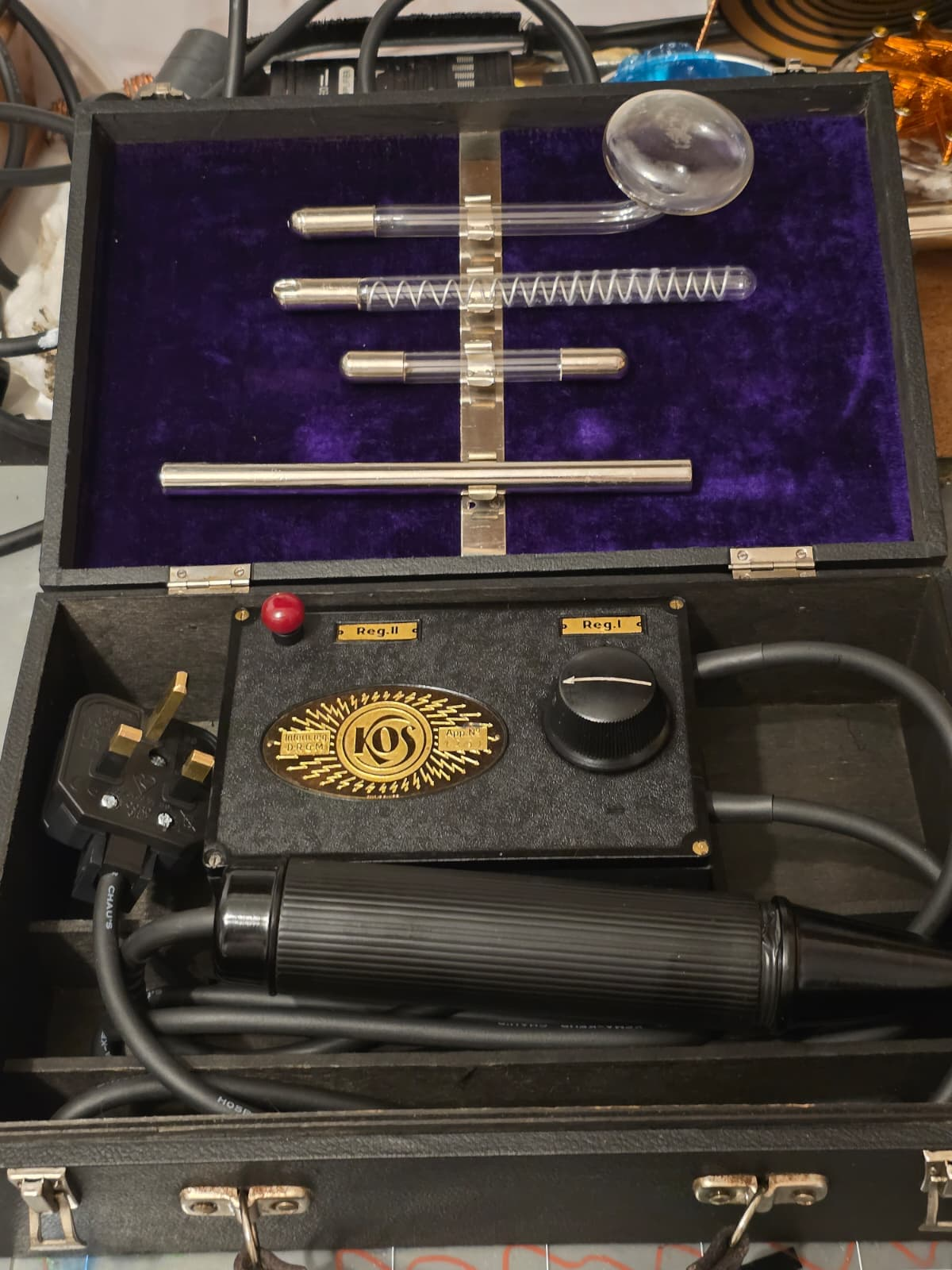
Dark apparatus, deep violet lining, a substantial handpiece and horizontally fitted glass frame the KOS name. A striking historical presentation with its original Forgotten Frequencies account retained.
Earlier listing — preserved for reference. Enquire about availability or similar devices.
A closer look.
Dark panel violet interior
The deep lining makes the glass stand out beautifully. Against the dark apparatus, each clear tube has a distinct shape and position, while the handpiece brings a heavier visual note to the arrangement. The KOS name sits within that very deliberate presentation. It is a set with plenty to look at before a single control is touched.
We are drawn to these contrasts: the weight suggested by the cabinet and handle, the delicacy of the glass, and the precision of a fitted interior. They are part of the pleasure of preserving an instrument as a whole object, with its own layout and personality.
The regulation described on our original page
The original account identifies a Reg I / Reg II arrangement and discusses the glass selection, handpiece and electrical restoration of the pictured example. Those are the earlier page’s descriptions, preserved in full below. The surviving photograph remains the visual reference for this particular KOS presentation.
There is a useful collector’s question here as well: how does a maker choose to organise the controls, the accessories and the carrying case into one coherent instrument? With KOS, the dark exterior and violet interior give that question a particularly memorable setting.
A place for the KOS story
We keep this example in the ARC hive as a historical model reference. Enquire about KOS apparatus, share a label or case detail from your own collection, or ask us about the next steps for a restoration.
Original Forgotten Frequencies description · captured 1 November 2026
The following is the original description of the illustrated example from our earlier Forgotten Frequencies page, preserved exactly as captured. Its restoration and electrical-character statements belong to that historical account.
KOS – HIGH FREENCY VIOLET RAY APPARATUS German Engineering • Industrial Precision • Controlled Electrical Authority Manufacturer: KOS Origin: Germany Era: Early–mid 20th century Output Type: High-frequency, low-current electrical field Controls: Dual regulation system (Reg I / Reg II) Electrodes: Original clear-glass set (mushroom, spiral, straight rods) Handle: Ribbed bakelite handpiece Case: Heavy-duty black case with deep violet lining Restoration: Fully restored electrically, all capacitors replaced, output calibrated
KOS – HIGH FREENCY VIOLET RAY APPARATUS Overview The KOS Violet Ray is not decorative. It is not theatrical. It is engineered. This is a device built by people who cared deeply about repeatability, stability, and electrical discipline. Everything about it feels intentional — from the control layout to the restrained electrode selection. KOS units were designed to do exactly what they are told, nothing more and nothing less. Electrical Character KOS machines are known for a field that is: Dense Focused Exceptionally stable There is very little noise in the discharge. Very little randomness. The field feels compressed and coherent, with a noticeable sense of electrical “weight” even at moderate settings. This is classic German high-frequency philosophy: precision over spectacle. Dual Regulation System (Reg I / Reg II) The twin regulation layout is a standout feature. Rather than a single blended control, KOS separates aspects of regulation to allow: Fine-grain control of output behaviour Stable tuning across the full range Reduced instability at higher settings This makes the machine highly predictable and easy to dial in — especially valuable for users who understand electrical response rather than chasing raw intensity. Electrode Geometry & Field Shaping The electrode set is deliberately restrained and functional: Mushroom electrode: Even, broad surface distribution Spiral electrode: Oscillatory surface interaction Straight rods: Directional and linear field projection Each electrode alters field density and geometry, not just contact area. This reflects a deep understanding of capacitive coupling and surface plasma behaviour. Nothing here is decorative. Everything earns its place. Handle & Transmission The ribbed bakelite handpiece is: Robust Well insulated Excellent at transmitting a clean discharge It reinforces the KOS identity — industrial, dependable, and electrically honest. Restoration Standard This KOS unit has undergone a full professional restoration, including: Complete electrical overhaul All capacitors replaced as standard practice Wiring inspected, corrected, and secured Output tested for stability and consistency The original circuit design and behaviour are fully preserved, while reliability and safety are brought up to modern expectations. This is a true restoration, not cosmetic preservation. Case & Presentation The black case with deep violet interior perfectly suits the machine: Serious Purpose-built Unapologetically technical It feels more like laboratory equipment than a consumer device — and that’s exactly the point. Why the KOS Matters KOS units appeal to people who value: Control over chaos Stability over show Engineering over marketing They don’t shout. They don’t exaggerate. They perform. Final Word The KOS High Frequency Violet Ray is: Disciplined Precise Electrically authoritative Fully restored. Technically honest. Built for those who understand what they’re working with. This isn’t a novelty device. It’s a proper piece of electrical history ⚡
Enquire about this model, its history or a restoration project.