
Restored Original Holo-Electron
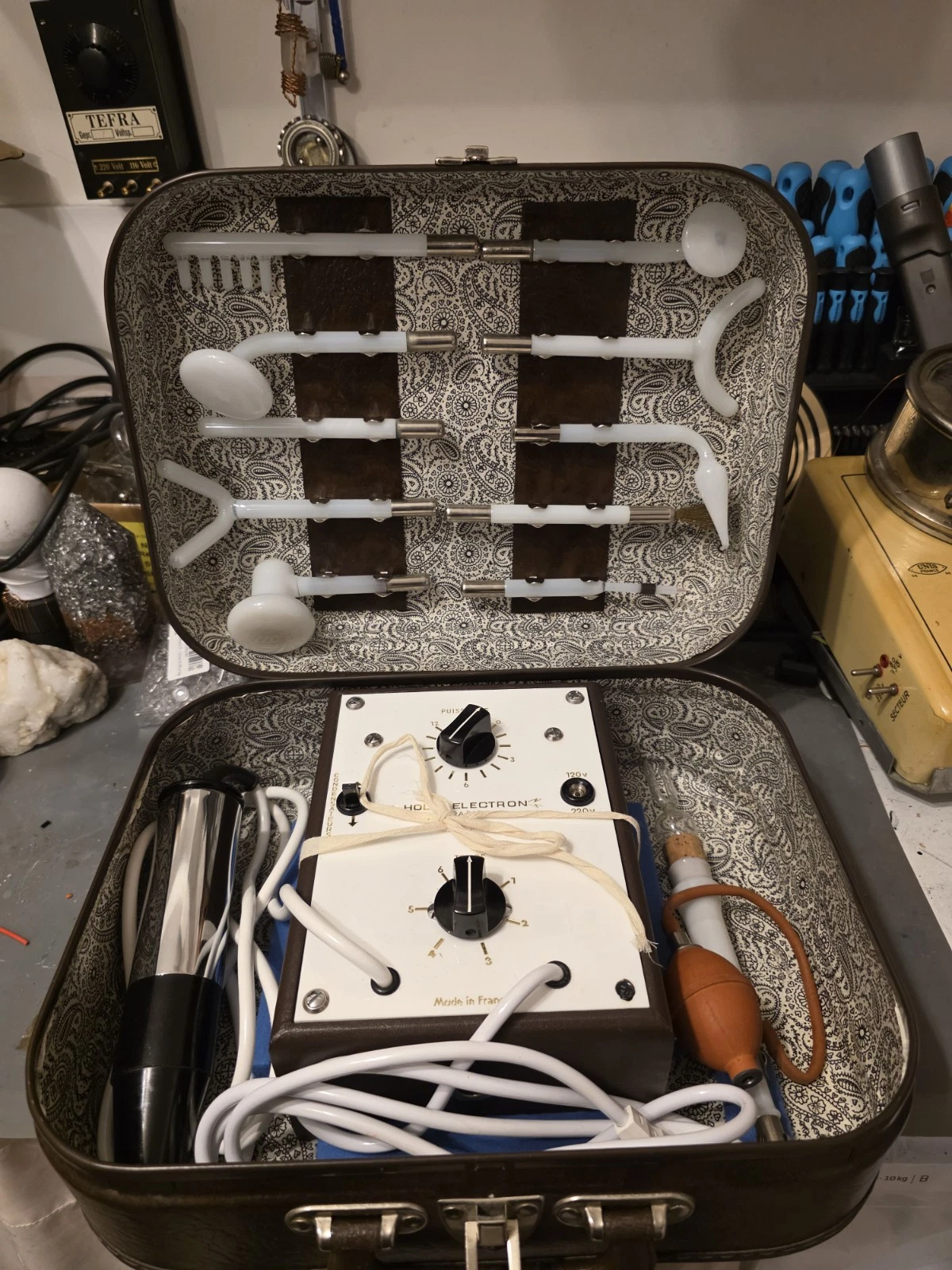
French electrical imagination, expressed in curves and glass. A French Holo-Electron set with analogue control, original wand and a broad collection of glass electrodes.
Enquire for current availability.
Device description
Equipment, restoration & condition wording · captured 31 October 2026. Enquire about current availability and exact inclusions.
French electrical imagination, expressed in curves and glass.
The Holo-Electron has a name that sounds as though it belongs above the door of a forgotten laboratory. Then you see the original wand, the analogue control and the collection of glass electrodes, and the name begins to make visual sense. This is a French instrument with the presence of a carefully composed set. Every curve and attachment encourages you to pause, look closer and wonder what its designers were trying to make possible.
What draws me towards this example is the breadth of its glass collection. Mushroom forms, curved applicators, a comb and specialist shapes turn the open apparatus into an arrangement of electrical sculpture. Each form changes the silhouette of the whole. You can appreciate it as an object of design while also following the practical questions that shaped it: where the hand goes, how an attachment connects, how a control communicates its purpose.
An instrument with a visual language
The analogue control gives this Holo-Electron a directness I find irresistible. A physical instrument asks you to read a face, understand a position and make a deliberate movement. Its original wand extends that relationship out from the main set. The control unit, handpiece and glass do different jobs, but their appeal comes from seeing them as a connected design. Each depends on the others to tell the full story of the apparatus.
Look especially at the contrast between the broad mushroom forms and the narrower, curved glass. Even before discussing their historical applications, the variation reveals a designer's attention to geometry and access. A comb is immediately recognisable; another specialist shape may take longer to interpret. That mixture of familiarity and strangeness is part of the pleasure. It gives the set layers: an attractive first impression, followed by questions that reward a much slower inspection.
The engineering beneath the theatre
The selector is marked 120 V / 220 V, an important surviving feature of this restored example. Those markings deserve to be read as part of the instrument's own design and confirmed against its present configuration. I also like what such a selector contributes visually: it makes the supply itself part of the conversation. This machine comes from an approach to apparatus in which controls and connections announce that electricity is being actively transformed.
Across traditional violet ray designs, the interest lies in the relationship between an electrical source, high-frequency generating components, the wand and the electrode. An exact internal circuit cannot be inferred from a nameplate alone. Even so, the physical arrangement lets you follow the broad idea from one stage to the next. That is a generous quality in an instrument. It invites understanding through real objects, with the glass waiting at the end of the chain.
A collection of questions, beautifully kept
For me, the best old apparatus leaves some room for fascination. The Holo-Electron is documented, named and made, yet it still has the atmosphere of a discovery. How did such ambitious electrical ideas find their way into such distinctive domestic-scale objects? Why did glass become so expressive a part of the design? Those are questions worth following through manuals, advertisements and surviving instruments. The object gives the research a centre of gravity you can actually see.
This particular set brings that appeal together through its original wand, analogue control and varied electrode selection. Its character rests in the exact arrangement shown, rather than in a generic picture of the Holo-Electron name. Spend time with the photographs and the individual glass forms. There is a lovely intimacy to an apparatus that rewards looking so closely. It carries technical ambition and decorative presence in the same compact, wonderfully unusual package.
Condition, configuration & inclusions.
This restored set has a dual-voltage selector marked 120 V / 220 V. Its electrode selection includes mushroom forms, curved applicators, a comb and specialist glass shapes. Ask about the exact configuration pictured and the voltage setup required for your location.
A working fragment of the age of electrical experimentation: coils, glass, analogue controls and visible plasma. These historical instruments are offered for collecting and research, without medical treatment claims.
Please enquire about current availability, the exact item pictured, condition and inclusions. All questions and arrangements stay here with Forgotten Frequencies.