
Restored Fluvita — Orange Case
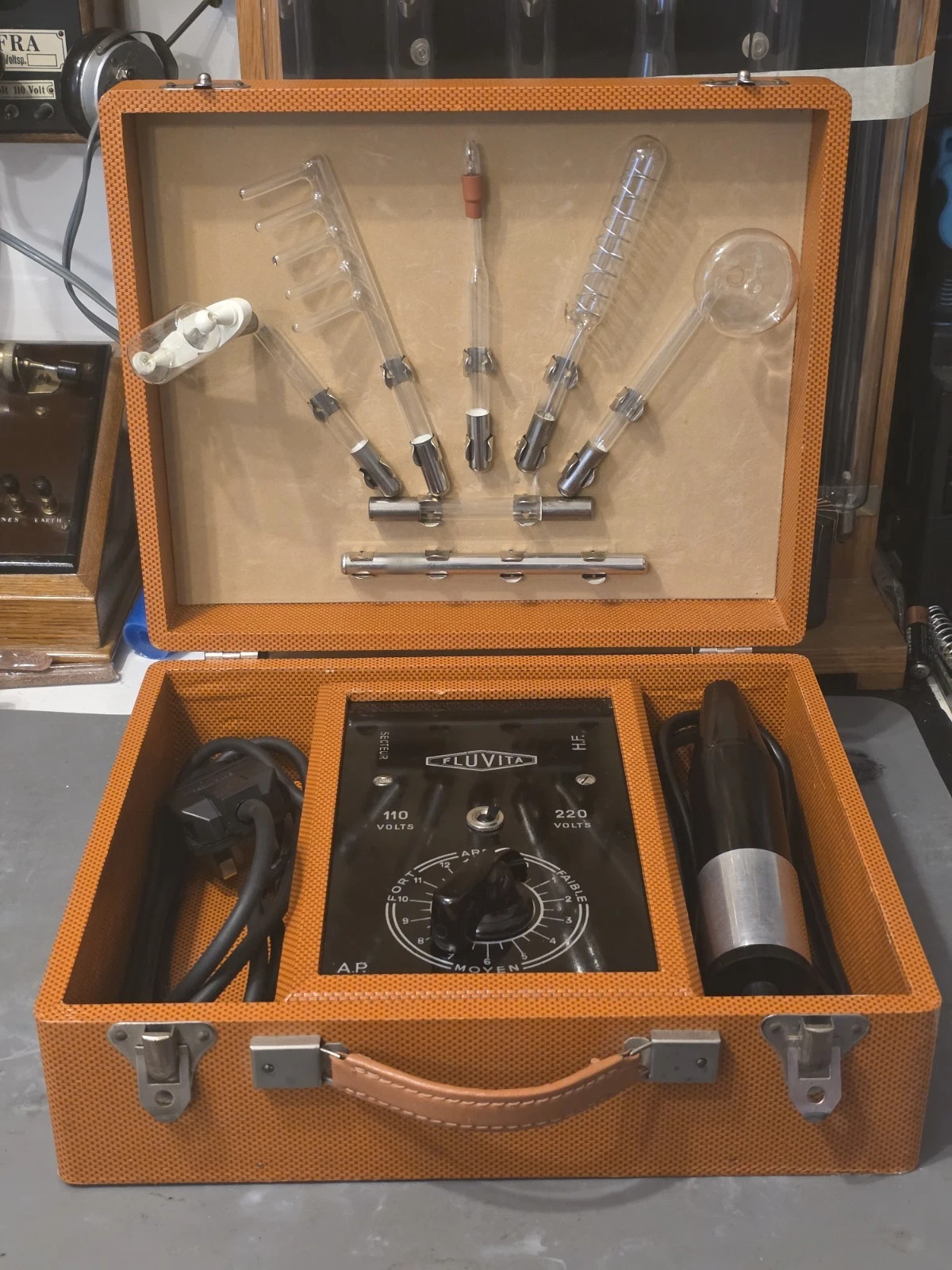
Orange, glass and analogue ingenuity with a personality all its own. A near-pristine Fluvita with its original control unit, matching orange case and glass electrode collection.
Enquire for current availability.
Device description
Equipment, restoration & condition wording · captured 31 October 2026. Enquire about current availability and exact inclusions.
Orange, glass and analogue ingenuity with a personality all its own.
This Fluvita has a colour you remember. The matching orange case and control unit give the apparatus an immediate identity, bright enough to stand apart from the darker fitted cases around it. Open the lid and the glass collection adds another register of detail: comb, spiral, mushroom and precision forms, alongside longer attachments and a metal-contact fitting. It is an unusually lively composition, with the confidence of an object that knows exactly how it wants to look.
Described in the existing record as near-pristine, this restored example rewards attention to the relationship between its parts. The substantial wand has its place beside the original control unit; the fitted lid gives the electrodes an organised setting. To me, the pleasure comes from that sense of a complete design. Colour makes the first introduction, but the instrument keeps your interest through the care with which its electrical idea has been given a physical form.
A different colour of nostalgia
Vintage electrical apparatus can call up a world of dark coverings, polished panels and velvet. The orange Fluvita brings its own mood to that world. Its matching case and unit feel decisive rather than incidental: two parts speaking the same visual language. There is a lovely tension between that bold colour and the transparency of the attachments. The glass appears delicate and changeable; the orange gives the whole arrangement a strong, memorable outline.
The lid is worth studying as a composition in its own right. A spiral introduces rhythm, a mushroom gives breadth, and the comb breaks the line into repeated points. Longer and more precise forms change the scale again. These shapes are part of the apparatus's practical history, but they also make it beautiful to look at. The collection offers a reminder that functional objects can become extraordinary when their materials are allowed to remain visually expressive.
Controls that let the idea show
The recorded features include a selector marked 110 V / 220 V and an adjustable intensity dial, with a UK plug fitted. Those details give the front of the instrument an understandable purpose. They also offer a useful starting point for asking about its exact present configuration. A physical dial makes the act of adjustment visible. You can see a designer translating an electrical relationship into a movement that a hand can make.
In the wider violet ray family, the fascination lies in how supply, generating components, handpiece and electrode cooperate. The external simplicity can conceal an involved electrical process, and the exact circuit needs to be understood from the individual apparatus. Even without reducing the Fluvita to a diagram, you can admire that chain of thinking. Its original unit, substantial wand and varied glass make the stages feel like parts of a single, deliberately presented instrument.
An object that refuses to disappear
I like machines that keep their individuality. This Fluvita does that through the orange presentation, the matching components and the range of shapes waiting in the lid. It has presence even when standing still. There is enough here for an immediate emotional response, followed by a more measured appreciation of controls, fittings and construction. That combination makes an old apparatus feel like a companion to an investigation rather than something to be glanced at and forgotten.
The photographs and recorded details belong at the centre of that appreciation. They show this example, with its own arrangement and surviving character. Let the colour draw you in, then spend time with the quieter decisions: where the wand rests, how the attachments are arranged, how the dial sits within the original unit. The Fluvita's charm grows out of those relationships. It brings a bright, unmistakable voice to the cabinet of forgotten electrical ideas.
Condition, configuration & inclusions.
Features include a 110 V / 220 V selector, adjustable intensity dial, substantial wand and UK plug. The fitted lid holds comb, spiral, mushroom and precision glass forms, longer attachments and a metal-contact fitting. A bright, distinctive example of vintage high-frequency apparatus.
A working fragment of the age of electrical experimentation: coils, glass, analogue controls and visible plasma. These historical instruments are offered for collecting and research, without medical treatment claims.
Please enquire about current availability, the exact item pictured, condition and inclusions. All questions and arrangements stay here with Forgotten Frequencies.