
Holo-Electron Paris — Orange Case
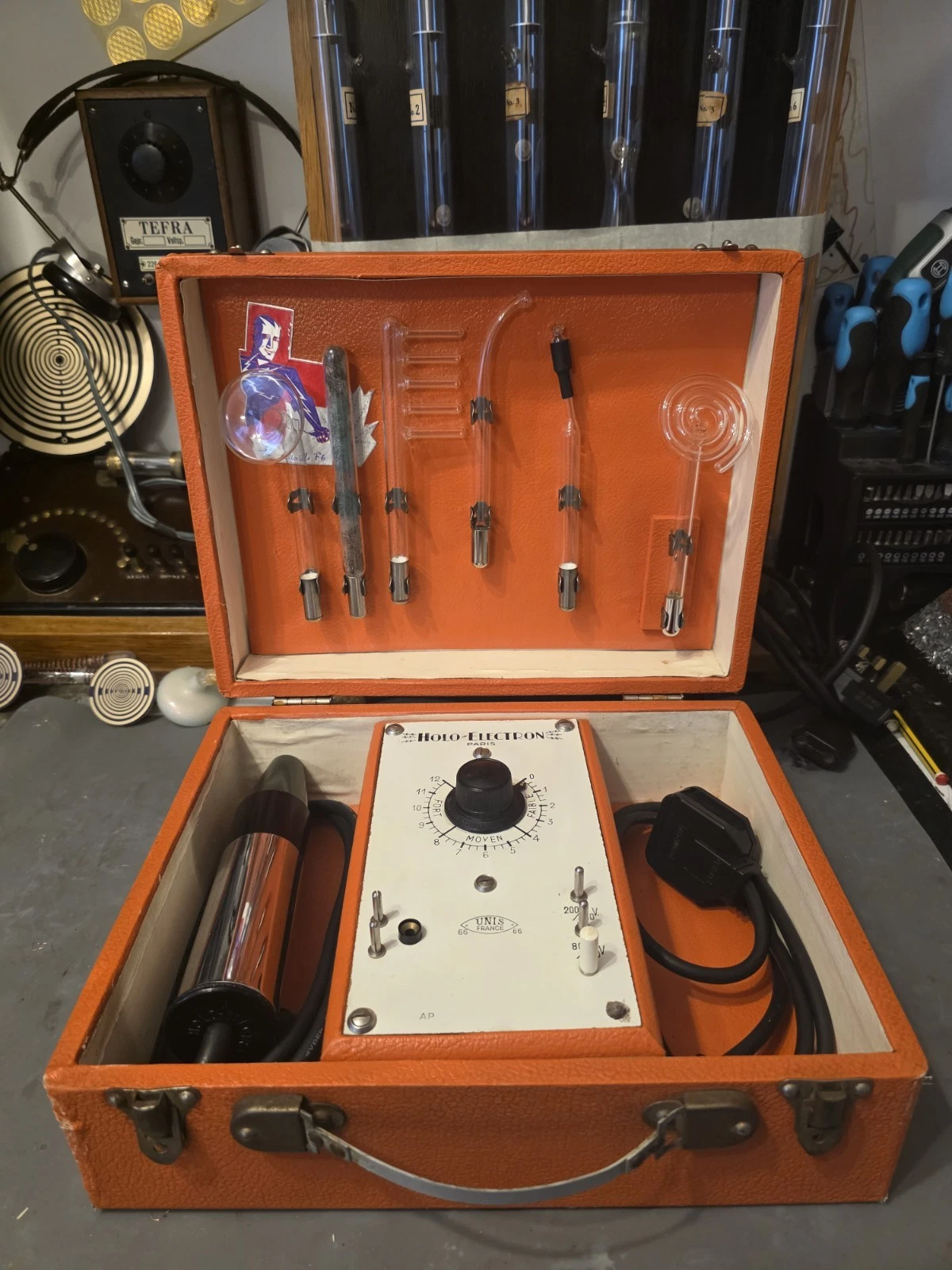
A bright Parisian survivor with its own marks and memories. An orange-cased Holo-Electron with a clean interior, original control unit and specialist electrode set.
Enquire for current availability.
Device description
Equipment, restoration & condition wording · captured 31 October 2026. Enquire about current availability and exact inclusions.
A bright Parisian survivor with its own marks and memories.
An orange Holo-Electron changes the mood of a cabinet. The colour brings warmth and confidence to an apparatus whose glass forms already have a remarkable visual life. This example combines its original control unit and substantial wand with a specialist set arranged in the fitted lid. The interior presents well, while the outside carries mild age-related marks and signs of use. That contrast gives the set an appealing honesty: carefully presented, with time still visible on its surface.
To me, those surviving marks can be part of the affection an old machine earns. They keep it from becoming an abstract illustration of a model. This is a particular Holo-Electron, with its own case and its own arrangement of mushroom, comb, curved, spiral and precision forms, plus a metal-contact attachment and other pictured fittings. The appeal begins in the orange presentation, then grows through the smaller details that distinguish this example from its relatives.
Colour with something to say
The orange case gives the apparatus a bold outline before the eye reaches the controls. It is a different kind of presence from a dark, velvet-lined instrument, and that difference matters when comparing examples. A collection becomes more interesting when each machine has a voice. Here, the case announces that voice immediately. The clean interior then brings the attention towards the original unit, the handpiece and the varied silhouettes of the attachments around them.
Look at the glass as a group, then look again at the individual pieces. The spiral introduces a coiled rhythm, the comb repeats its teeth, and the curved forms bend away from the straighter geometry of the main apparatus. These are purposeful shapes with a strong sculptural quality. Their arrangement in the lid gives them a shared setting. It is the sort of visual relationship that can hold your attention even before the technical questions begin.
A physical conversation with electricity
The restored apparatus has adjustable intensity and voltage-selection switches, with a UK plug recorded in the description. Those physical controls make the design's intentions visible. They tell you that the machine expects adjustment and configuration, and they provide concrete details to discuss when learning about this exact set. I find that directness attractive. A switch and a dial establish a relationship between the operator's hand and the electrical arrangement inside the case.
The broader violet ray idea brings together high-frequency generation, a handpiece and an electrode whose form becomes part of the experience. The exact internal design belongs to the individual machine; a case colour or maker's name cannot supply a complete circuit. Yet the visible arrangement still lets the mind travel through the stages. That is part of its charm as an object of study. The engineering has a physical presence, with components you can identify and compare.
A survivor with its own accent
Holo-Electron sets reward comparison because their shared identity leaves room for striking differences in presentation and surviving contents. This orange example has its own balance of warmth, glass and analogue controls. Its mild exterior marks belong in that account, alongside the well-presented interior. An honest description helps affection grow around the actual object. There is no need to polish away every trace of age in the language when the age is part of what draws us towards it.
Spend time with the photographs and let the details settle into a whole. The original control unit anchors the set; the substantial wand carries the design outwards; the specialist collection gives it a changing outline. I see an apparatus that invites both appreciation and investigation. It holds a little of the atmosphere of French electrical invention, while its particular colour and surviving character make the encounter personal. That is where an interesting machine becomes a memorable one.
Condition, configuration & inclusions.
The restored apparatus has adjustable intensity, voltage-selection switches, a substantial wand and UK plug. The fitted lid contains mushroom, comb, curved, spiral and precision glass forms, a metal-contact attachment and other fittings as pictured. The exterior shows mild age-related marks and signs of use; the interior presents well.
A working fragment of the age of electrical experimentation: coils, glass, analogue controls and visible plasma. These historical instruments are offered for collecting and research, without medical treatment claims.
Please enquire about current availability, the exact item pictured, condition and inclusions. All questions and arrangements stay here with Forgotten Frequencies.