
Solozon — Adjustable-Wand Apparatus
A German instrument with an intriguing idea in the palm of the hand. A rare German Solozon with an unusual control dial built into the wand.
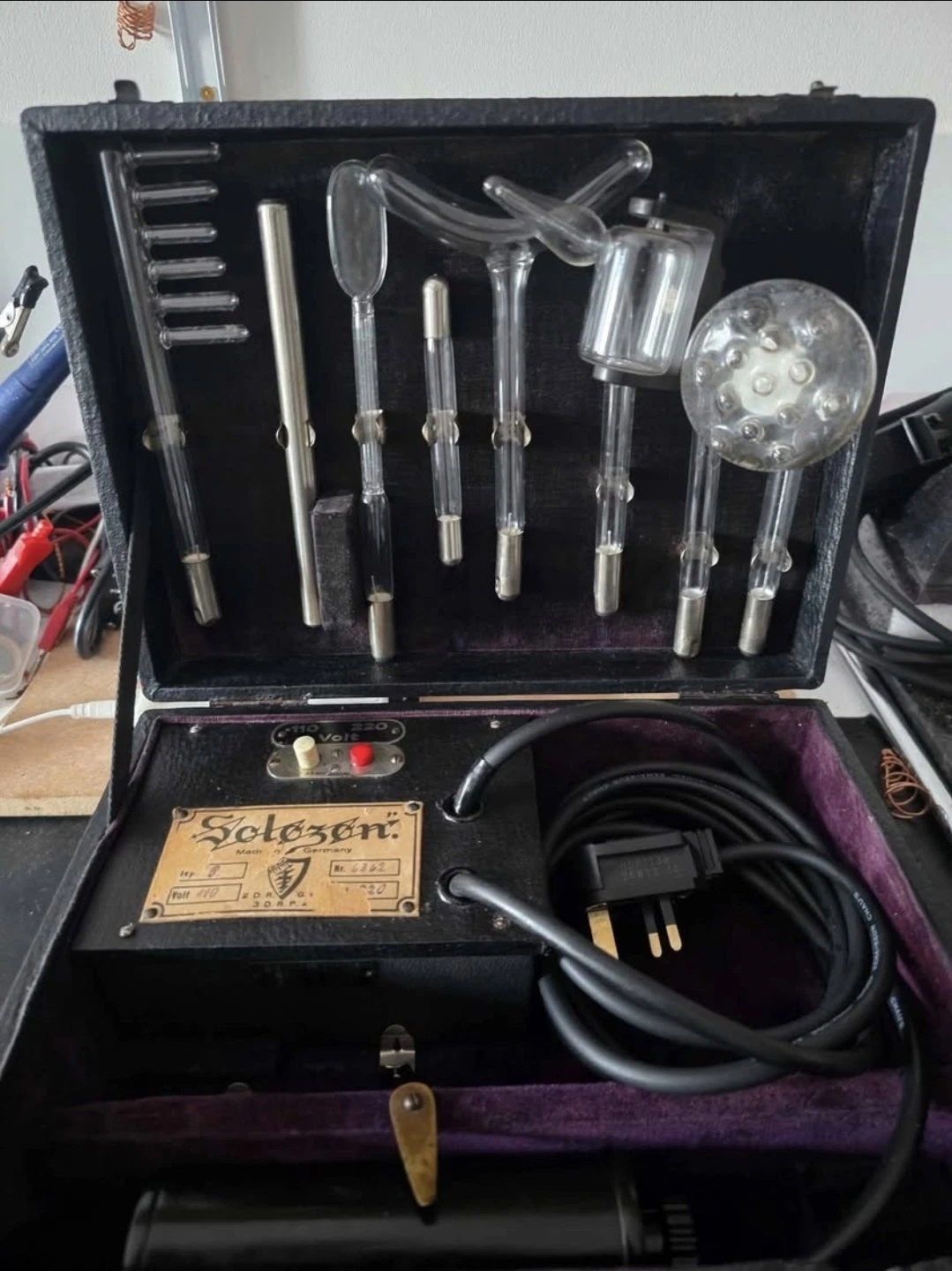
Enquire for current availability.
Device description
Equipment, restoration & condition wording · captured 31 October 2026. Enquire about current availability and exact inclusions.
A German instrument with an intriguing idea in the palm of the hand.
The Solozon's most interesting detail is wonderfully direct: a turning control dial built into the wand itself. It is the sort of feature that can turn a quick glance into a much longer investigation. Here is a rare German apparatus that approaches the relationship between person and instrument in its own way, bringing adjustment to the handpiece rather than leaving every decision at a distant box. Small design choices can reveal a surprisingly large amount of thought.
I find that kind of ingenuity deeply appealing. It gives the Solozon a personality founded in something real and observable, rather than a dramatic name or an imagined origin. The original description records careful restoration and a specialist electrode set. Those facts are the beginning of this particular machine's record. The unusual wand control is the detail that keeps the curiosity alive, inviting a closer conversation about the apparatus and the way its designer thought.
The decision to put a dial here
A handpiece is already the point where an electrical instrument meets its operator. Adding a turning dial gives that meeting another dimension: the object being held is also a place of adjustment. It raises useful questions about reach, attention and the physical organisation of the equipment. What information and control should remain at the main unit, and what belongs nearer the hand? The Solozon makes those questions tangible in a distinctive piece of apparatus.
The exact behaviour, scale and configuration of this example's control are matters to explore through its photographs and a current demonstration. Its location, however, is itself a fascinating design fact. It asks us to see the wand as an engineered assembly with a particular role, rather than a simple handle at the end of a cable. For a collector interested in variations between makers, such differences can be every bit as absorbing as changes in case design.
A familiar glow, a different arrangement
Traditional violet ray apparatus belongs to the broader world of electrical oscillation, induction and gas discharge. A suitably arranged high-frequency system can establish the conditions for a glass electrode to become luminous. That visible effect has always been part of the fascination, but the route to it is just as interesting: the electrical components, the way they are controlled, and the physical relationship between generator, handpiece and interchangeable glass.
The Solozon gives that family story an individual accent through the adjustable wand. It is a reminder that these instruments were designed by people solving practical problems, experimenting with layouts and choosing how an operator would encounter the machine. The glow may draw us in, but the design decisions hold our attention. Looking closely at those decisions can make an apparently familiar category of equipment feel wonderfully open-ended again, full of variations worth recording.
For the collector who follows the differences
This is the kind of machine I would place in a collection for the conversation it starts. The specialist electrodes provide one line of enquiry; the wand control provides another. German identity and the recorded restoration give further context. The deeper fascination is that an inventive decision made for an earlier apparatus can still surprise us today. An arrangement that once existed in a designer's imagination now survives as an object we can study, appreciate and keep in the story.
If the Solozon has caught your eye, ask us about the dial, the precise attachments, the restoration details and the present demonstration. We can discuss this exact example rather than a generic description of the model family. Its charm lies in that specificity. A control placed in an unexpected location, a collection of glass and the survival of the apparatus together offer a beautifully concrete reason to keep exploring the less familiar corners of the violet ray world.
Condition, configuration & inclusions.
The turning dial on the handpiece allows adjustment at the wand itself, a distinctive feature of this early apparatus. The source listing describes careful restoration and a specialist electrode set. Enquire about this particular example, its controls, included attachments and demonstration.
A working fragment of the age of electrical experimentation: coils, glass, analogue controls and visible plasma. These historical instruments are offered for collecting and research, without medical treatment claims.
Please enquire about current availability, the exact item pictured, condition and inclusions. All questions and arrangements stay here with Forgotten Frequencies.