
Restored Sterling Violet Ray
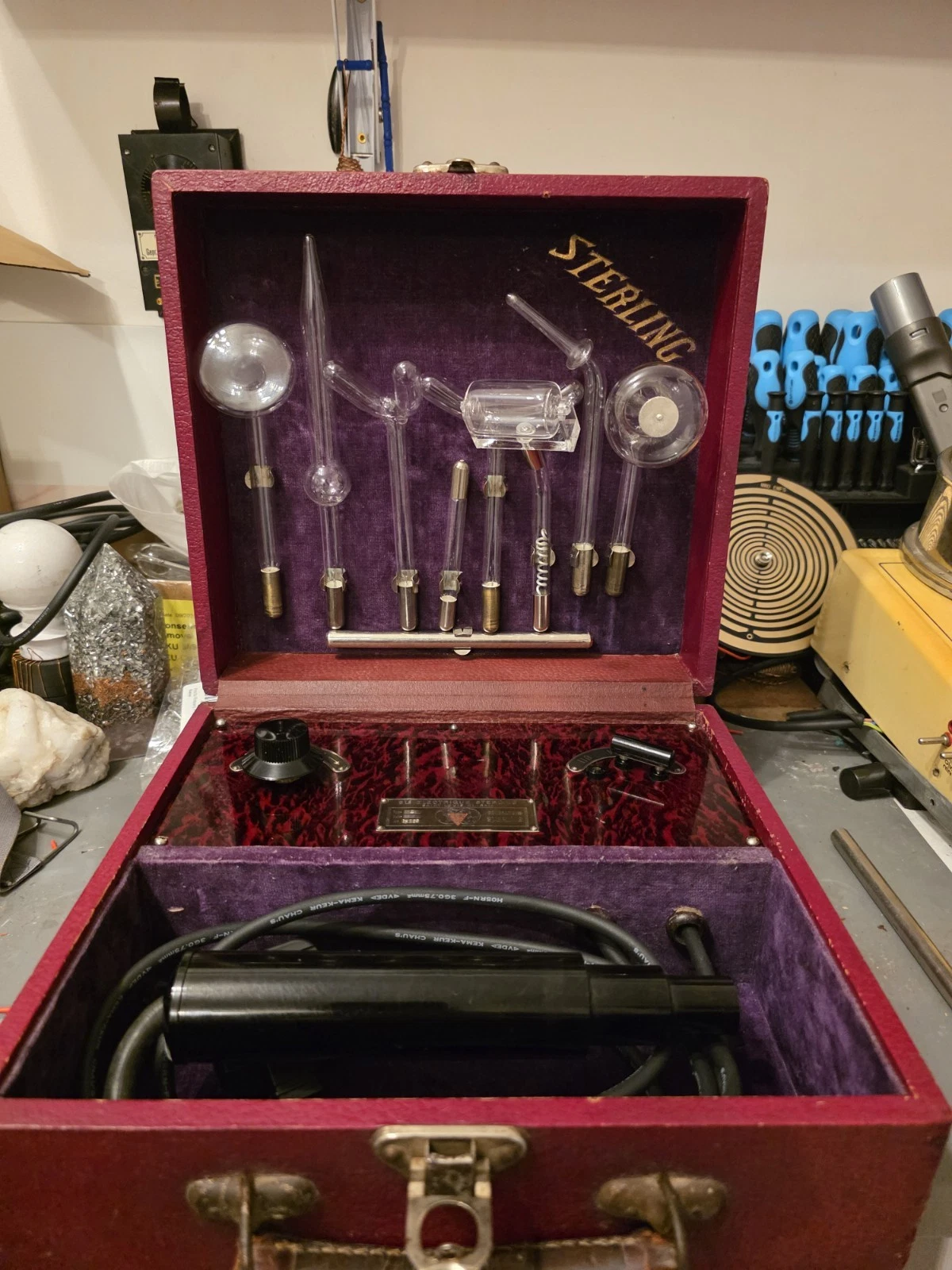
British apparatus with a velvet heart and a commanding presence. An original British Sterling with a red and purple velvet-lined fitted case.
Enquire for current availability.
Device description
Equipment, restoration & condition wording · captured 31 October 2026. Enquire about current availability and exact inclusions.
British apparatus with a velvet heart and a commanding presence.
The Sterling has a wonderfully assured presence. An original British set, it brings together a red and purple velvet-lined case, substantial fittings, its original wand and a period electrode collection. The colours make a rich setting for the apparatus, while the components give that richness a serious purpose. To me, it has the appeal of a carefully kept instrument cabinet: something designed to be opened with attention and understood through the relationship between all its pieces.
Its original description records dual-output capability and restored working condition. That gives the collector a useful technical thread to follow alongside the visual appeal. The generator, wand and glass belong to a particular surviving arrangement, and the exact configuration is worth discussing in detail. The Sterling invites that kind of interest. It offers an immediate feeling of character, then rewards the slower work of looking at connections, controls and the individual attachments gathered around them.
A rich setting for a serious instrument
Red and purple velvet give this set a sense of ceremony. The lining makes the transition from case to apparatus feel deliberate, creating a distinct interior world for the instrument and its attachments. I find fitted sets especially compelling when their visual character grows from the way the pieces belong together. The Sterling's presentation does that: substantial fittings provide structure, while the softer interior gives the shapes of the wand and glass a strong backdrop.
The original Sterling wand matters because it is part of the identity of the set. A handpiece is where an abstract electrical design becomes something shaped for a person's hand. Seen beside the generator and period electrode collection, it helps make the apparatus readable as a whole. The charm lies in those relationships. A beautiful case is one attraction; a beautiful case holding a recognisable, connected instrument has a much deeper hold on the imagination.
Following the two-output question
Dual-output capability is an important feature of the recorded description, and it deserves an exact explanation for this example. The relevant questions concern the actual connections, what each control governs and how the surviving attachments correspond to the arrangement. Those answers come from the instrument itself. The prospect of tracing them is part of the fascination. An unusual configuration gives you a reason to move beyond a model name and study the machine as a specific design.
Across the wider violet ray family, electrical transformation and high-frequency behaviour are brought into a compact, physical apparatus. The precise circuit varies, but the broad intention becomes tangible through generator, wand and electrode. The Sterling's substantial presentation gives that process a visual gravity. It feels like an instrument that expects your attention, and the period collection around it provides several ways to begin asking how its designers connected an electrical idea with a practical form.
A British voice in the collection
One of the pleasures of studying these machines is discovering how different examples express a shared electrical subject. The Sterling brings its own British identity and a particularly striking red-and-purple presentation. It belongs beside French and German apparatus as a distinctive voice, with its own arrangement and surviving details. That is why I would want its description to stay close to the photographed set. Its individuality is already there, waiting to be appreciated without borrowing someone else's biography.
For me, preserving a machine like this means keeping the visual and technical story together. The lining catches the eye, the original wand connects you to the instrument's design, and the dual-output arrangement creates a path for deeper study. Take time over all three. The Sterling offers the warmth of a cherished object and the intellectual attraction of apparatus that still raises questions. That meeting of affection and curiosity is at the heart of this collection.
Condition, configuration & inclusions.
The original Sterling wand and period electrode collection accompany the generator. The source listing describes dual-output capability and restored working condition. A distinctive British set with substantial fittings and a striking original presentation. Ask about the exact configuration and present electrical setup.
A working fragment of the age of electrical experimentation: coils, glass, analogue controls and visible plasma. These historical instruments are offered for collecting and research, without medical treatment claims.
Please enquire about current availability, the exact item pictured, condition and inclusions. All questions and arrangements stay here with Forgotten Frequencies.