
Jacques-Arsène d’Arsonval
1851–1940
Where electricity met the living body.
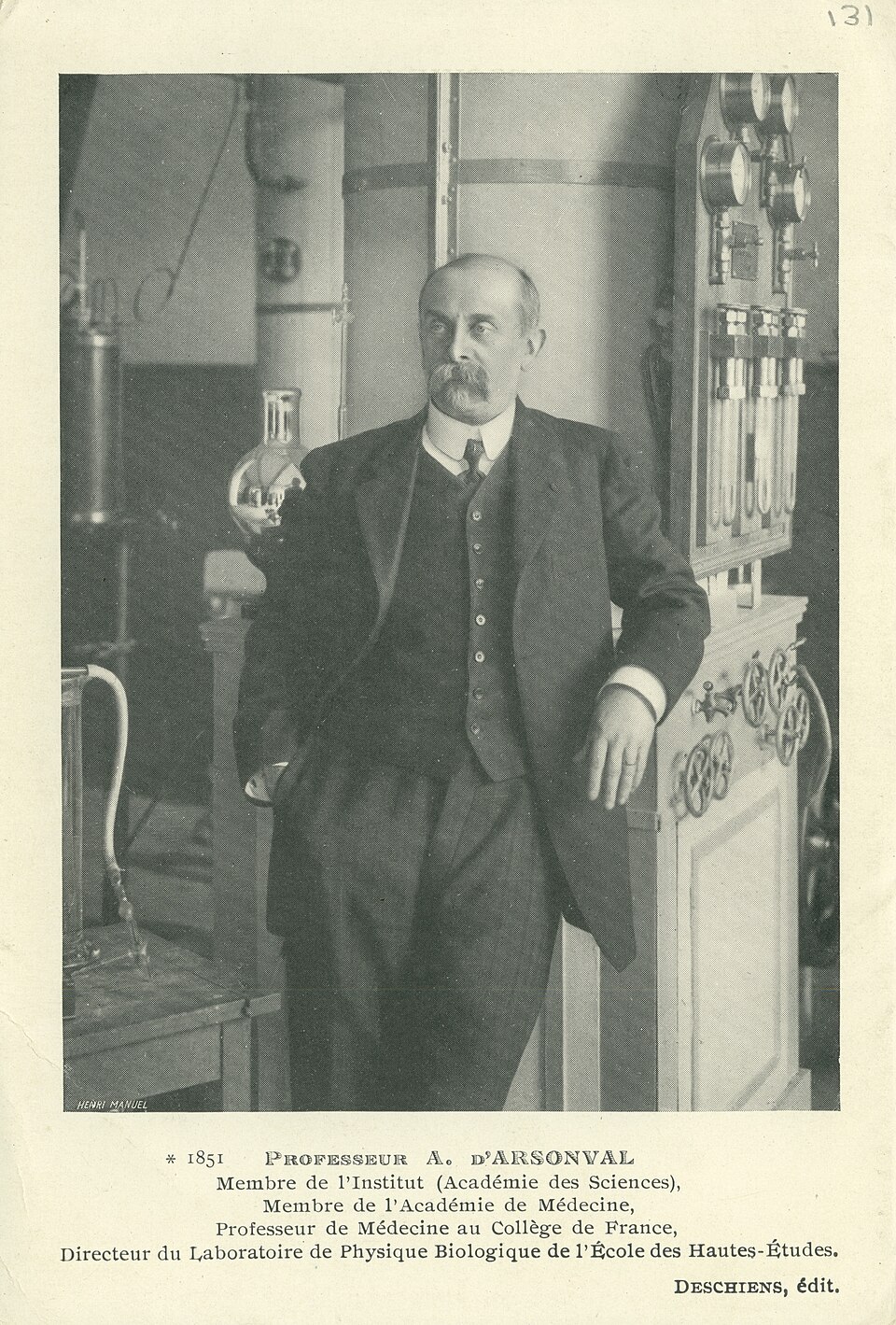

Physiology, resonators, liquid air, ocean power, a radiological motor car and psychical investigation meet in d’Arsonval’s remarkably broad career. Follow the laboratory life behind a name that became an electrical tradition.
1851–1873 · A Limousin childhood and a route diverted by war
Jacques-Arsène d’Arsonval was born on 8 June 1851 at La Borie, in the commune of La Porcherie in Haute-Vienne. Medicine was already a family profession. His eventual career would carry him into Parisian laboratories, industrial companies and national academies, but his connection with the Limousin countryside lasted until the end of his life.
His education took him through local schooling, Brive and the lycée at Limoges. He passed the science baccalaureate in 1869 and went to Sainte-Barbe in Paris with engineering ambitions. The Franco-Prussian War disrupted that route. Back in Limoges, he entered medical training, following a path his father favoured. This is an important beginning for a man often remembered through a single electrical treatment: he came to biological research with the appetite of an engineer. Medicine supplied the questions; physics and machinery increasingly supplied his way of answering them.
1873–1878 · Claude Bernard and the faulty galvanometer
In 1873 d’Arsonval returned to Paris as a medical student. The institutional account of his first encounter with Claude Bernard centres on a broken galvanometer during a lecture. The young visitor repaired the instrument, drawing the attention of the celebrated experimental physiologist. The story survives because it captures a real feature of his career: he could make an experiment work with his hands as well as discuss its theory.
He became Bernard’s assistant at the Collège de France while continuing his medical studies. Bernard’s laboratory was a demanding education in the relationship between a living body and the conditions under which it was examined. Temperature, pressure, electrical response and the behaviour of instruments all mattered. A result could depend on a small mechanical detail.
D’Arsonval’s medical thesis concerned the role of the lung’s elasticity in circulation. Rather than building a conventional practice, he settled into experimental work. Bernard’s death in 1878 ended the apprenticeship, but the conviction that physiology needed precise physical measurement remained at the centre of his life.
1878–1882 · Brown-Séquard, Paul Bert and a laboratory of his own
Bernard’s successor was Charles-Édouard Brown-Séquard. D’Arsonval stayed at the Collège de France, assisting the new professor and eventually teaching in his place. Their partnership put him close to research on nerves, organs and the ways substances produced within the body might influence other tissues. It also placed a mechanically gifted researcher within an institution where medicine could be investigated beyond the bedside.
Paul Bert helped him establish a biological-physics laboratory at the École pratique des hautes études from 1881. The choice of name expressed the direction of his work. The laboratory was a meeting point for physical instruments and living processes, rather than a consulting room decorated with electrical machines.
His publications on animal heat show the range of that programme. Measuring heat production demanded attention to the surroundings as well as the organism. These experiments helped form a working habit that would follow him into high-frequency electricity: define the physical stimulus, observe the response and improve the apparatus when the available instrument could not answer the question.
The 1880s · Giving invisible currents a readable trace
The Deprez–d’Arsonval galvanometer belongs beside the spectacular discharge machines in any account of his work. In collaboration with Marcel Deprez, d’Arsonval helped develop a moving-coil instrument for detecting and measuring small currents. A historic example in the French national heritage inventory was made by Jules Carpentier in 1882. This was an alliance of investigator, electrical engineer and precision maker.
The underlying idea is easy to grasp. A current-carrying coil responds to a magnetic field; its motion can become a readable indication of electrical activity. For physiology, an instrument sensitive to small changes opened possibilities that a dramatic spark could not. Measurement made faint phenomena available for comparison.
His interests also extended to sound and time. Work with Paul Bert on microphones joined the physiological problem of hearing to the new telephone industry. He adapted Hipp’s chronoscope into a more compact instrument for very short time intervals. These projects make his electrical medicine easier to understand: he was already accustomed to translating subtle bodily events into movements, sounds and recorded differences.
1881 · A power station imagined in the temperature of the sea
One of d’Arsonval’s most far-reaching proposals had little to do with medicine. In 1881 he suggested exploiting the difference between warm surface seawater and cold water at depth to generate power. The later history of ocean thermal energy conversion identifies this proposal as an early foundation of the field. Georges Claude would subsequently pursue practical ocean-energy experiments.
The proposal was ambitious because the ocean offers an enormous store of heat, while the useful temperature difference is comparatively modest. A working system must move heat between a warm source and a cooler sink and overcome the practical cost of handling large volumes of water. It was an attempt to use a natural gradient, not to obtain energy without a source.
The connection with his other work is revealing. A researcher studying animal heat could also look at the sea as a physical system in which temperature differences might be converted into useful work. For d’Arsonval, physiology and engineering repeatedly led toward one another.
1888–1893 · Organ extracts and the unfinished beginnings of endocrinology
Electrical currents were only one part of the experimental frontier he shared with Brown-Séquard. Their published work also explored extracts taken from glands and other tissues. The bibliography preserved by the Collège de France records papers on these preparations in 1891, 1892 and 1893, including pancreatic, liver, brain and testicular extracts. D’Arsonval investigated preparation and sterilisation as well as the proposed physiological effects.
This work belongs to the early, uneven history of internal secretions and organotherapy. The researchers were asking whether products of an organ could act elsewhere in the body. Their expectations and methods preceded the later isolation of specific hormones and the development of controlled replacement therapies. The striking claims of the period should be read in that setting.
For a full biography, these experiments matter because they show a man willing to investigate possibilities that were still poorly defined. He did not confine his curiosity to established instruments or accepted remedies. He pursued the physical and chemical means by which one part of a living system might alter another.
1891–1893 · High-frequency electricity and a different bodily response
D’Arsonval’s investigations into alternating currents became central to his international reputation. The important question was not simply how much electricity passed, but how the current changed over time. His studies compared forms of electrical excitation and the responses of nerves and muscles. A paper presented to the Académie de médecine on 22 March 1892 explicitly brought together sinusoidal currents, high frequencies and high potentials.
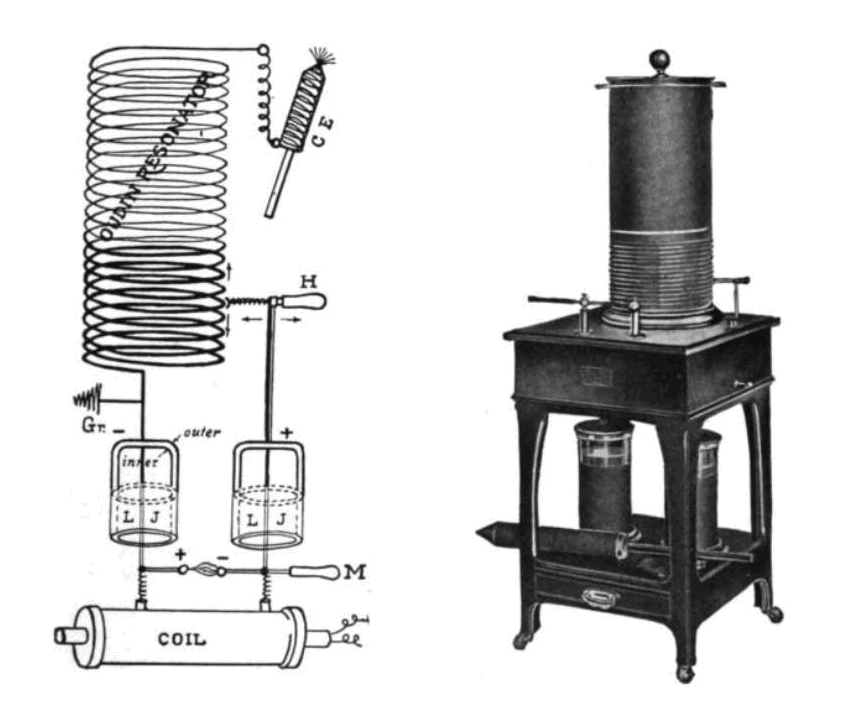
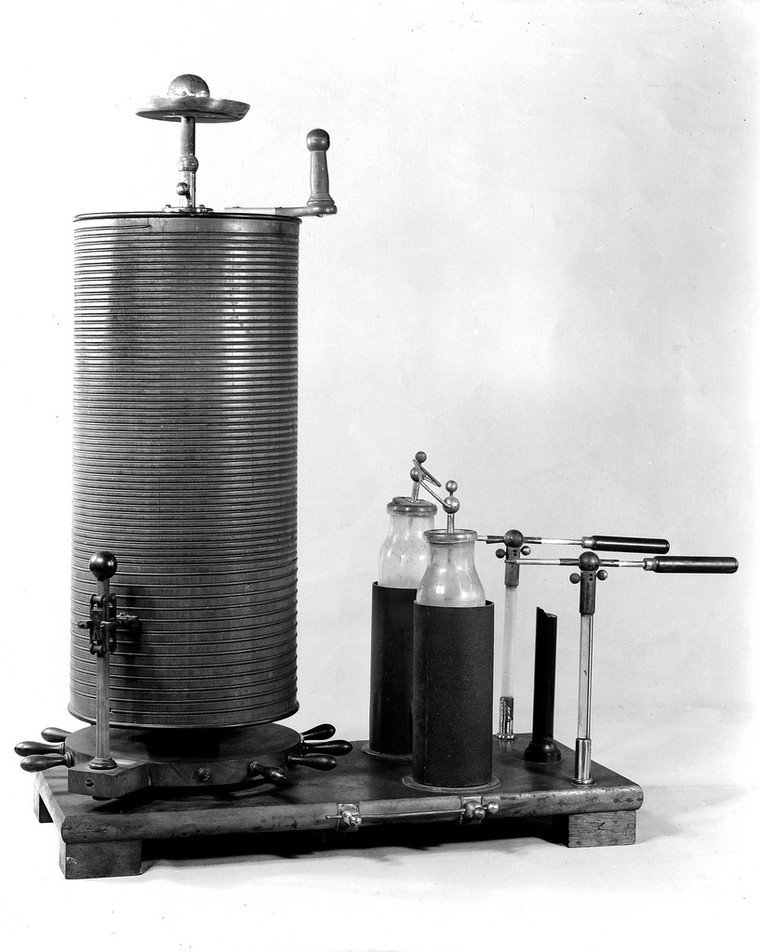
Rapidly alternating currents could produce responses very different from the familiar contractions associated with slower stimulation. This helped shift attention toward heating and other physiological effects, and toward apparatus capable of producing these currents repeatedly. The often-illustrated large solenoid made the experimental setting unmistakable: the body could be placed within an electrical arrangement, rather than merely touched by a small electrode.
The name darsonvalisation grew from this programme. It should retain its historical specificity. These were investigations of particular currents and arrangements, followed by proposed therapeutic applications. Their existence does not make every later machine bearing a related name electrically identical, but they established a fertile meeting ground between laboratory physiology, medical ambition and resonant apparatus.
1896 · When a field made light appear inside the observer
Some of d’Arsonval’s most intriguing observations concerned light that appeared to the observer without a glowing tube being its visible source. His note of 2 May 1896, published under a title about measuring alternating currents, records phosphènes: sensations of light associated with exposure to an alternating magnetic field. The original page has since been reproduced in research presentations on magnetic stimulation. Here is an authentic meeting point between the old electrical laboratory and a phenomenon that can feel, to the person experiencing it, strangely inward.
The episode gives another dimension to the famous photographs of a person enclosed by a large coil. D’Arsonval’s bodily experiments were concerned with more than the drama of a lamp illuminating in an electrical arrangement. The observer’s sensation could itself become part of the experimental record. Vision, balance and the nervous system presented questions about how a changing field and a living conductor interacted. The field was invisible; the reported effect arrived as an experience. Bringing those two descriptions into contact was one of the characteristic challenges of his biophysics.
This strand sits particularly well beside his better-known high-frequency work because it prevents a single electrical appearance from dominating the whole biography. A luminous discharge in glass, a lamp included in a demonstration and a flash perceived within the visual field are three very different events. Period authors were trying to give such events a language, while learning which parts of their instruments and their own bodies mattered to the result.
For readers drawn to the border between electricity and consciousness, this is a substantial starting point. The history contains a real observation and a real text, without requiring a later mystical explanation to be placed in d’Arsonval’s mouth. His laboratory was already asking how something outside the body could become a signal within experience. That question continues to make the old apparatus feel unexpectedly close to the present.
1894–1900 · The professor, the clinic and the instrument maker
In 1894 d’Arsonval succeeded Brown-Séquard in the Chair of Medicine at the Collège de France and joined the Académie des sciences. He had already entered the Académie de médecine in 1888. The research once pursued as an assistant’s work now had the authority and teaching platform of a senior institution. His courses brought the relationship between electricity and living organisms before successive audiences.
The field developed through collaboration. Paul Oudin worked on resonators that raised electrical potential; makers such as Eugène Ducretet turned experimental arrangements into saleable equipment. Ducretet’s 1900 catalogue preserves several named systems, reminding us that there was a family of evolving machines rather than one universally defined violet ray.
D’Arsonval also helped establish the École supérieure d’électricité in 1894 and the Société française d’électrothérapie in 1897. These organisations gave teaching, professional exchange and practical engineering a lasting structure. His influence travelled through pupils, manufacturers and societies as well as papers. The spread of electrical medicine depended on all of those connections.
1888–1910 · A parallel path through liquid air and industry
Another thread ran from cold gases to industrial enterprise. In 1888 d’Arsonval described a double-walled vessel with a vacuum between its walls, intended to insulate liquefied gases. The Collège de France identifies it as a precursor of the familiar vacuum flask. The problem was practical: an extraordinary low-temperature material could be difficult to preserve long enough to examine or use.
He supported Georges Claude’s work on liquefying air, and Claude’s process helped lead to the creation of Air Liquide in 1902. D’Arsonval became an early shareholder and remained a director until his death. The bibliography also records his own 1902 paper on liquid air and his preface to Claude’s 1903 book on its production, properties and applications.
The scale of his equipment eventually helped drive the move from the rue Claude-Bernard laboratory to Nogent-sur-Marne. That move gives a physical shape to the later career: more space for bulky machines, with experimental science and industrial engineering continuing to share the same working world.
1904–1905 · The electrical room takes to the road
Among the less familiar images associated with d’Arsonval is a radiological motor car published in La Nature in 1905. The surviving photograph brings together the names Gaiffe, d’Arsonval and Panhard. Its record also identifies Arthur Constantin Krebs, the Panhard & Levassor engineer, with the design. Instead of a monumental electrical room waiting for a visitor, the apparatus has become part of a vehicle: an attempt to take the physical means of investigation to another place.
The image extends a theme that runs through d’Arsonval’s entire working life. A new effect was only one beginning. It had to be connected with a source of power, an instrument maker, a usable setting and the people expected to operate it. The motor car made those connections visible in an unusually compact way. Engineering a laboratory into a moving platform meant thinking about the complete arrangement and its circumstances, rather than the isolated name of a current or a tube.
It also restores some of the collective character of the period. The inventor’s surname remains prominent, but the machine belongs to a meeting of medical physics, electrical manufacture and automobile engineering. These were not remote worlds. The same expanding industrial culture could produce a precision measuring instrument, a high-voltage installation and a means of carrying equipment out onto a road. D’Arsonval’s friendships and collaborations were part of how an experimental idea acquired those different bodies.
For the ARC hive, the photograph is an excellent companion to the grand indoor installations. Both are remarkable contraptions, yet their ambitions differ in a revealing way. One creates an imposing place around an experiment; the other asks how much of that place can travel. The lesser-known vehicle belongs in the biography because it turns the familiar image of d’Arsonval as a professor among enormous coils into a more restless figure: a researcher interested in where apparatus could go, and what it might enable once it arrived.
1905–1909 · Eusapia Palladino and the search for an unexplained force
D’Arsonval also entered a more controversial experimental territory. He chaired the Institut général psychologique’s section for psychical and physiological research. Its 1909 volume Documents sur Eusapia Palladino records investigations conducted between 1905 and 1908 into the Italian medium’s reported phenomena. This is a genuine part of his life, preserved in an original report rather than a later occult legend.
The investigators attempted to examine movements of objects, changes in apparent weight, lights and other reported effects. D’Arsonval and Édouard Branly were associated with work comparing the subject’s weight with movements of objects. The report includes observational accounts, discussion of the conditions of control and an explicit examination of deception. Its participants did not always agree about what their observations justified.
What this episode establishes is d’Arsonval’s willingness to bring instruments and physiological questions into a disputed field. It does not establish a new force as a demonstrated fact. The unresolved edge is part of the story: respected scientists were deciding how to investigate claims whose conditions made reliable observation unusually difficult, and how far a personal impression could be trusted.
1909 · The observer becomes part of the mystery
The 1909 Palladino report is fascinating in its smaller observational details. Its investigators discuss the difference between knowing that a hand was under control and merely feeling as though contact had continued. They consider the position of hands, the effect of a curtain, changing illumination and the difficulty of watching several parts of a moving person at once. A passage on complete darkness notes that visual experiences arising within the observer could be mistaken for an outside event. The same enquiry that entertained extraordinary phenomena also examined the extraordinary fragility of ordinary observation.
That makes the investigation more than a story about famous scientists attending a séance. Instruments could register an apparent change, but someone still had to decide what arrangement produced it. A witness could be highly trained in one laboratory discipline and still have divided attention in an unfamiliar room. D’Arsonval’s involvement places him inside that problem: how could physiology, weighing, perception and the possibility of deception be investigated together when the person at the centre of the experiment helped shape its conditions?
The book’s fascination comes partly from that unfinished character. It is not a polished scientific victory presented after every difficulty has been resolved. The reader encounters a group attempting to determine what a trustworthy observation would look like. The report preserves the friction between the desire not to miss something important and the equally serious task of establishing what actually happened. That friction is one reason psychical investigation attracted technically accomplished people, rather than being merely a separate world of credulous spectators.
Seen beside d’Arsonval’s physiological instruments, the séance room becomes another apparatus problem, with a far less stable object at its centre. It reveals the breadth of his curiosity and the limits that curiosity encountered. The man whose name came to stand for a repeatable electrical method was also prepared to enter a setting where repeatability, control and the investigator’s own senses were precisely what had become uncertain.
1910s–1938 · The public savant and the man behind the apparatus
By his later decades d’Arsonval had become an institution in his own right. He held the medicine chair until 1930, and his advancement through the Légion d’honneur culminated in its Grand Cross in 1931. In 1938 his long service to the Académie de médecine was marked by a fiftieth-year jubilee. The public record is full of titles, yet a colleague’s recollection preserves a more recognisable person.
Edmond Faral remembered his warm welcome, kindness to younger colleagues and unassuming manner. He recalled d’Arsonval arriving from Nogent in a noisy yellow automobile old enough to look like a museum object. It is a wonderfully appropriate image for someone whose working life crossed early telephony, precision instruments and large electrical machines.
Such recollections are affectionate testimony, not a view into every aspect of his private life. They nevertheless restore something the eponymous apparatus tends to remove: an older researcher who remained attached to the people and place in which he had worked for most of his adult life.
1940 and after · Returning to La Borie, leaving an experimental legacy
D’Arsonval died at La Borie on 31 December 1940. Faral’s tribute, delivered at the Collège de France in January 1941, remembers letters sent from that home during the preceding year. The biography closes close to where it began, after a career lived largely between Parisian institutions and the expanding space of the laboratory.
His legacy can be followed in several directions: the moving-coil instrument, high-frequency physiology, industrial gases, ocean-energy proposals and the organisations that connected engineering with medicine. Original correspondence held by the Académie des sciences and the Collège’s publication records make it possible to move beyond the simplified label of electrical healer.
The most compelling through-line is a habit of experiment. Again and again he tried to turn an elusive effect into something an instrument could register or an engineered system could use. Some investigations became durable technologies; others remain evidence of hopes, disputed observations or incomplete explanations. The breadth is what makes the life worth exploring in full.
The life at a glance
1851 · Born at La Borie on 8 June
1873–1878 · Medical training and apprenticeship with Claude Bernard
1881 · Biological-physics laboratory and ocean thermal-power proposal
1882 · Deprez–d’Arsonval instrument built by Carpentier
1888 · Elected to the Académie de médecine; describes an insulating vacuum vessel
1892 · Presents comparative electrical-physiology work on 22 March
1894 · Succeeds Brown-Séquard at the Collège de France
1902 · Supports the industrial development of liquid air
1905–1909 · Psychical research and publication of the Palladino investigation
1930–1938 · Retirement from the chair and national honours
1940 · Dies at La Borie on 31 December
Photographs & original documents

Sources & further reading
- Collège de France — Arsène d’Arsonval
- Collège de France — d’Arsonval’s Chair of Medicine, 1894–1930
- Collège de France — Bibliographie de Arsène d’Arsonval
- Chisholm Williams — High-frequency currents in the treatment of some diseases (1903)
- US Government — Ocean Thermal Energy Conversion Report to Congress (1981)
- Académie des sciences — Fonds Arsène d’Arsonval
- Edmond Faral — Tribute to Arsène d’Arsonval and Henri Bergson (1941)
- Institut général psychologique — Documents sur Eusapia Palladino (1909)
- Eugène Ducretet — Notice générale sur les courants de haute fréquence et de haute tension (December 1900)
- Pierre Vayre — Docteur Jacques Arsène d’Arsonval: de la biophysique à l’Académie de chirurgie (2007), institutional archive research
- French Ministry of Culture — Deprez–d’Arsonval galvanometer, made by Jules Carpentier in 1882
- A. d’Arsonval — Dispositifs pour la mesure des courants alternatifs de toutes fréquences, 2 May 1896; original note reproduced on slide 5
- La Nature — photograph of the Gaiffe–d’Arsonval radiological motor car, 1905
- Institut général psychologique — Documents sur Eusapia Palladino, 1909, original report scan
- S. H. Monell — A System of Instruction in X-Ray Methods and Medical Uses of Light, Vibration and High-Frequency Currents, 1902
