
Georges Lakhovsky
c. 1869/1870–1942
From railway engineering to a universe of oscillation.
A practical inventor became the author of an expansive electrical theory of life. Railways, sound, plant experiments, concentric rings, the ground beneath the apparatus and a fascination with unusual forms of influence all enter his story.
Origins: a life across borders
Georges Lakhovsky entered the French record as an inventor from the Russian Empire, and later became closely associated with Paris. His precise birth year remains uncertain: major library authorities do not agree, and the Bibliothèque nationale de France qualifies its usual 1869 date. A detailed childhood story, complete with conversations and early revelations, would go beyond the dependable records assembled here. The adult documentary trail is much firmer. It shows a man moving between practical engineering and wide philosophical speculation, and eventually between Europe and the United States. This movement matters to the story. His work did not develop within one university department or one medical school. It travelled through patent offices, publishers, laboratories, exhibitions and networks of sympathetic practitioners. The result was a body of work with several identities: mechanical invention, radio experiment, biological hypothesis and an unusually ambitious account of humanity’s place in the physical world.
Paris, 1901: the engineer before the oscillator
One of the clearest early documents is an application filed in July 1901 and granted the following year as U.S. patent 703,796. Lakhovsky identified himself as a subject of the Russian emperor residing on Boulevard Saint-Germain in Paris. The invention was a bolt-retainer, particularly suited to securing railway rails to wooden sleepers. Its purpose was practical: resist sideways shocks, maintain a firm grip in wood and permit the rail to be removed without destroying the entire fixing. The drawing is a useful corrective to the later image of a man concerned only with invisible energies. Here he was thinking about material strain, maintenance and the behaviour of a mechanism under repeated vibration. It also establishes his habit of turning a perceived weakness into a specific arrangement of parts, explaining the advantages and placing the design into an international patent system.
Railways, measurement and mechanical judgement
The railway work continued beyond a single fastener. His 1915 U.S. patent for an instrument to measure or verify railway-track superelevation, gauge and inclination addressed the geometry of the track itself. These measurements concern the relative position of rails and the way a curve or slope is laid out. In the context of his life, the instrument shows an inventor interested in making difficult physical relationships readable. A condition that might otherwise depend on separate checks was brought into the design of a measuring apparatus. This is a lesser-known strand of Lakhovsky’s career, but an important one. It places his later oscillation theories after years of engagement with structures, forces and instruments. It does not prove that the biological theory followed from the railway work; it shows that the eventual author of that theory already possessed a sustained, documented practice of technical invention.
Sound and the problem of transmitting a vibration
By the 1920s, Lakhovsky’s patent work also included sound. U.S. patent 1,593,457, issued in 1926, concerns an apparatus for receiving and transmitting sound. His later 1941 patent on improving the sound emitted by microphones and loudspeakers shows that this interest persisted alongside his better-known wave-and-life publications. Sound technology is a useful part of the biography because it prevents the years between railway engineering and the MWO from disappearing into a gap. Receiving, transmitting and modifying a vibration were practical technical problems in this period, not merely metaphors. Nevertheless, an acoustic vibration and an electromagnetic oscillation are different phenomena. The historical connection lies in Lakhovsky’s recurring attraction to resonant systems and transmission. His working life covered ordinary engineering objects as well as the extraordinary biological interpretations for which he would later be remembered.
1925: presenting a cellular theory to radio readers
In February 1925, Radio News published Lakhovsky’s own account of ultra-radio-frequency experiments. Its dramatic cancer-related title belonged to the confidence and publicity of the period. Inside the article, he set out his proposed contest between a living cell’s oscillation and the oscillation of a microorganism. Illness, in his interpretation, involved the cell losing that contest; an external electrical source might help restore the cell’s activity. This was a theory he was actively promoting, rather than a modern explanation of disease. Its historical importance is the audience and the language. Readers accustomed to transmitters, wavelengths and interference were being invited to imagine the body as another electrical system. The article also pictured the experimental oscillator and supply equipment. That combination of apparatus, biological promise and radio terminology helped give his work a life beyond a specialist medical readership.
The Salpêtrière plant experiments
A specific experimental story concerned geraniums, usually identified in the publications as Pelargonium, with conspicuous abnormal growths. A historical communication associated with A. Gosset, A. Gutmann, Lakhovsky and J. Magrou was presented in July 1924; Lakhovsky reproduced and discussed this work in later writings. The authors claimed that their electrical apparatus was associated with favourable changes in the plants. These reports mattered to Lakhovsky because they offered visible subjects: stems, photographs and changes over time. They seemed to him to bridge an electrical hypothesis and an observable biological result. The episode should retain its original identity. Abnormal growth in a plant is not interchangeable with human cancer, and the authors’ use of medical language belongs to their historical interpretation. As an episode in experimental culture, however, it explains how strongly a few striking living specimens could shape the direction of a research programme.
The open circuit: from powered apparatus to passive rings
Another branch of the work involved an open metal circuit placed around a subject, rather than a continuously powered treatment generator. La santé par les ondes preserves the presentation of these ideas, observations and supporting accounts. The ring was understood by Lakhovsky as a resonant element interacting with its surroundings. Its apparent simplicity was central to its appeal: the geometry suggested that something ordinarily considered inert could become part of an electrical exchange. The distinction between this passive open circuit and a powered Multiple Wave Oscillator is essential to the biography. They grew out of related thinking, but were not the same object. Later bracelets, garden coils and commercial devices frequently gather under one name, obscuring those differences. Studying the original pamphlet restores the range of experiments and proposals that existed before the MWO became the dominant visual emblem of his work.
A larger explanation: life, radiation and L’Universion
Lakhovsky was not content to describe an instrument and leave the surrounding theory untouched. His publications expanded towards a general explanation of matter, living processes and the environment. The French bibliography includes L’Universion, published in 1927, with a preface associated with d’Arsonval, while the English Secret of Life appeared in 1939 in Mark Clement’s translation. In this intellectual world, the cell was imagined as an oscillator whose activity existed within a larger field of radiation. The attraction of the idea was its unity: health, biological variation and the invisible physical environment could be discussed within one framework. That breadth also explains why readers encounter him in different traditions, from electrical medicine to radiesthesia and speculative cosmology. For the life story, it marks a change of scale. A designer who once described how a fixing held in timber was now attempting to explain what held living systems in equilibrium.
1927 · The ground beneath the oscillator enters the theory
Lakhovsky’s cosmic account did not stop at the sky. In his 1927 Contribution à l’étiologie du cancer, the ground beneath a person became part of the proposed relationship between a living organism and its electrical surroundings. The short original publication includes geographical and geological material. He was trying to connect a theory of radiation and cellular oscillation with patterns that seemed, to him, to demand an explanation extending beyond an individual body. Soil, terrain and distance could therefore enter the same story as the cell and the ring.
The underlying imaginative move was considerable. An organism, in this view, was not an isolated mechanism carrying all of its determining conditions inside itself. It occupied an environment through which physical influences travelled, were modified and encountered living structures. The landscape became a participant in the argument. Lakhovsky’s explanatory framework linked this medical question with other phenomena he discussed, including the orientation of living beings. The proposed common thread was electromagnetic communication across space.
This chapter of his thinking helps account for the later attraction of his work to readers interested in geobiology, earth energies and the character of a place. Those later interests have their own authors and methods, but the 1927 text supplies an early, specific Lakhovsky document in which the Earth is doing more than supporting the apparatus. The map is part of the hypothesis. It is a different kind of object from the concentric antenna, yet both express his search for a relationship between a larger field and a particular living form.
Reading the short work beside the later MWO patent gives the biography a valuable change of scale. One page asks about distributions across terrain; another defines a physical arrangement. Together they show how widely Lakhovsky wanted the oscillation idea to travel. His ambition was not simply to introduce a machine. It was to make the electrical condition of the surrounding world central to the way life itself was described.
1931–1934: giving the MWO a definite form
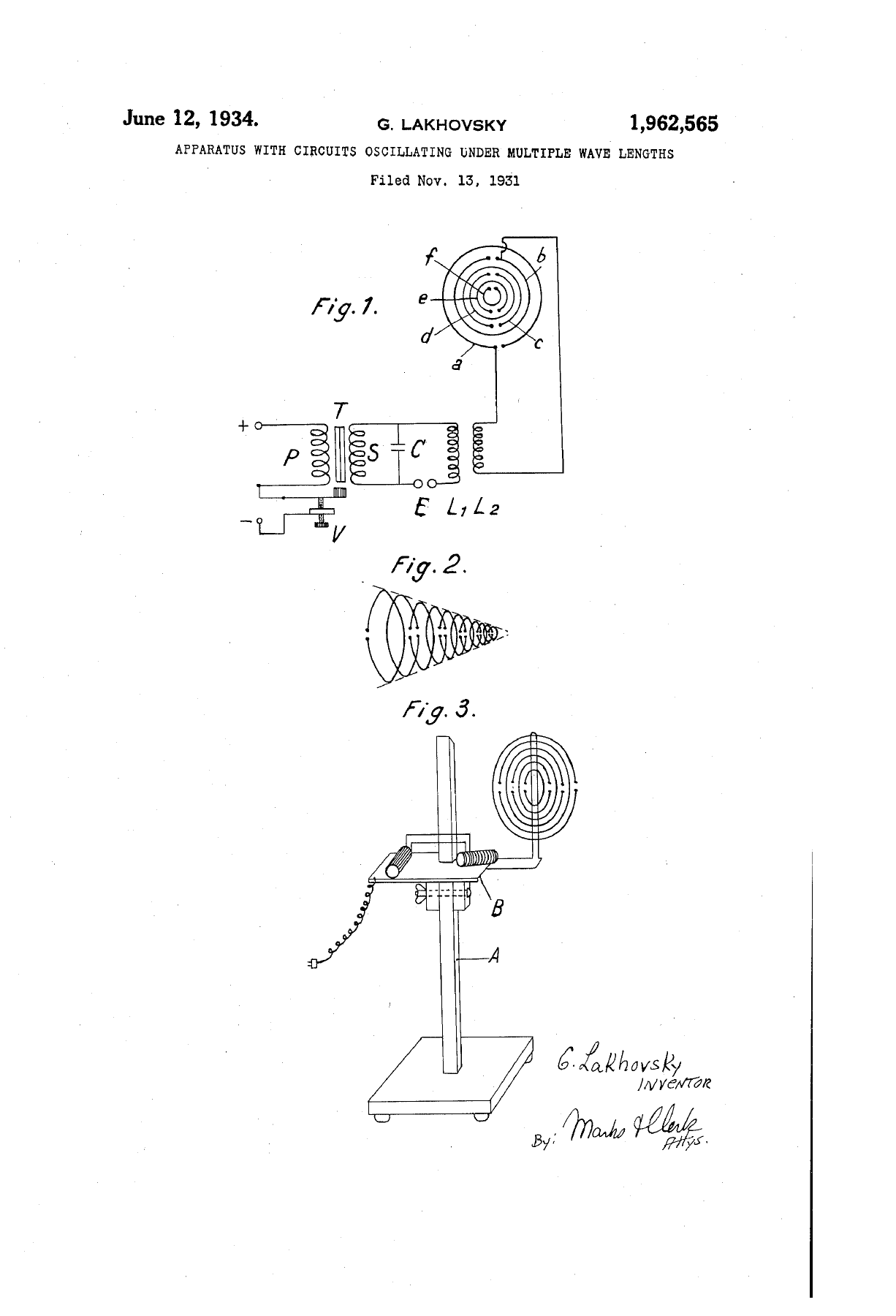
The Multiple Wave Oscillator supplied a particularly memorable physical form for the wider theory. The French priority date associated with its core U.S. patent is 2 May 1931; the American application followed in November, and the patent was granted on 12 June 1934. It describes concentric insulated split rings of different diameters, excited by a high-frequency source. Some rings are connected to the driving circuit, while others are excited by induction. The drawings explore planar and conical arrangements and a support that permits orientation of the assembly. This was a proposal to produce multiple wavelengths, rather than to select a single disease setting. For readers of the present ARC hive, the drawing is worth studying slowly. It reveals which parts are actually specified and which features of a modern replica belong to a later designer. The patent gives the invention a dated technical identity within the much wider claims made around it.
The 1930s writer: more than a medical-device catalogue
Lakhovsky’s bibliography became remarkably varied during the 1930s. Alongside books on cellular oscillation and the MWO were titles on the Earth, matter, longevity, society and politics. The bibliographic record of Le Racisme et l’orchestre universel and La Civilisation et la folie raciste places racial ideology among his concerns; the latter circulated in a New York edition in 1941. These works should not be reduced to evidence for the oscillator, nor should a title alone stand in for a reading of its full argument. They nevertheless show how narrow a biography becomes when every year is treated as another step towards a single machine. Lakhovsky wanted to address broad questions about civilisation as well as bodies. His public identity was that of an author with a general system, and his books connected the vocabulary of vibration with debates and anxieties far beyond the clinic.
1934–1936 · La Cabale and an enlarging private universe
The title La Cabale makes an important part of Lakhovsky’s self-presentation explicit. Published in 1934, its subtitle calls it the history of a discovery: cellular oscillation. The BnF records a substantial book, rather than a passing newspaper complaint. The choice of title places opposition and the struggle for recognition inside the story he wanted to tell about his work. For a biography, that is evidence of how the inventor framed his position; the title alone cannot identify every opponent or establish every allegation subsequently repeated in his name.
Two years later, La Nature et ses merveilles brought wireless telegraphy, autosuggestion, homeopathy, animal magnetism and dowsing together in its subtitle. The combination is extraordinary, and the national-library bibliography preserves it plainly. It shows how far his published interests extended beyond the familiar antenna. Lakhovsky wanted a vocabulary broad enough to move among electrical transmission, mental experience and practices already associated with more elusive forms of influence. The books make the esoteric branch of his intellectual life visible without requiring a modern author to invent it for him.
The juxtaposition of those two publications is especially revealing. In one, a discovery has a contested social history. In the other, familiar divisions between technology and unusual experience become porous. An oscillator, a bodily response and a reported act of perception could all appear within the same expanding imaginative territory. Whether a particular reader follows every proposed connection or only some of them, this breadth helps explain why his work continues to attract such different audiences.
Lakhovsky’s place in fringe culture therefore comes partly from his own writing, not simply from the later survival of his machines. The inventor supplied a figure of thought as memorable as the open ring: a universe in which apparently separate events might be connected by vibration, and a researcher who believed the significance of those connections had not been properly recognised. The full biography needs that literary and personal world beside the technical documents.
Vienna and the debate over short waves
Radiations and Waves preserves Lakhovsky’s account of presenting his work at the 1937 International Congress of Short Waves in Physics, Biology and Medicine in Vienna. In his telling, variations in reported results and concerns about thermal effects reinforced his preference for a multiple-wavelength approach. This episode is revealing because his technical position was not simply that more electrical power must be better. He argued for a different relation between the source and the individual living subject. His descriptions of the cell’s structures as microscopic circuits were part of that argument. The congress account belongs to the history of what he said and proposed; its claimed biological effects require separate evaluation. It also places him within an active international conversation about short-wave apparatus, rather than in an entirely isolated workshop. He was responding to competing devices, reports and interpretations circulating in the same period.
New York and the final tube design
By 1941, Lakhovsky was publishing in New York and filing another American application. The resulting patent, issued in June 1944 as U.S. 2,351,055, placed multiple-wavelength conducting or producing elements within an evacuated or rare-gas tube. It explicitly referred back to the 1934 apparatus and considered medical and industrial possibilities. The design is an important late experiment because it shows that his thinking had not stopped at the familiar exposed antenna. He was still exploring how the multiple-wave-length concept might be packaged and used in another form. The issued document names Anne-Marie Louise Lakhovsky as administratrix of the deceased inventor and records an assignment to Henry S. Blum. Those legal details place family and business succession inside the technical story. They also explain a common chronological confusion: the 1944 tube patent and the 1934 split-ring patent are separate inventions, issued a decade apart.
1941–1944 · The astonishing smallness of the final tube
The late tube patent changes the visual scale of Lakhovsky’s work. The familiar MWO image is theatrical: a person or object positioned in relation to large concentric metal forms. The patent filed in New York in 1941 and granted after his death in 1944 draws a different object, with multiple elements enclosed within a transparent envelope. The proposed electrical world has moved inside a lamp-like body. Even without a surviving operational example beside it, the drawing records a remarkable change in how he imagined packaging the idea.
The specification describes several alternatives. Separate internal elements would correspond to different wavelengths; other versions modify their arrangement or introduce ways of varying the electrical relationship. The drawings show that he was thinking through a family of physical forms, rather than merely decorating one tube with the appearance of the earlier rings. The multiple-wave concept was being reconsidered as a self-contained component. This is a genuine late inventive document, not a modern replica retrospectively attributed to him.
Its legal history makes the object poignant as well as strange. The published patent identifies the deceased inventor through his administratrix, Anne-Marie Louise Lakhovsky, and records the interest of Henry S. Blum. The technical proposal therefore arrives in the public record together with the arrangements by which work continued after its author could no longer explain or revise it. The instrument and the estate have become two parts of the same page.
For the modern reader, the little tube is a useful antidote to an overly fixed visual memory. An inventor can become identified with one silhouette so completely that his other experiments disappear. Lakhovsky did not end his working story by endlessly redrawing the same exposed antenna. The final patent suggests a continuing search for another material body for his theory, one that makes the enormous ambition of multiple waves look, at least on paper, unexpectedly compact.
Death in 1942 and the afterlife of the rings
Lakhovsky died in New York in 1942. Later accounts disagree about parts of his final illness and the circumstances surrounding an accident, so those dramatic details should not be supplied as a settled ending without a dependable contemporary record. The work itself continued to circulate through translations, reprints, replicas and readers who found his electrical picture of life compelling. The English Secret of Life is particularly important in that afterlife, allowing his ideas to reach readers outside French. His lasting visual legacy is the open ring: recognisable, adaptable and apparently simple, yet tied to a much more elaborate system of thought. A useful modern reading holds both sides together. There was a real inventor with a substantial documentary trail, and there were far-reaching biological claims that remain claims. The patents, books and surviving illustrations allow that life to be explored without inventing either a flawless hero or a one-dimensional caricature.
The life at a glance
c. 1869/1870 · Birth year uncertain in major authority records
1901–1902 · Paris address and bolt-retainer patent
1915 · Railway-track measuring instrument patent
1924 · Reported Salpêtrière geranium experiments
1925 · Radio News article presents the radio-cellular theory
1926–1927 · Sound patent; L’Universion and expanded wave-and-life writing
1931 · Core MWO application filed
1934 · U.S. split-ring patent granted
1937 · Vienna congress account and Radiations et ondes
1939 · English Secret of Life
1941 · New York publications and later tube-patent application
1942 · Death in New York
1944 · Tube patent issued posthumously
Photographs & original documents
Sources & further reading
- U.S. Patent 1,962,565 — Apparatus with circuits oscillating under multiple wave lengths
- La santé par les ondes — BIU Santé / Université Paris Cité scan
- The Secret of Life, 1939 — Wellcome catalogue
- U.S. Patent 2,351,055 — Tube for producing multiple wave lengths
- BnF authority — Georges Lakhovsky (1869?–1942)
- German National Library — Georges Lakhovsky authority record
- U.S. Patent 703,796 — Bolt-retainer, 1902
- U.S. Patent 1,136,427 — Railway-track measuring instrument, 1915
- U.S. Patent 1,593,457 — Reception and transmission of sound, 1926
- U.S. Patent 2,263,408 — Improving sound from microphones and loudspeakers, 1941
- Radio News, February 1925 — Lakhovsky’s original article
- L’oscillation cellulaire — historical plant reports reproduced by Lakhovsky
- L’Universion, 1927 — WorldCat record
- BnF — Lakhovsky publications and editions
- United Nations bibliography — La civilisation et la folie raciste, New York 1941
- Radiations and Waves, 1941 — English edition preserving the Vienna account
- Georges Lakhovsky — Contribution à l’étiologie du cancer, 1927
- Georges Lakhovsky — 1927 Contribution à l’étiologie du cancer, reproduced original text
- BnF — La Cabale: histoire d’une découverte, l’oscillation cellulaire, 1934
- BnF — Georges Lakhovsky’s publications, including La Nature et ses merveilles, 1936
- Georges Lakhovsky — Tube for Producing Multiple Wave Lengths, US2351055A, 1944