
Paul Oudin
1851–1923
A name wound into the apparatus.
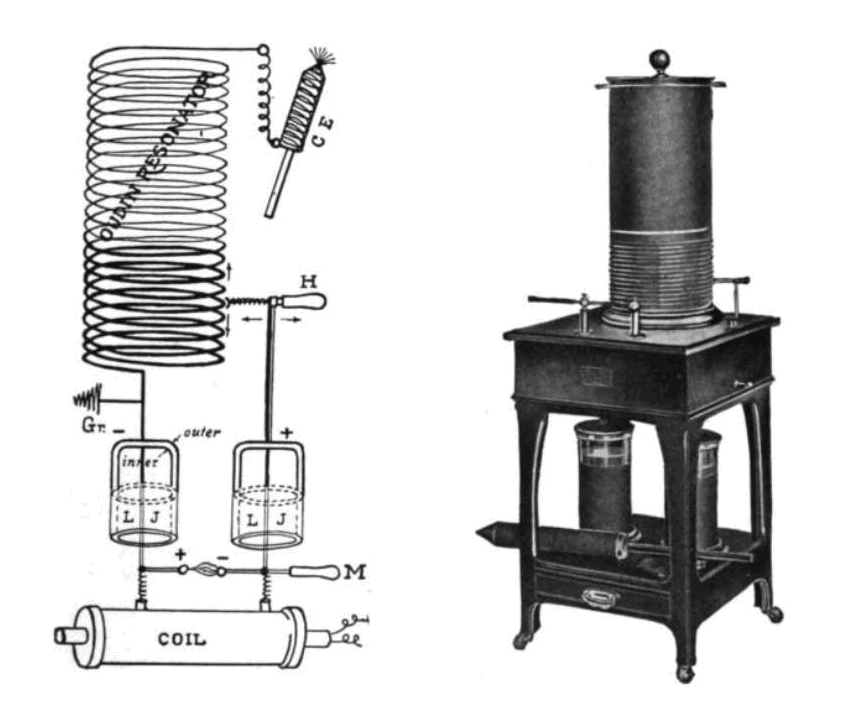

The Paris physician behind the resonator moved among high-frequency currents, X-rays, light and the manufacturers who turned an experimental arrangement into a complete electrical room. His life opens a less familiar route into the violet ray age.
1851–1881 · Recovering a physician from the name on a coil
Paul Oudin was born in 1851 and died in 1923. His name survives most visibly in the Oudin resonator, yet the national-library record also preserves a physician who wrote about clinical observation, ozone, X-rays, high-frequency currents and radiotherapy. Following those publications reveals a much broader working life than the outline of a single electrical machine.
His childhood, family circumstances and the exact stages of his medical education are less well documented in the accessible institutional sources used here. It would be misleading to supply a colourful apprenticeship or a childhood revelation that those records do not establish. By 1881, however, he was publishing on a medical case involving temperature measurements and acute pulmonary disease. That is a firm early point from which to follow his career.
He belonged to a generation of physicians who encountered powerful new physical instruments during their working lives. His distinctive role was to explore what those instruments might reveal about the body, and how their effects might be turned toward medicine.
1881 · Temperature, the body and an early clinical publication
Oudin’s 1881 paper, Quelques considérations sur les températures pariétales, à propos d’un cas de phthisie aiguë, concerned measurements of body-wall temperature in a case described with the contemporary term phthisis. Its title places him within the clinical effort to make bodily changes measurable. It predates the apparatus that would make his name internationally recognisable.
The distinction matters. Oudin was not simply an electrical enthusiast who later acquired a medical vocabulary. His documented early work began with a patient, an observed condition and the attempt to extract useful information from physical measurements. The subsequent interest in currents and rays can be followed as an extension of that medical curiosity.
Temperature offered one way to turn an impression of illness into a physical record. Later, electrical discharge and radiography would give him very different phenomena to investigate. Across these changes in equipment, the concern with observing the body remained. The early paper places an ordinary clinical problem at the beginning of a career that would increasingly involve extraordinary apparatus.
Before and alongside the resonator · Ozone as an experimental medicine
An undated paper co-authored with Donatien Labbé is devoted to ozone from a physiological and therapeutic point of view. The Bibliothèque nationale de France preserves the four-page publication and a link to its digitised original. Because its catalogue does not assign a date, it should not be made to support an exact year of discovery. It does establish ozone as one of Oudin’s research interests.
Ozone connected electrical apparatus with chemistry. Electrical discharges could change the surrounding gas, creating a substance whose sharp smell made an otherwise invisible process immediately perceptible. For doctors investigating new physical agents, this raised questions about effects on tissues and organisms as well as possible clinical uses.
The paper belongs to the experimental therapeutic hopes of its period. It also shows the breadth of what an electrical laboratory could investigate: the same apparatus could produce light, heat, discharge and chemical change, each suggesting a different line of investigation.
1892 · Resonance becomes a defining idea
Ducretet’s December 1900 account dates Oudin’s use of resonance to increase electrical potential to 1892. It is a valuable contemporary statement because later summaries give varying dates for the invention of the Oudin coil. The catalogue describes a principle and subsequent modifications, rather than a single finished machine appearing all at once.
The essential concept was resonance: an oscillating electrical arrangement could produce a stronger response when its parts were suitably related. Oudin developed a resonator associated with the high-frequency apparatus used by d’Arsonval and other investigators. The resulting equipment became particularly associated with high electrical potential and visible discharges.
A coil drawing alone can make this seem like a minor variation. In practice, changing the resonant arrangement changed the electrical behaviour available to experimenters and practitioners. Oudin’s contribution lay in that relationship between circuit and observable effect. It placed him in an international conversation also involving Tesla and Thomson, while retaining a recognisable apparatus tradition of its own.
January 1896 · Oudin and Barthélemy enter the X-ray race
The announcement of Wilhelm Röntgen’s discovery opened another field almost overnight. Oudin and Toussaint Barthélemy were among the French physicians who worked to reproduce the new images. Henri Poincaré presented their photograph of the bones of a hand to the Académie des sciences on 20 January 1896. René Colson’s 1897 book records the presentation while the discovery was still new.
The speed is striking. A physician who could work with electrical equipment was suddenly in a position to explore the interior of a living body in an unfamiliar way. Yet an image was not obtained merely by understanding the announcement. Early experimenters had to learn how their tubes, electrical supply and photographic materials behaved together.
The Musée de la radiologie preserves a February 1896 print inscribed with the Oudin–Barthélémy procedure. Its imperfect result is part of its historical power. It records a working method being learned, not the polished certainty of a mature diagnostic service. Oudin was helping turn extraordinary news into a reproducible medical practice.
1896 · Making a new way of seeing available to medicine
Oudin and Barthélemy presented the medical applications of the Röntgen method to congresses in Nancy and London in August 1896. The publication preserved by the BnF marks a transition from the excitement of the first pictures to professional communication: colleagues needed examples, methods and a sense of what the images could show.
Early radiology also joined previously separate networks. Electrical manufacturers, photographers, physicists and physicians all possessed some of the necessary expertise. Oudin’s place between clinical observation and high-frequency apparatus made him a participant in that exchange. He could contribute to a field whose practical limits were being discovered while the equipment itself was changing.
The emerging diagnostic question was more specific than a general belief in healing rays. What could an image reveal about bones, organs or disease that ordinary examination could not? Antoine Béclère’s 1899 monograph on X-rays and tuberculosis includes Oudin and Barthélemy’s work in its bibliography, preserving their contribution within the early medical literature rather than only in later stories about electrical pioneers.
1896–1898 · Reporting the injuries as well as the promise
Oudin’s involvement with X-rays also led him to document harm. With Barthélemy and the dermatologist Jean Darier, he co-authored Accidents cutanés et viscéraux consécutifs à l’emploi des rayons X, published in 1898 as a communication associated with the Moscow congress. Its subject was injuries following exposure, including effects on the skin and internal organs.
This is an important counterweight to the image of the pioneer as an unquestioning promoter. The new rays could reveal the body, but the body could also be damaged while an image was being obtained. Studying the complications was part of learning what the technology actually did. It required bringing adverse observations into the same professional conversation as the successful photographs.
The publication does not give Oudin sole credit for the development of radiation protection. It places him among the early investigators who recognised that the enthusiasm surrounding a physical discovery had to be accompanied by the study of its consequences. That is a substantive part of his medical legacy.
1898–1900 · From experimental arrangement to manufactured apparatus
The Oudin resonator spread through a close relationship between investigator and instrument maker. Ducretet’s 1900 catalogue reproduces an earlier account presented to the Académie des sciences on 6 June 1898 and describes refinements to the resonator’s arrangement. The catalogue is both a technical source and a commercial document: it shows what a maker offered to laboratories and practitioners.
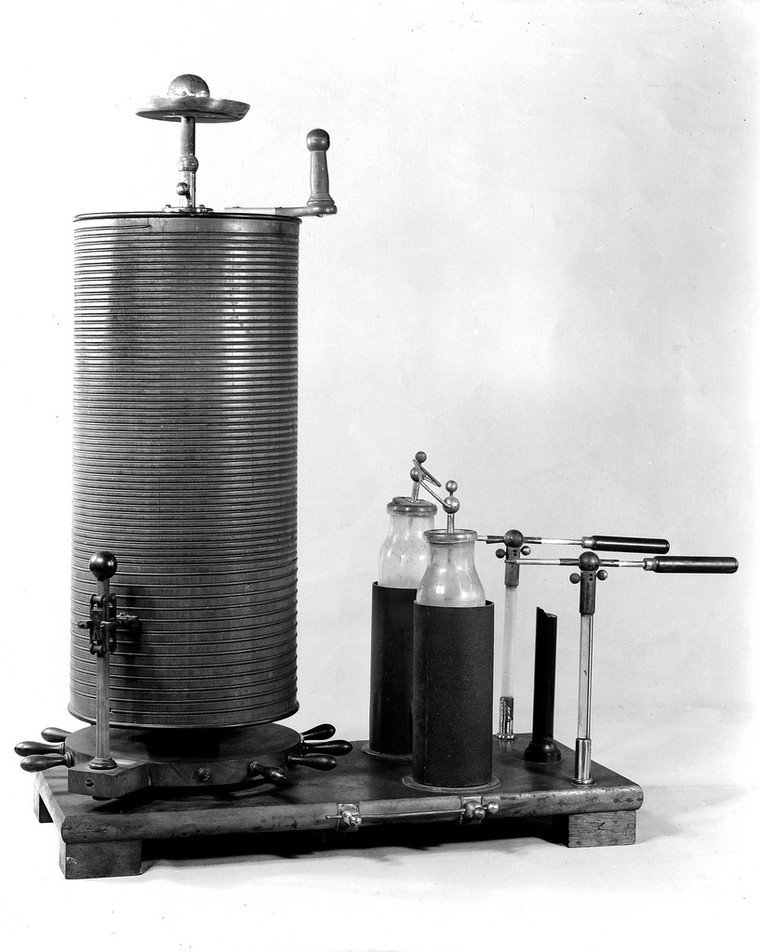
Wellcome preserves a photograph of a d’Arsonval apparatus with Oudin resonator made by Ducretet in Paris in 1899. Its substantial frame and associated components put the surviving name into perspective. The early installation was a piece of medical and laboratory equipment, with a physical presence very different from the later portable domestic wand.
The maker’s account names several experimental traditions rather than treating all high-frequency systems as interchangeable. Oudin’s work therefore belongs to a shared electrical world with distinct designs and intentions. The historical object is most revealing when its maker, date, configuration and documentary context remain attached to it.
1900 · Working with Doumer on physiological and therapeutic effects
Oudin’s collaboration with E. Doumer produced a 1900 work on the physiological and therapeutic properties of high-frequency, high-tension currents. Its title makes the period’s sequence of inquiry clear: investigate what a current does to the organism, then consider what medical use might follow. The partnership also shows that the apparatus was being discussed through sustained professional collaboration.
Such publications are valuable because they preserve the questions the researchers thought they were answering. Terms such as frequency, potential, discharge and physiological response had practical consequences for how different systems were compared. The impressive appearance of a machine was not, by itself, a description of its action.
A biography should retain that experimental ambition without converting every reported outcome into an established treatment. Oudin and his colleagues were building a field while participating in it. Their writing records what they proposed and observed, and invites comparison with the instruments, later replications and the subsequent history of medicine.
1902–1905 · The resonator becomes a complete electrical room
A manufacturer’s catalogue can bring Oudin’s world to life more vividly than an isolated circuit diagram. The Kny-Scheerer catalogue of 1905 offered its Perfection Type X-ray equipment with an optional high-frequency attachment expressly associated with Oudin’s apparatus. The same pages describe cabinetry, measuring and switching equipment, tube stands, connecting accessories and fitted electrodes. What crossed the Atlantic was not only an idea about resonance. It was the prospect of equipping an entire professional room.
That commercial setting explains much of the surviving machine’s visual character. Furniture was part of the apparatus: an oak cabinet, concealed wiring, the arrangement of controls and the presentation of the electrical components. The installation had to look like something a practitioner could purchase, accommodate and incorporate into a working identity. The photographs and specifications preserve the moment when a dramatic laboratory phenomenon became a supplied outfit with a recognisable place in medical commerce.
The catalogue is enthusiastic and competitive. Its language promotes the maker’s version against other types of electrical equipment, while its introductory history comments on the rapid succession of inventions and the temptation to impress audiences with spectacular effects. The industry was arguing with itself as it grew. The people selling the instruments were already distinguishing a persuasive display from the kinds of performance they wanted buyers to value. This is a particularly revealing complication in a history sometimes retold as a simple opposition between visionary inventors and one uniformly hostile establishment.
Oudin appears here as part of a broad, public electrical culture: physicians, suppliers, cabinet makers, glass workers, journals and buyers. The room-scale machines can now look like artefacts from a concealed civilisation, but their own documents show a busy and conspicuous trade. Recovering that trade makes the lost world larger. It gives each surviving handle, dial and fitted space a relation to the people who expected to use it, rather than leaving the machine suspended in an atmosphere of undated mystery.
1903–1907 · A name that travelled through textbooks and clinic photographs
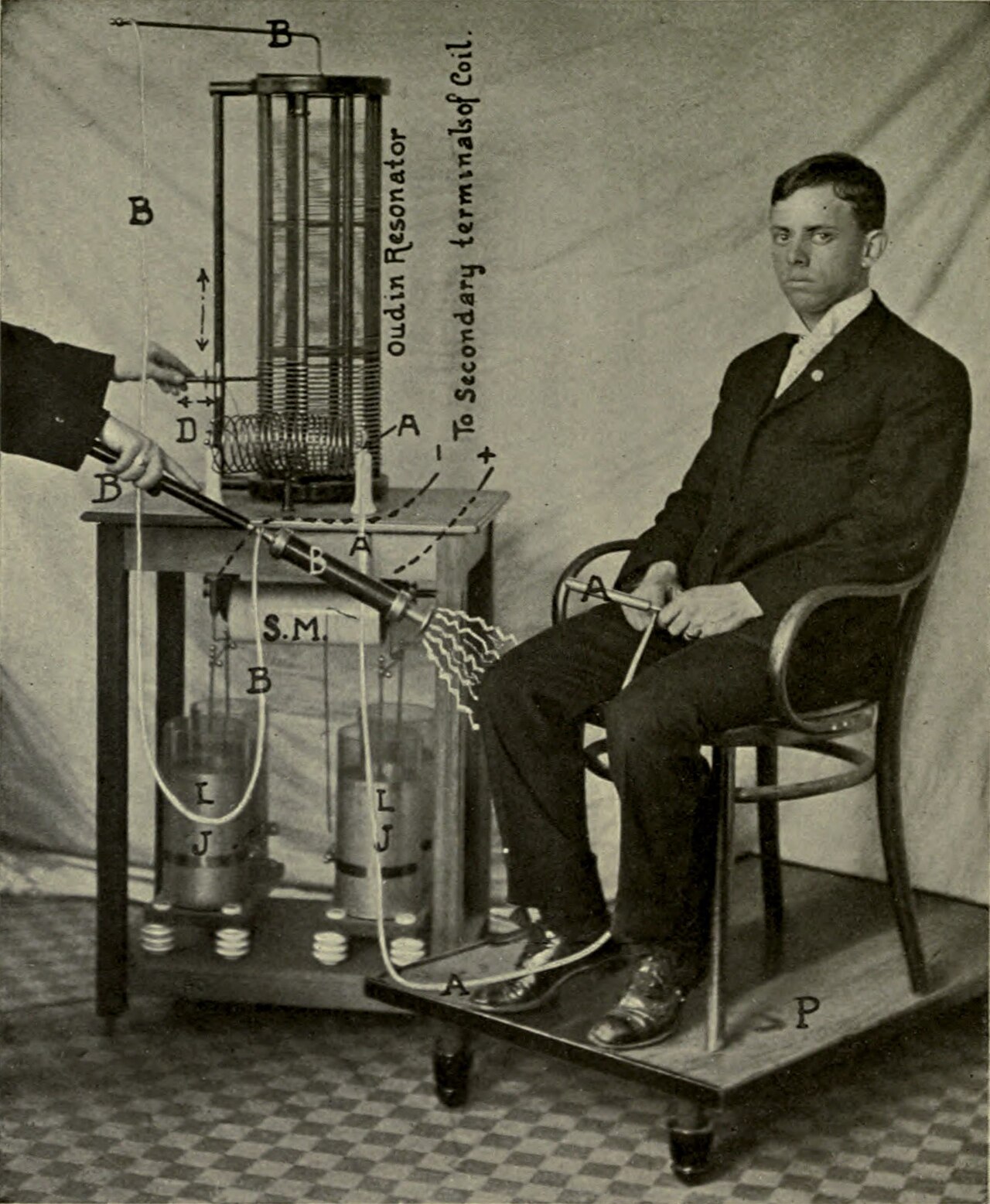
By the early twentieth century Oudin’s apparatus appeared in English-language medical literature. Chisholm Williams’s 1903 book illustrates an Oudin–Dean installation with its electrical equipment and treatment furniture. Mihran Kassabian’s 1907 Roentgen Rays and Electro-Therapeutics includes photographs and diagrams of an Oudin coil. These are contemporary signs of international circulation, not simply later collectors applying a famous label.
The illustrations reveal an entire clinical setting: maker-built apparatus, connectors, electrodes and people positioned around the equipment. They also show how knowledge travelled. A practitioner who had never visited the Paris laboratory could encounter Oudin through a printed photograph, a circuit explanation or a colleague’s account.
The printed record carried his name far beyond his immediate circle. As later readers encounter those photographs, they can still see the scale of the installations and the close relationship between the electrical supply, the patient’s surroundings and the practitioner. The machine was part of an organised clinical scene, rather than an isolated curiosity.
1909 · The names on a current and the puzzle they left behind
As electrical medicine spread, the names Tesla, Oudin and d’Arsonval began to operate at several levels at once. They could refer to an inventor, an arrangement of apparatus, a described electrical output or a familiar form of application. Aspinwall Judd’s 1909 teaching manual is unusually helpful because it sets several of these names beside one another and attempts to tell a practitioner what the categories mean. Its discussion treats some secondary outputs as closely related, while distinguishing them from other uses of the same broad electrical family.
This is one reason a collector can encounter apparently conflicting descriptions without either object being a forgery. A maker might organise an installation differently; an author might group its effects differently; an English-language manual might use an inventor’s name as a practical shorthand. The vocabulary was travelling through a marketplace and a teaching culture while the apparatus itself continued to change. The printed name therefore acquired a life that did not stop neatly at the boundary of one laboratory or one original drawing.
Oudin’s resonator is an especially good centre for this story because it sits between the large high-frequency arrangement and the visibly localised discharge associated with many later instruments. Period books picture substantial installations and discuss their separate electrical modes. The fitted portable violet-ray case inherits part of this visual and verbal world, but a case on a table and a clinical resonator occupying a room should not be collapsed into a single unchanging machine.
The resulting puzzle is part of the pleasure of the ARC hive. A historic label can be the start of an investigation rather than its conclusion. Reading Judd beside the photographs and original catalogues reveals a living technical language, full of overlaps, rival emphases and practical compromises. The apparent confusion is itself historical evidence: an electrical idea becoming widespread enough that many different people were trying to make it their own.
1913 · A wider life in radiotherapy and light
In 1913 Oudin co-authored Radiothérapie, roentgenthérapie, radiumthérapie, photothérapie with A. Zimmern. The title brings together X-rays, radium and light-based treatment in a substantial medical publishing context, with a preface by A. Gilbert and P. Carnot. The publication is a clear later-career landmark: his interests had continued well beyond the resonator that now dominates popular accounts of him.
These agents were not physically interchangeable. A high-frequency electrical current, an X-ray beam, a radioactive material and visible or ultraviolet light presented different experimental and clinical problems. Their appearance within one medical volume reflects a period when physicians were organising the rapidly expanding uses of physical agents.
Oudin’s career can therefore be followed as a continuing attempt to connect new physical discoveries with medical work. The resonator was an influential contribution within that life, rather than its complete definition. The 1913 book preserves the mature breadth of a physician who had already witnessed the first rush of X-ray photography and the subsequent recognition of radiation injury.
1913 · The light world beyond the violet glow
The physical agents named in Oudin and Zimmern’s 1913 volume open a much larger scene: X-rays, radium and phototherapy, brought together within the expanding domain of radiotherapy. Oudin was writing at a moment when an invisible action could become a photograph, a new element could become an object of enormous public attention, and carefully selected light could become a medical research programme. The glow of a vacuum electrode belonged to this surrounding excitement, although the phenomena themselves had different physical origins.
Finsen’s work helps establish the setting. The Nobel Foundation’s 1903 award recognised his use of concentrated light radiation, particularly in lupus vulgaris. A contemporary Nature article from 1901 already presented phototherapy as an expanding area and described a debate over different portions of the spectrum. Light was being treated as something that could be selected, excluded, concentrated and studied, rather than as an undifferentiated brightness. In that world the particular colour and physical source were part of the question.
Oudin’s later book belongs to the effort to organise this abundance. Its title puts neighbouring physical agents together under a medical publishing programme, and that juxtaposition is historically revealing. An electrical clinic could be a meeting place for technologies whose workings were not identical, but whose advocates shared the conviction that new physical discoveries would change what medicine could attempt. An apparatus photograph captures only one moment in that larger conversation.
This wider light world explains why the surviving equipment exerts such a strong imaginative pull. It comes from a period when visible colour, invisible rays, matter and living response were being rearranged into new relationships at remarkable speed. Oudin’s career moved through that changing scene. Keeping the later light and radiation work beside the famous coil restores his curiosity at full scale: a physician following an expanding field, rather than a man who made one curious machine and then vanished behind its name.
1923–1924 and after · A professional community remembers its former president
Oudin died in 1923. In July 1924 the Société française d’électrothérapie et de radiologie médicale published a supplement devoted to his scientific work. The Centre Antoine Béclère’s collection inventory identifies it as a tribute to a former president of the society and points to reprinted work on high-frequency electrodes and local electrical effects. His colleagues remembered a body of work, not merely a named coil.
That professional remembrance is the strongest closing image supplied by the sources here. Oudin’s reputation had been built through collaborations with d’Arsonval, Barthélemy, Darier, Doumer, Zimmern and the instrument-making world. His historical presence survives in shared publications and equipment as much as in personal anecdote.
The surviving traces bring those parts of his life back together: the early clinical paper, the radiographs, the injury report, the resonator, the textbooks and the later radiotherapy volume. Together they reveal a physician working at the edge of what electricity and radiation seemed capable of doing, while helping document what happened when those new agents entered medicine.
The life at a glance
1851 · Born; BnF authority record establishes the year
1881 · Publishes on temperature measurements in a pulmonary-disease case
1892 · Resonance work dated by Ducretet’s contemporary account
1896 · X-ray image presented on 20 January; medical congress communications follow
1898 · Co-authors a report on X-ray injuries
1899–1900 · Ducretet apparatus and collaboration with E. Doumer
1903–1907 · Oudin installations illustrated in English-language medical textbooks
1913 · Co-authors a book on radiotherapy, radium and phototherapy
1923 · Dies
1924 · Professional society publishes a scientific memorial supplement
Photographs & original documents

Sources & further reading
- Wellcome Collection — d’Arsonval apparatus with Oudin resonator, Ducretet, Paris, 1899
- Bibliothèque nationale de France — Paul Oudin (1851–1923), author bibliography
- Chisholm Williams — High-frequency currents in the treatment of some diseases (1903)
- Eugène Ducretet — Notice générale sur les courants de haute fréquence et de haute tension (December 1900)
- BnF — Paul Oudin, 1851–1923, authority record
- Centre Antoine Béclère / Université Paris Cité — Historic X-ray tubes and electrodes inventory
- BnF — Oudin and Barthélemy, Applications de la méthode Röntgen aux sciences médicales (1896)
- BnF — Doumer and Oudin, Propriétés physiologiques et thérapeutiques des courants de haute fréquence et de haute tension (1900)
- BnF — Oudin, Quelques considérations sur les températures pariétales (1881)
- Mihran Kassabian — Roentgen Rays and Electro-Therapeutics (1907), illustrated Oudin apparatus
- BnF — Labbé and Oudin, Sur l’ozone considéré au point de vue physiologique et thérapeutique, undated
- BnF — Oudin, Barthélemy and Darier, Accidents cutanés et viscéraux consécutifs à l’emploi des rayons X (1898)
- BnF — Oudin and Zimmern, Radiothérapie, roentgenthérapie, radiumthérapie, photothérapie (1913)
- Société française de radiologie — Two original 1896 radiographs with Oudin–Barthélémy inscriptions
- René Colson — La plaque photographique (1897), chapter on Röntgen rays
- Antoine Béclère — Les rayons de Röntgen et le diagnostic de la tuberculose (1899)
- Kny-Scheerer — Illustrated Catalogue of Roentgen X-Ray and High-Frequency Apparatus, 1905
- Aspinwall Judd — Practical Points in the Use of X-Ray and High-Frequency Currents, 1909
- S. H. Monell — A System of Instruction in X-Ray Methods and Medical Uses of Light, Vibration and High-Frequency Currents, 1902
- Nobel Foundation — Niels Ryberg Finsen, 1903 award record
- Nature — The Treatment of Disease by Light, 11 July 1901