
Royal Raymond Rife
1888–1971
The instrument builder behind a complicated legend.
Precision lighting, optical workshops, private patrons and business disputes gave Rife’s career its changing shape. Follow the instruments and letters into the later movement that recast his work as a story of discovery and suppression.
Elkhorn, Nebraska, and a partly documented childhood
Royal Raymond Rife was born on 16 May 1888 in Elkhorn, Nebraska. The Science Museum’s biographical record identifies his American origins and life dates, while the specialist historical archive preserves a delayed birth certificate and a supporting affidavit made by his aunt, Nina Dryden, in 1939. Those documents are much later than his birth and require the care appropriate to family recollections. They provide a firmer starting point than the elaborate stories about his childhood that now circulate online. The available institutional record is not detailed enough to recreate his schooling year by year. Nor does it substantiate every degree and overseas appointment later attributed to him. What emerges more clearly is an adult who made his reputation through objects: an ability to work with optical and mechanical parts, and a determination to make an instrument reveal more than an ordinary observer expected to see.
San Diego, Mamie and the life around the workshop
Rife’s mature life became closely associated with the San Diego area. Museum historian Brian Bracegirdle records his 1912 marriage to Mamie Ah Quin, from a prominent Chinese-American family in the city. The spelling of her name varies in later accounts, one reason to follow family and archival records rather than silently standardise every version. In a later interview, Rife’s friend Ben Cullen remembered Mamie warmly and said that Rife spoke highly of her. Such recollections offer a view of the household behind the public inventions, without requiring imagined scenes or private conversations. Cullen also described a friendship built around repeated visits and long periods of shared work. The public story often treats Rife as a solitary figure. The personal recollections suggest instead a life supported by relationships, a home and a circle of people willing to spend time around demanding, unfinished projects.
Patronage and the precision-worker’s reputation
Accounts of Rife’s early San Diego years connect him with the Timken family’s circle and with work on mechanical and optical problems. Bracegirdle’s museum study discusses the familiar account of a workshop near a garage and the suggestion that support from wealthy patrons helped make further optical work possible. It also notes that the dates and educational stories are inconsistent. The cautious conclusion is more useful than either complete acceptance or dismissal: Rife acquired enough support and workshop freedom to pursue elaborate private instruments, but the exact route by which he obtained his training and money remains incompletely documented. Later recollections describe impressive hand skills and a readiness to alter parts personally. This was the culture of the experimental instrument builder, where a modification could be tried at the bench rather than sent through a large institution’s manufacturing process. It helps explain the individuality of his surviving microscopes.
1927–1929: a lamp with a practical purpose
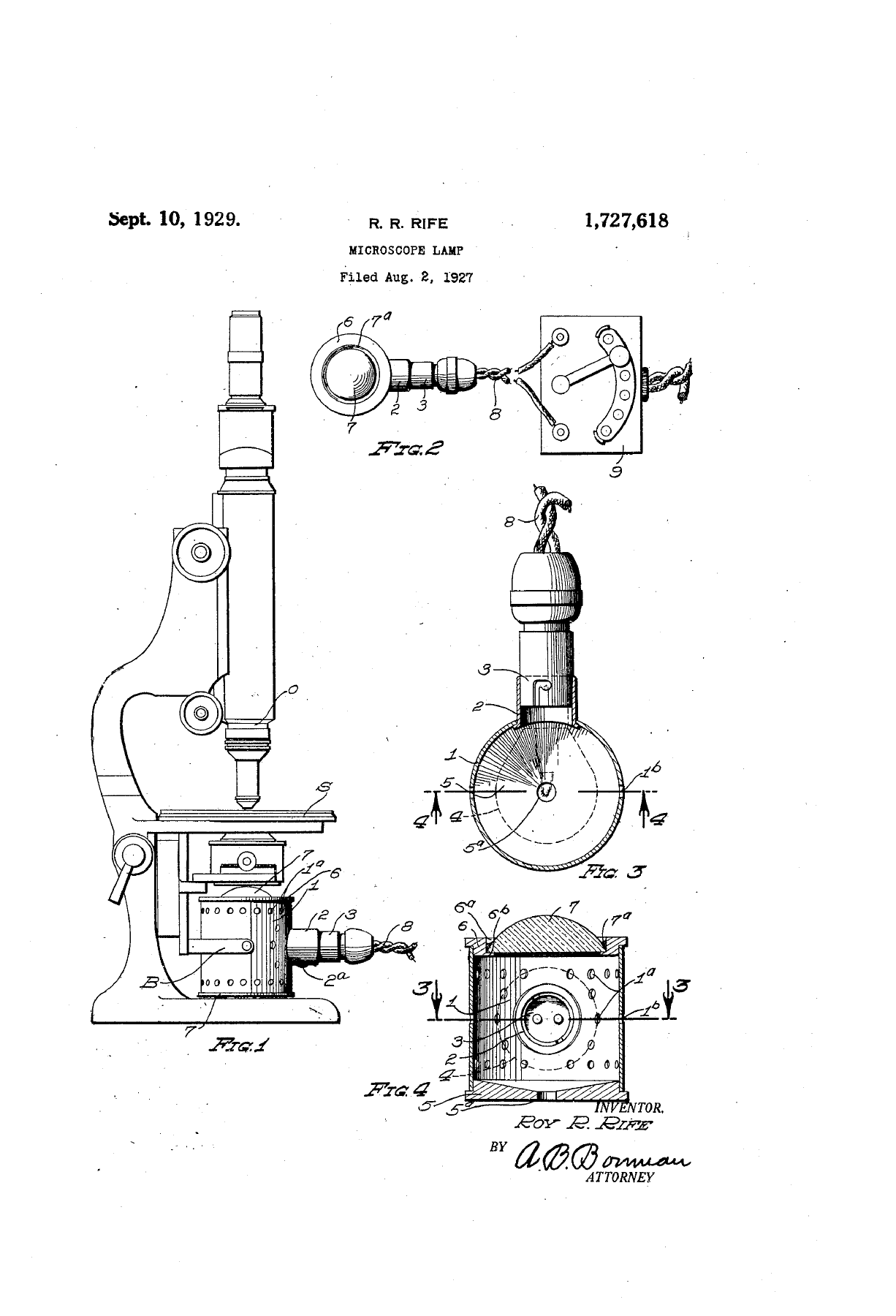
The patent trail becomes definite with Rife’s microscope lamp. He filed the U.S. application in August 1927, and patent 1,727,618 was granted in September 1929. The invention addressed illumination: how to place a controllable light source on a conventional microscope, manage heat and give the observer a steadier field. It belongs to practical optical engineering rather than to the later treatment claims attached to his name. The document shows him working on the ordinary conditions that make close observation possible. A good image depends on the light as well as on the lenses. This seemingly modest invention is therefore an important biographical anchor. It gives a dated, signed record of Rife acting as a designer, stating a problem and explaining the advantages of a proposed object. The signature is Roy R. Rife, a reminder that the monumental name of later legend belonged to a working person with a shorter everyday name.
1929–1931: making the invisible a public spectacle
Rife’s work attracted popular attention around the turn of the 1930s. A surviving laboratory photograph, dated to November 1929 in the Commons record, shows the inventor surrounded by his apparatus rather than posed as a conventional academic portrait. The June 1931 Popular Science article presented microscopy together with moving pictures, using the dramatic possibilities of seeing tiny living subjects in motion. This aspect of the story deserves space of its own. Rife was not interested only in a magnified still image; he wanted observation to become a record that could be shown and discussed. The popular magazine framed the instrument as an opening into a hidden world. Its excitement belongs to the period’s visual culture and scientific publicity. It also helps explain how an individual workshop project could acquire an audience far larger than the number of people who had actually looked through the instrument.
Arthur Kendall and the 1931 collaboration
Arthur Isaac Kendall, a bacteriologist at Northwestern University, became a crucial collaborator in the public phase of Rife’s microscopy. Their joint paper appeared in California and Western Medicine in December 1931 and was explicitly described as a preliminary communication. At the level needed for this biography, its importance is the collaboration and the type of record it created: Rife’s instrument was being discussed in a named scientific journal alongside a recognised academic researcher. The paper connected work in Chicago, Rife’s San Diego laboratory and facilities in Pasadena. It therefore shows that the project existed within a network, not simply in the recollections of one inventor. The article concerns a microscopy question; it should not be converted into a clinical trial of an electrical-treatment device. Read in its actual form, it is evidence of the moment when Rife’s optical work crossed from workshop demonstration into a published scientific exchange.
The November demonstration and the people who made it possible
A related contemporary journal account describes a gathering at Dr. Milbank Johnson’s home on 20 November 1931. Johnson helped bring Kendall west, and local medical colleagues were invited to view the microscope. The editorial response was hopeful and conditional: the instrument might open a new field if its apparent advantages held up. That tone is more revealing than the later shorthand of a banquet that proved everything. The event combined patronage, hospitality, professional curiosity and a live demonstration. It also supplied photographs and a list of names that later became central to retellings of Rife’s career. Among the people and facilities connected with this phase were Johnson, Kendall, Alvin Foord and Pasadena Hospital. Their distinct contributions should remain distinct. Organising access, observing an image, contributing laboratory expertise and endorsing a medical claim are not all the same act.
1932: Rosenow and a widening circle of observers
Edward C. Rosenow became another important participant in the microscopy discussion. A report of his July 1932 visit described time spent with Kendall and Rife in Chicago, and a short paper under his name appeared in Science that August. The historical significance is that another named researcher took an interest in the instrument and published observations about it. This does not require us to reproduce biological procedures or assume that every interpretation was correct. It shows the social life of an experimental device: it was transported, compared, explained and discussed between people with different expertise. Rife supplied the special instrument and practical familiarity with it; the academic collaborators brought their own research questions. The surviving publication trail is narrower than later claims of universal acceptance, but it is substantial enough to study on its own terms. It records a real episode of scientific engagement rather than merely a retrospective legend.
1933: the Universal microscope as an individual machine
The microscope generally called Rife’s Universal was associated with 1933. Contemporary and later illustrations show a complex, highly individual instrument with multiple optical components and adjustments. Seidel and Winter devoted a substantial part of their 1944 discussion of new microscopes to it, describing its versatility and the ways its illumination arrangements could be varied. Their account is a valuable contemporary description, not an independent guarantee of every performance figure. The machine’s appeal is nevertheless easy to understand. It looks like the product of an inventor continually adding ways to observe, refine and compare an image. A reader can study the object as a piece of material history: what an experimentalist believed should be adjustable, what he considered worth controlling, and how much mechanical complexity he accepted in pursuit of that goal. The Universal belongs to the biography as a sustained design project, not just an illustration beside a medical story.
Frequency claims and the move towards commercial apparatus
Alongside his microscopes, Rife pursued electrical apparatus that he believed could influence disease-related processes. Later statements attributed to him described a long programme of research and claimed successes, but these should remain clearly identified as his account. The apparatus history is not the same as the clinical claim. Philip Hoyland, a radio technician and designer, became central to the development of the plasma-ray equipment associated with the later 1930s. An agreement dated 24 April 1938 records Royal Rife and Hoyland sharing an interest in the Rife Ray with C. R. Hutchinson. This is a useful, less familiar document because it restores the collaborative and commercial reality of the work. Designs had owners and partners; manufacture needed arrangements; different people held different interests. It is a more concrete starting point for understanding what followed than treating every surviving circuit as the unchanging creation of one man.
1934 · The house at La Jolla and the story that outgrew it
The most famous episode in the Rife legend begins with an unexpectedly ordinary matter: finding somewhere to work. In letters dated 2 April 1934, Milbank Johnson discussed taking a house in La Jolla for the summer and bringing the experimental programme closer to people he hoped could be studied. The reproduced correspondence to Arthur Kendall and to Rife supplies a dated glimpse of the arrangements before the episode became a celebrated story. Here are accommodation, a proposed period of residence, practical attention and a patron trying to move an undertaking forward.
Those small details are valuable because the 1934 clinic acquired a much larger afterlife. It is often invoked as the decisive event in accounts of Rife’s promise and later eclipse. The letters establish intentions and relationships at the time; later interviews supply recollections of what participants thought happened. They are different windows onto the same setting. Rife and his associates could remember a turning point without every later retelling preserving the same number, description or conclusion. The original planning documents let the story retain a firm physical beginning.
Johnson’s role becomes especially vivid. Rife’s laboratory reputation depended on more than the work of a solitary maker. Someone had to arrange money, space, introductions and the attention of other professionals. Kendall, Johnson and Rife appear as people coordinating a project, with different contributions and expectations. In that network one can see how an ambitious apparatus might cross from a private workshop into a setting where larger public claims would be made about it.
This is where the intrigue of the La Jolla story is strongest: the sense of a possible breakthrough gathering people, places and hopes around itself. The ARC hive preserves that momentum while keeping the dates attached to the sources. The summer venture belongs to the history; the many later versions belong to its legacy. Reading the letters restores the moment before that legacy hardened, when the next step was still being planned and the outcome remained ahead of the people writing.
1938–1939: Beam Rays and the business disputes
The corporate record places the name Beam Rays Inc. in June 1938, after earlier names used by the same corporate shell. The archive distinguishes those predecessor businesses from the later manufacture of plasma-ray apparatus. In 1939, Hoyland brought a civil action against the company and its directors. A separate dispute involved a British group connected with plans to sell the equipment. These were business and contractual conflicts with particular parties, dates and documents. They should not be compressed into an undifferentiated story of a single organisation suppressing a single invention. For Rife’s life, the records show the strain of moving from private experimental work into manufacture, distribution and contested ownership. They also explain why the later equipment story is so complicated: apparatus, commercial rights and personal loyalties did not always travel together. The original filings are especially valuable because they preserve disagreement while the people involved were still making their own claims.
1938–1939 · An invention divided into shares
The agreement dated 24 April 1938 gives the Rife story a particularly tangible form of tension. Rife and Philip Hoyland granted C. R. Hutchinson a one-third title and interest in the Rife Ray apparatus. The document later appeared in the Beam Rays litigation. An invention that could be discussed as a personal discovery was also becoming an asset with divided rights. The changes in that relationship matter because a promising technical project can be pulled apart by questions of control long before a later historian reaches for a single powerful outside enemy.
The archive’s legal sequence has several distinct movements. Hoyland filed against Beam Rays and its directors in January 1939. A request for receivership was denied, other matters went to trial, and the custodian’s account records that his suit ultimately failed. A separate English group, including Bertram Gonin, pursued a contractual dispute over arrangements to sell the equipment. That case followed a different course and was eventually dismissed in 1952 for lack of action. These were overlapping conflicts, not one proceeding with one set of parties.
What emerges is a difficult human transition from making and discussing apparatus to organising its ownership and distribution. Collaborators who shared access to a workshop might not share the same idea about commercial authority. A prototype, a design, the right to manufacture and the right to sell could become points of friction between people whose names later appear together in a simplified legend. The surviving filings preserve those differences because each participant had reasons to state a particular version of events.
For the reader drawn to suppression stories, this legal material is a compelling starting place. It does not make the drama smaller. It gives the drama faces, interests, obligations and consequences. Rife’s apparatus entered a world of contracts as well as experiments, and that world could exert pressures of its own. The papers show how a scientific promise might become entangled in a business whose internal relationships were no longer holding together.
The No. 5 microscope and the British connection
One of Rife’s microscopes has a particularly definite later history because the object survives. The Science Museum holds his prismatic compound microscope No. 5, signed and dated 1938, together with its lamp, mahogany case and associated components. The museum credits the London School of Hygiene and Tropical Medicine. It is a powerful reminder that the story can be followed through an actual instrument rather than photographs alone. Documents and later interviews connect a British doctor, Bertram Gonin, with the route by which a Rife microscope reached Britain, although details of purchase and transfer were later disputed. The surviving No. 5 should not be silently identified with the earlier Universal as though they were one machine. Each has its own form and documentary history. For a modern visitor, this distinction creates a richer question: how did Rife alter an idea when making another instrument for a different setting and another user?
The later years: Crane, Mexico and the surviving record
During the 1950s, John Crane and John Marsh became important in the continuation and recording of Rife-related work. Audio conversations preserve Rife discussing his instruments in later life, while a 1961 question-and-answer document places him in Tijuana and records his own retrospective version of the research. These sources bring back a human voice, but they are recollections rather than contemporaneous laboratory proof of every event described. The archive also preserves the record of Mamie’s death in 1957 and a 1968 assignment of microscope rights to Crane. Rife died on 5 August 1971, aged eighty-three. His posthumous reputation grew through the efforts of people who gathered interviews, letters, photographs and equipment records. The enduring interest is not exhausted by either celebration or rejection. There is an instrument builder to understand, a network of collaborators to recover, and a contested legacy whose individual documents deserve to be read rather than merged into one seamless legend.
1970s–1987 · How a workshop became a suppression story
Rife’s death did not close the account. It changed who could speak for it. Participant recollections, interviews, photographs, private correspondence and surviving instruments became the material from which a later generation reconstructed the workshop. The Rife Historical Documents collection identifies oral-history work by John Hubbard among its holdings. Such recordings and transcripts are part of the reason names that might otherwise have disappeared can still be encountered as voices, with loyalties, memories and their own explanations of what went wrong.
A major publishing landmark arrived in 1987. WorldCat records Barry Lynes and John Crane’s The Cancer Cure That Worked! Fifty Years of Suppression, issued by Marcus Books in Toronto. The title itself states the interpretation that would become central to much popular Rife writing. It gathers the earlier apparatus story into a larger moral plot: discovery, promise, obstruction and an inheritance waiting to be recovered. The library record establishes the book and its date; the argument announced on its cover remains the authors’ argument.
That shift from laboratory record to recovered-discovery narrative is crucial to understanding Rife’s continuing appeal. A reader is no longer looking only at an unusual microscope. The instrument has become the physical centre of a story about who gets to define knowledge, what happens when a research community fractures, and how later supporters try to rescue a reputation. The archive and the movement feed one another, but they do not have exactly the same task. One preserves particular documents; the other seeks a meaning large enough to hold them together.
The story is most gripping when both remain visible. A contemporary letter can reveal a difficulty that a later narrative makes symbolic. An interview can preserve an unforgettable recollection without settling every chronological detail. A surviving microscope can bring the whole discussion back to a crafted object. Rife’s posthumous world is therefore another chapter in his biography: the invention of an enduring public figure out of a complicated experimental life.
The life at a glance
1888 · Born 16 May in Elkhorn, Nebraska
1912 · Marriage to Mamie Ah Quin recorded in museum historian’s account
1927 · Microscope-lamp patent application
1929 · Lamp patent granted; laboratory photograph dated to November
1931 · Popular Science feature; November demonstration; Kendall–Rife paper
1932 · Rosenow visits and publishes microscopy observations
1933 · Universal microscope associated with this year
1938 · No. 5 microscope signed; Rife Ray ownership agreement; Beam Rays name adopted
1939 · Hoyland and British contractual disputes
1944 · Seidel and Winter publish The New Microscopes
1950s · Work and recordings with Crane and Marsh
1957 · Death of Mamie Rife
1961 · Retrospective question-and-answer account from Tijuana
1968 · Assignment of microscope rights to John Crane
1971 · Death on 5 August
Photographs & original documents
Sources & further reading
- U.S. Patent 1,727,618 — Microscope lamp
- Kendall & Rife, 1931 — Observations on Bacillus Typhosus in Its Filterable State
- Rife’s prismatic compound microscope No. 5, 1938 — Science Museum Group
- Arthur Isaac Kendall and Royal Raymond Rife — Smithsonian Institution Archives
- Science Museum Group — Royal Raymond Rife, 1888–1971
- Rife Historical Documents — birth, family and death records
- Brian Bracegirdle — Rife and his microscopes, Quekett Journal of Microscopy 39 (2003), 459–473
- Ben Cullen interviewed by John Hubbard — transcript of a participant’s recollections
- H. H. Dunn — Movie New Eye of Microscope in War on Germs, Popular Science, June 1931
- Royal Raymond Rife in his Lab — Commons record of period photograph
- California and Western Medicine — contemporary editorial response to the Rife microscope
- Rife Historical Documents — journal scans including the November 1931 demonstration notice
- Edward C. Rosenow — Observations with the Rife microscope, Science, 26 August 1932
- Rosenow — July 1932 visit account, transcribed from Mayo proceedings
- Seidel & Winter — The New Microscopes, Journal of the Franklin Institute, February 1944
- Royal Rife — 1961 retrospective question-and-answer document
- Rife–Hoyland–Hutchinson owners’ agreement, 24 April 1938 — archive entry and original document link
- Beam Rays corporate records — reproduced archive
- Hoyland v. Beam Rays — 1939 complaints and records
- Blewett–Gonin–Parsons contractual dispute — 1939 records and 1952 dismissal
- 1977 visit to Bertram Gonin’s daughter — archive entry
- Rife in conversation with John Crane and John Marsh — original-recording transcript
- Assignment of microscope rights to John Crane, 4 March 1968 — archive entry
- Milbank Johnson to Arthur Kendall, 2 April 1934 — reproduced original letter
- Milbank Johnson to Royal Rife, 2 April 1934 — reproduced original letter
- Rife Historical Documents — correspondence collections, 1929–1974
- Rife Historical Documents — Beam Rays records, owners’ agreement and 1939 cases
- WorldCat — The Cancer Cure That Worked! Fifty Years of Suppression, Barry Lynes and John Crane, 1987
- Rife Historical Documents — original interviews and participant recollections


