
Nikola Tesla
1856–1943
The electrical spark behind the story.
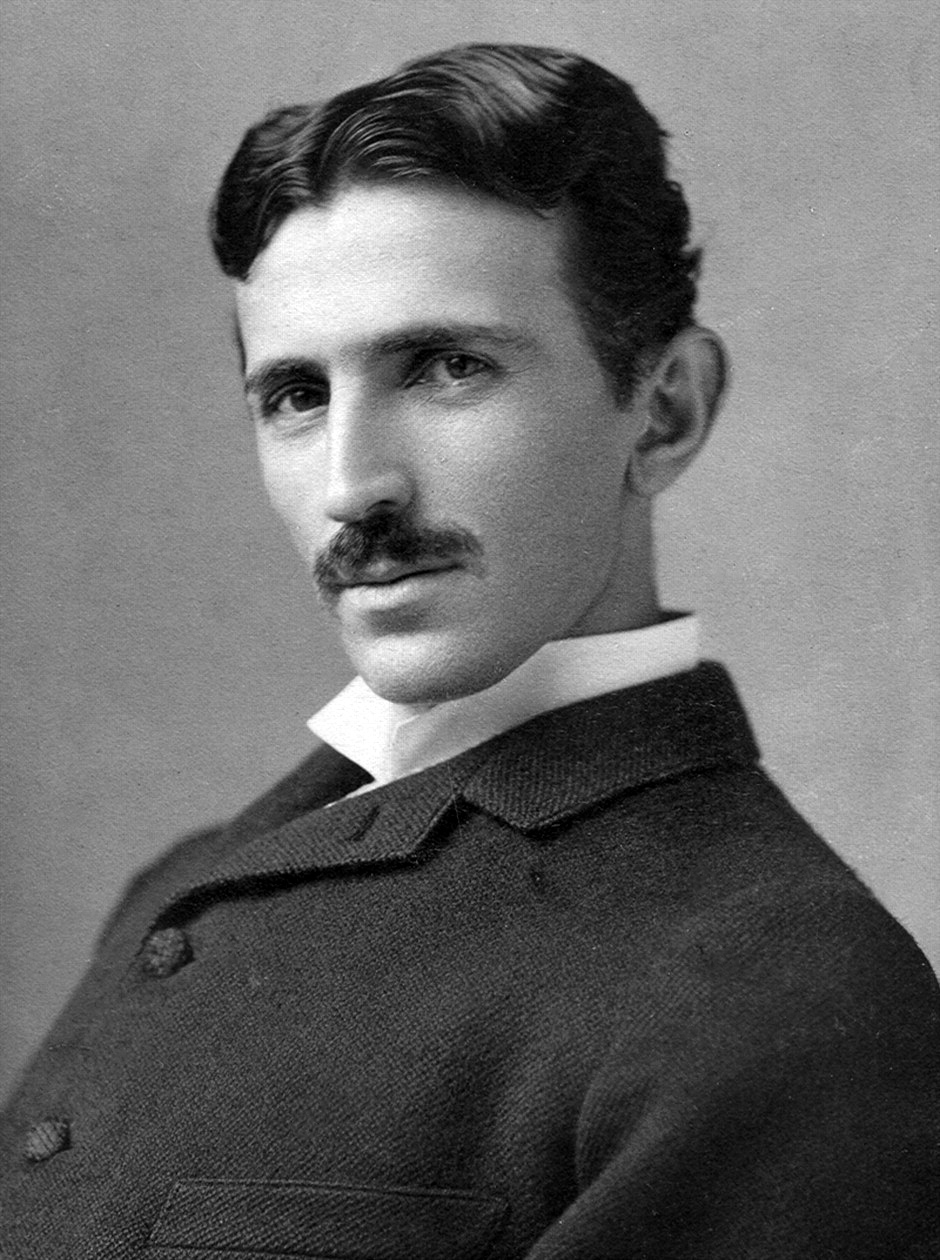

From Smiljan and the rotating field to luminous laboratories, planetary-signal claims and the government review of his papers: follow Tesla’s working life, unfinished projects and extraordinary afterlife through the original record.
1856–1860s · Smiljan, family and the making of an inward world
Nikola Tesla was born on 10 July 1856 at Smiljan, in the Austrian Empire, in what is now Croatia. He grew up in a Serbian family in which religion, language and practical ingenuity carried considerable weight. His father Milutin was an Orthodox priest; his mother Đuka made tools and household devices. Tesla later credited her inventiveness with shaping his own. This was a rural childhood of water, animals, homemade mechanisms and books, rather than a boyhood spent among the sophisticated electrical machines with which his name would become associated.
The death of his older brother Dane left a deep mark on the family. In his 1919 autobiography Tesla remembered feeling overshadowed by the extraordinary promise his parents attributed to the lost child. His account also describes intense visual experiences, flashes of light and images that could intrude on ordinary perception. These are his recollections, written decades later, not a diagnosis. What matters to his story is how he said he learned to direct that inner imagery: inventing imaginary journeys, then mentally assembling and testing mechanisms. The disciplined engineer and the highly unusual imaginative life were connected in the way Tesla chose to explain himself.
1860s–1874 · School, water wheels and a narrow escape from cholera
The family moved to Gospić when Tesla was young. His schooling eventually took him to the Higher Real Gymnasium at Karlovac, then often called Carlstadt. Physics demonstrations helped turn an existing mechanical interest toward electricity. He remembered being fascinated by models, water turbines and descriptions of Niagara Falls. The mature inventor would make Niagara part of his public life story, treating the childhood vision as an early glimpse of a future that had not yet become possible.
After finishing secondary school in 1873, he returned to Gospić and contracted cholera. His autobiography presents the illness as a decisive family turning point. Milutin had wanted his son to enter the priesthood; during Nikola’s dangerous illness, he agreed that he could pursue engineering if he recovered. A period of outdoor life followed before further study.
It is tempting to tell these years as a sequence of signs announcing a predetermined genius. They are more revealing as a young man’s uncertain passage through expectations, illness and ambition. Tesla had a strong memory and exceptional confidence in his imagination, but his path depended on relatives, teachers, money and survival. His later preference for grand physical visions grew out of those ordinary constraints as well as the extraordinary talent.
1875–1880 · Graz, overwork, gambling and unfinished studies
Tesla entered the Austrian Polytechnic at Graz in 1875 with a scholarship and remarkable energy. His first year was academically successful. A demonstration of a Gramme dynamo became one of the memorable episodes in his later account: watching the commutator and sparking brushes, he imagined a motor that could dispense with them. He recalled a professor dismissing that possibility. The episode became part of his explanation of why he continued thinking about rotating magnetic fields after formal classes had ended.
The student’s life did not continue smoothly. Gambling, the loss of financial support and unfinished examinations interrupted the promising beginning. Tesla left Graz without graduating. He worked as a draughtsman in Maribor, became estranged from his family for a time and returned to Gospić in 1879. His father died that April. Tesla later spent a period in Prague, but did not obtain a university degree there either.
The unfinished education is important. Tesla was not a man whose subsequent authority simply followed a conventional academic ladder. He carried serious technical training into the workplace, alongside the consequences of failed studies and family loss. His own autobiography turns the struggle with gambling into a story of self-mastery; an honest biography can retain that personal account without converting every recollection into a fully documented incident.
1881–1883 · Budapest, Paris and the rotating field
Work at the Budapest telephone exchange brought Tesla into practical electrical engineering. He was dealing with real systems, faults and equipment rather than only the ideal machines of his imagination. In his retrospective account, the decisive solution to the motor problem came during an 1882 walk with his friend Anthony Szigety. He was reciting Goethe’s Faust when the idea of a rotating magnetic field became clear, and he drew an explanation in the sand.
The picturesque scene is Tesla’s own remembered origin story. Its engineering content is less theatrical and more enduring: alternating currents arranged out of phase can create a magnetic field that rotates without a mechanical commutator. That offered a route toward a new kind of motor. Turning the insight into reliable equipment, patents and a market would take further work and further collaborators.
Tesla then joined the Continental Edison organisation in France. At Ivry and on assignments elsewhere, he installed and repaired electrical lighting equipment and dynamos. A difficult assignment in Strasbourg in 1883 gave him space to work further on his motor ideas. These years joined two qualities that would recur throughout his career: an ability to diagnose immediate engineering problems and an insistence on returning to a larger design that employers or financiers might not yet want.
1884–1887 · New York, Edison and the first difficult businesses
Tesla arrived in the United States in 1884 and worked for Edison Machine Works. His task was not initially to overturn the electrical industry; it was to solve problems in the existing direct-current business. His own accounts describe demanding repairs, long hours and growing dissatisfaction. He and Edison parted, but the later image of two men representing all of AC and DC compresses a much larger industrial contest into a personal rivalry.
Tesla’s early attempt to establish an electrical-lighting business did not give him lasting control of his future. He developed arc-lighting work, lost the support he needed and endured a period of poorly paid labour. By 1887 new backing enabled him to pursue the alternating-current motor and polyphase system more seriously. Patents and demonstrations now began to translate the private mental model into an invention other people could evaluate.
This is the less glamorous hinge in his career. The celebrated inventor did not simply step from the steamship into a fully equipped laboratory. He had to find people willing to finance a particular proposal, then make that proposal convincing. His subsequent relationships with Westinghouse, editors and wealthy patrons grew out of this need. The surviving correspondence shows an inventor embedded in business and social networks, even when he later presented the experience as the struggle of a solitary mind.
1888–1890s · Polyphase power, Westinghouse and public success
Tesla’s polyphase inventions brought his first major professional success. In 1888 he presented his alternating-current motor work to the American Institute of Electrical Engineers, and George Westinghouse’s company obtained rights to important patents. An electrical field could now be made to rotate by the relationship between currents in separate windings. A rotor responded to that moving field, offering an alternative to motors that depended on sliding commutator contacts.
The significance was not a single mysterious force. It was a system: generation, transmission, transformation and useful mechanical power had to work together. Tesla’s contributions were substantial, while the implementation also depended on engineers, factories, financial decisions and other inventions. The 1893 Chicago exposition and the development of Niagara power made alternating-current engineering highly visible. They also helped establish Tesla as a public figure whose demonstrations could draw audiences beyond specialist societies.
His new position did not make him content to refine motors indefinitely. The more secure electrical-power work financed or enabled attention to higher frequencies, illumination and wireless possibilities. That movement is central to the violet ray story. The successful motor engineer increasingly used his reputation to open a different experimental frontier, where the apparatus could be spectacular and the possible applications far less settled than the machinery that had earned his commercial standing.
1891–1894 · Coils, glowing glass and the laboratory as theatre
In the early 1890s Tesla’s New York laboratory became a place where electrical engineering was also a performance of possibility. He investigated high-frequency alternators, disruptive discharges, resonant transformers and unfamiliar forms of electric illumination. The Tesla coil grew from this work: oscillating electrical energy could be transferred between coupled circuits to obtain striking high potentials. His June 1891 patent for a System of Electric Lighting belongs to that development, and its stated lighting purpose should be kept in view.
The lectures at Columbia in 1891, London and Paris in 1892, and Philadelphia and St Louis in 1893 brought glowing lamps, sparks and unusual electrical effects before scientific audiences. Gas inside partially evacuated glass could become luminous under electrical excitation. The appeal was physical and immediate: invisible electrical changes acquired colour, light and motion. Martin’s 1894 collection preserves a remarkable range of the demonstrations and their explanations.
Friends and patrons were part of this world. The Library of Congress records correspondence with Samuel Clemens, better known as Mark Twain, and the editor Robert Underwood Johnson, alongside industrial and financial contacts. Tesla was not only the isolated figure of later legend. He moved through a culture of dinners, publishing, demonstrations and personal introductions. That social skill helped his work reach people who might never have opened an electrical journal, while also encouraging expectations that a brilliant demonstration must be the beginning of an immediate revolution.
1895–1897 · Fire, shadow pictures and rebuilding
The destruction of Tesla’s South Fifth Avenue laboratory by fire in March 1895 was a genuine catastrophe. Apparatus, records and experimental work were lost. It disrupted research that had become both technically elaborate and financially dependent on the laboratory’s public reputation. Tesla had to rebuild a working environment, and the episode helps explain why the surviving record can be uneven: not every experimental claim can be checked against the original object or notebook.
After Röntgen’s announcement of X-rays, Tesla investigated the new rays and published reports on their production and effects. The Nikola Tesla Museum’s bibliography lists a succession of 1896 writings on radiography, reflected rays and related observations. His high-voltage equipment made the subject accessible to him, but it was also a new and dangerous experimental field whose biological effects were not yet adequately understood.
The X-ray work is a useful correction to the habit of treating Tesla as someone who followed one secret theory throughout his life. He responded rapidly to new discoveries and moved between electrical, optical and physiological questions. Some of the same apparatus could illuminate a bulb, excite a discharge tube or participate in investigations of penetrating radiation. The shared workshop did not make these effects identical. Their difference is precisely what makes the laboratory period worth studying in detail.
1893–1898 · Mechanical oscillators, ozone and the living body
Tesla also asked how oscillation might affect the human body. In his 1898 address to the American Electro-Therapeutic Association he described the development of high-frequency generators and discussed physiological observations and possible applications. The interest was real, not an invention of later violet ray advertising. It sat alongside work by medical researchers such as d’Arsonval and Oudin, whose own instruments and methods were different.
Another branch of Tesla’s experimentation used mechanical vibration rather than a glowing glass electrode. He designed oscillating machinery and wrote about physical responses to vibration. Later stories enlarged this work into an earthquake machine capable of shaking whole neighbourhoods. The documented oscillators are interesting without needing the strongest versions of those stories: they show him seeking regularity and resonance in mechanical systems as well as electrical ones.
His 1896 ozone apparatus patent is another concrete example of a lesser-known line of work. It uses electrical discharge to produce a chemical change in a gas. A patented method of generating ozone is not itself a demonstration that breathing ozone or treating illness with it is beneficial. The historical thread worth following is the way Tesla connected electricity, matter and possible utility. This period supplies original documents for that thread, rather than requiring a belief that every subsequent therapeutic claim attached to his name was his own.
1898 · The boat that answered without a wire
At the end of the century Tesla developed another idea whose implications went well beyond electric light: a mechanism that could respond to distant commands. His 1898 patent describes control of moving vessels or vehicles, with receiving circuits, relays, steering and propulsion. A public demonstration used a small boat. The craft carried its own power; radio signals supplied commands rather than mysteriously delivering all the energy needed to move it.
Tesla called this field telautomatics. In his later account he imagined machines carrying out actions that would otherwise require human beings. The extraordinary feature was the separation of operator and mechanism. An observer could see a vessel change course while its controlling person remained elsewhere, without the obvious wire that had made earlier electrical control easier to understand.
The proposal could be discussed as a toy, a weapon, a remotely operated machine or the beginning of a new industrial art. Tesla preferred to see the wider possibilities. It is one of the best examples of his ability to combine working demonstration with a very expansive future. For a biography concerned with the fringe, the lesson is not that the strangest interpretation must be true. Here an apparently uncanny effect had a precise engineered basis, and that basis was imaginative enough to alter how people thought about agency and machines.
1899–1900 · Colorado Springs: a larger scale of experiment
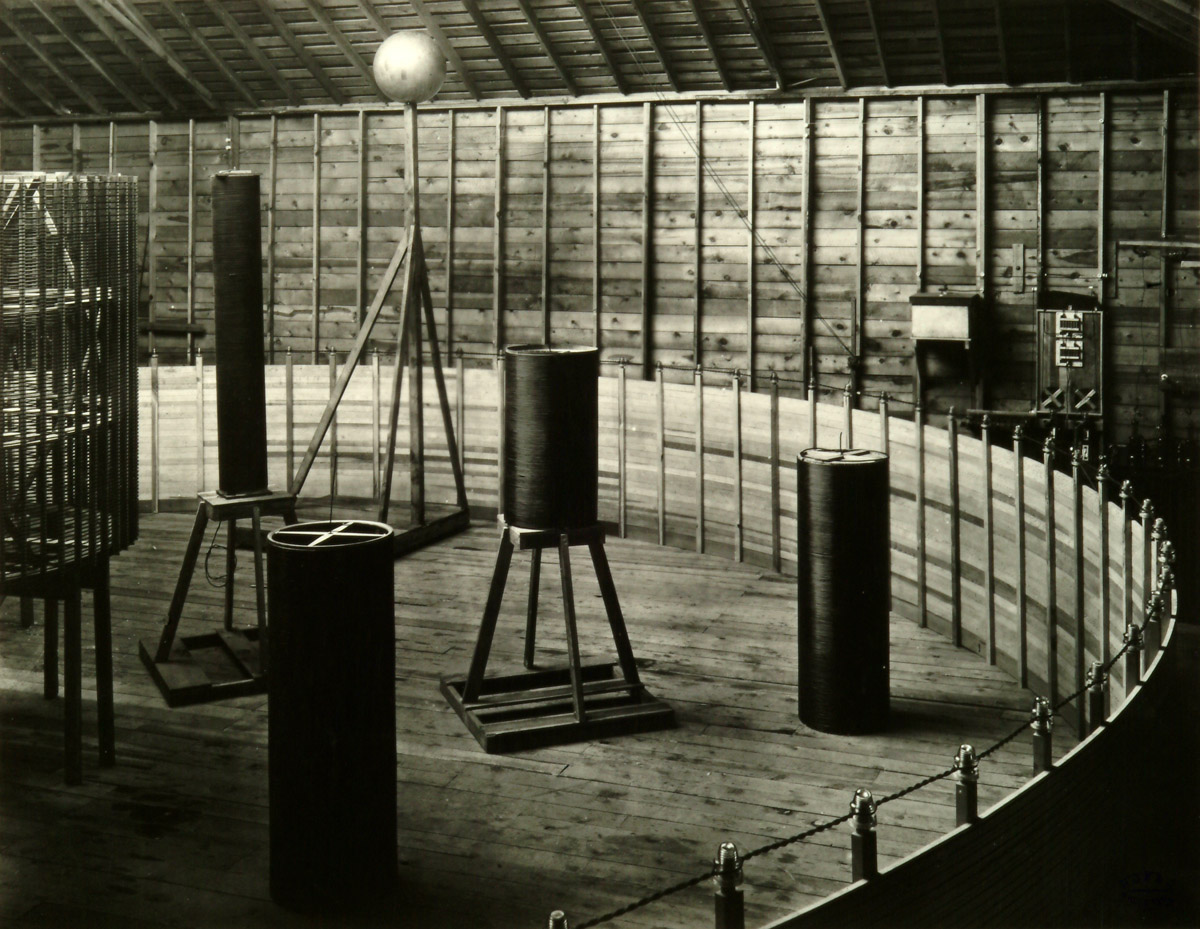
Tesla went to Colorado Springs in 1899 to investigate high-voltage, high-frequency phenomena and wireless transmission on a larger scale. Assistants helped construct an experimental station with a large oscillator and an elevated terminal. The site gave him room for apparatus that could not readily fit into a Manhattan workshop. He remained until January 1900.
He studied lightning and electrical behaviour associated with the earth, made measurements, altered coils and pursued the magnifying transmitter. His ambition was to find a way to send signals and, ultimately, useful power over great distances. In his later writings he interpreted the earth as an active part of the proposed transmitting system rather than merely a place beneath a conventional aerial. The surviving experimental notes and photographs are much more informative than a modern slogan about unlimited free energy.
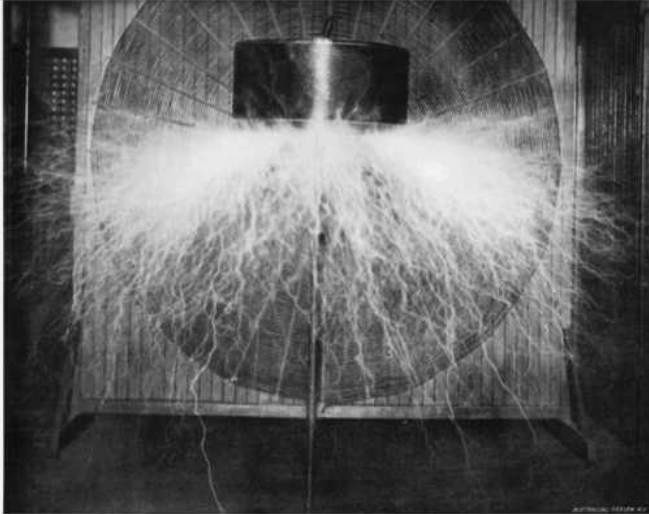
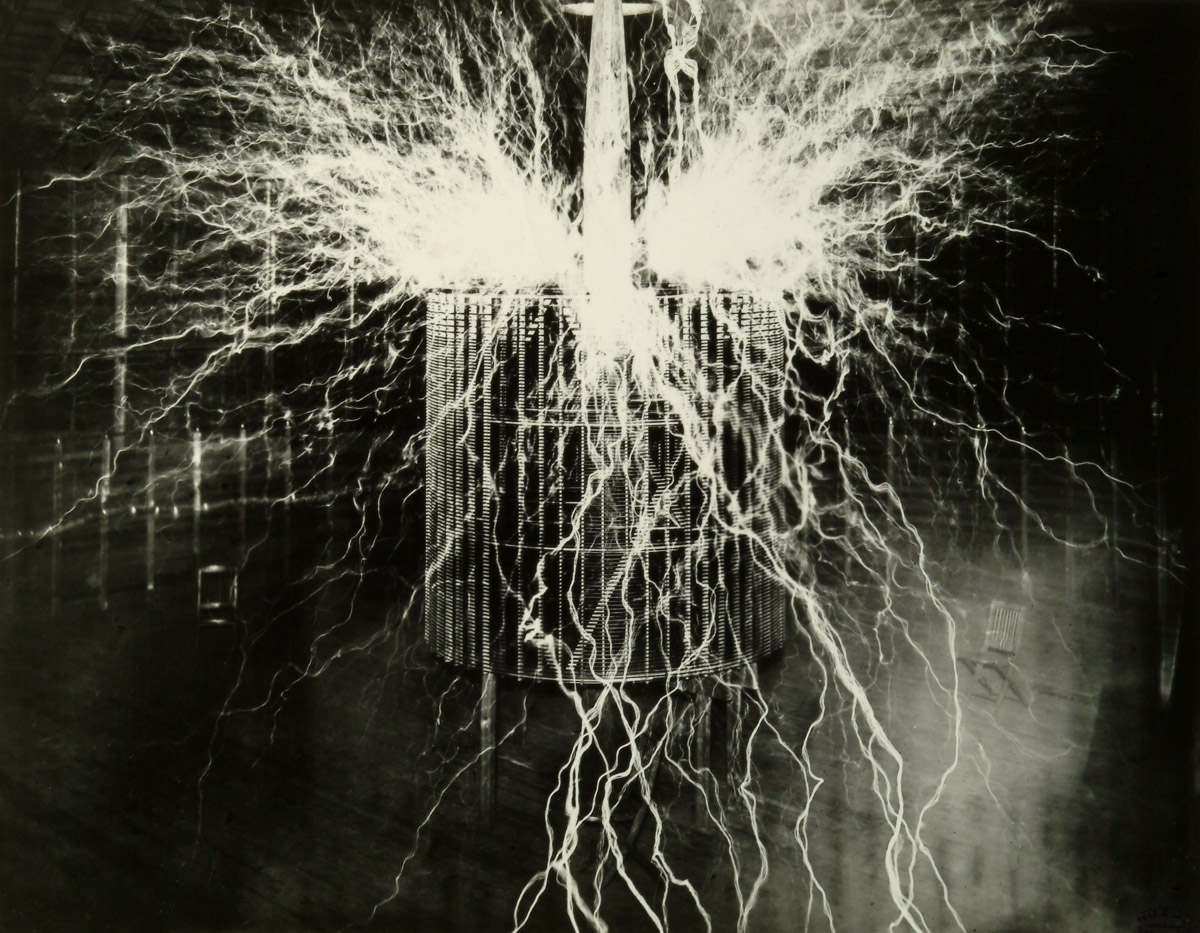
Colorado also supplied some of Tesla’s most enduring imagery. Enormous artificial discharges turned the laboratory into a visual theatre of the electrical age. Photographs require the same care as documents: dates may identify a later print or inscription, and a publicity composition is not automatically a literal record of someone sitting beside an energised machine. Tesla’s own expansive interpretations—including unusual signals he considered potentially significant—should be read as his proposals. What the station certainly shows is the scale of his effort, the technical seriousness of the experiments, and the distance between a powerful experimental installation and a completed worldwide service.
1899–1901 · The signals Tesla thought came from another world
One of the most extraordinary things to emerge from Colorado Springs was a listening story. Tesla had been developing apparatus sensitive enough, he said, to follow distant electrical disturbances and approaching storms. Among those disturbances he believed he had detected a recurring order. In his February 1901 Collier’s article, the solitary laboratory becomes the setting for an encounter with a possibility that initially frightened him: perhaps the instrument was registering an intelligent signal from beyond Earth. The piece is Tesla’s own account, published during his lifetime, and its emotional register is as revealing as its electrical argument.
A January letter to the New York Sun makes the episode more precise. Responding to the astronomer Norman Lockyer, Tesla defended the practicability of interplanetary signalling, while stating that he had not announced receipt of a deciphered message from Mars. He distinguished his conviction about a possible planetary origin from an exchange whose meaning had been established. Across the two texts we can watch a suggestion become a public campaign: an observation, a proposed interpretation, an argument over the energy required and a vision of communication based initially on simple numerical order.
This is a richer fringe history than the later image of an inventor calmly conversing with extraterrestrials. Tesla’s own narrative is charged with anticipation. The instrument seems to have opened a door, yet the reader is standing with him before anything recognisable has walked through it. His sensitivity to faint effects and his ambition for vast transmission distances had become two sides of the same adventure. A man already trying to make Earth into an electrical system was prepared to imagine the neighbouring worlds as possible participants.
The encounter belongs in his biography because it reveals how he moved from engineering to cosmic speculation without experiencing a neat boundary between them. The surviving articles preserve that movement in his own voice: excitement, defiance, vulnerability and the enormous desire to hear an answer.
1901 · Radiant energy and the later free-energy reading
In November 1901 Tesla received a patent whose title still seems to promise a hidden doorway: Apparatus for the Utilization of Radiant Energy. It is frequently drawn into the modern free-energy story, partly because its language combines radiation, the Earth and the accumulation of electrical charge. The original document is more interesting when allowed its particular shape. Tesla discusses radiation acting upon a conducting body, charge accumulating in a condenser and a receiving device operated by the resulting discharge. His examples include natural and artificially produced radiation. The proposed apparatus is an attempt to obtain useful electrical action from an interaction that begins outside an ordinary generator.
The drawing belongs beside his other work on electrical reception, rather than being treated as a mysterious photograph of a completed power station. Here the inventor is pursuing a receiver, storage and controlled release as a connected system. The patent also retains the theoretical vocabulary of its moment. Tesla advances his own explanation in terms of strongly electrified particles, while acknowledging another contemporary explanation involving the action of radiation on the surrounding medium. Even the act of collecting energy was bound up with a dispute over what, physically, was arriving.
That tension helps explain the document’s enduring appeal. To later independent experimenters, it looks like a claim that the world is richer in available electrical relationships than conventional machine diagrams suggest. To an historian, it is a definite 1901 design, filed while Tesla was stretching his thinking about transmitters, receivers and environmental energy. Those readings can be explored together without making the patent stand in for every subsequent claim attached to his name.
There is no need to flatten the page into either a miracle or a disappointment. Its fascination is the act of attention it records: an inventor asking whether a subtle physical effect could be collected, accumulated and made to operate something. That question is thoroughly Tesla, and the original patent gives the modern fringe discussion an object worth looking at closely.
1901–1917 · Wardenclyffe, world telegraphy and the unfinished tower
Wardenclyffe on Long Island was Tesla’s attempt to turn the large vision into a permanent installation. The project began in 1901 with major financial backing from J. P. Morgan. Stanford White designed the laboratory building, and an imposing tower became its public symbol. Tesla wanted a system that could transmit information widely, and his aspirations also included the wireless transfer of power.
The public writing is ambitious and surprisingly concrete about communication. In a 1904 account Tesla imagined news and individual messages reaching small receivers across the world. That vision was not the same thing as a modern mobile network, but it reveals how he connected a transmitting station with changes in everyday access to information. The engineering, business model and financing had to support one another; they did not come together successfully at Wardenclyffe.
Further money did not arrive on the terms needed to complete the project. Debt accumulated and Tesla eventually lost control of the property. The tower was dismantled in 1917. The surviving site’s own history traces that demolition to financial obligations and creditors, rather than to the popular story that a fully functioning source of free power was secretly destroyed. The failure does not make the ambition trivial. It makes Wardenclyffe a human story of exceptional confidence, changing plans, dependence on patrons and the vulnerability of a research programme when its promised future cannot yet be made into a sustainable present.
1900s–1930s · Turbines, self-portrait and increasingly bold claims
The end of Wardenclyffe did not end Tesla’s inventive activity. He continued to work on machinery, including the disk turbine represented by his 1913 patent. Instead of a conventional bladed runner, the design proposed closely spaced disks through which a fluid would move and transfer momentum. It returned him to a mechanical interest that had existed since childhood. A patent records a serious design and its claimed arrangement; commercial success requires a different history of manufacturing, efficiency and economics.
In 1919 Tesla published My Inventions as a six-part autobiographical series. It is indispensable for his account of imagination, discipline, illness and remembered discoveries. It is also a carefully shaped self-portrait, written by a man looking back over a career whose public promise exceeded his finances. It gives the story a human voice, but should be compared with letters, dates and surviving apparatus.
In later years his birthday interviews became occasions for dramatic announcements. A 1934 newspaper interview reported his proposed particle-beam defensive weapon, usually remembered as the death ray. The newspaper’s wording distinguishes what Tesla asserted from a witnessed operational demonstration. This is exactly the sort of fringe material worth preserving in a full biography: a bold, historically documented proposal, with its ambition and context intact, rather than either an invented secret success or an embarrassed omission from the life story.
A contemporary TIME profile from 1931 offers a smaller-scale portrait of the ageing inventor. A lifelong bachelor, he lived in hotels, continued thinking through problems during irregular nights and kept pigeons, including birds reported to have nested in his desk. The account mixes admiration with the period’s fascination with an eccentric genius, but the everyday details are revealing. A life once organised around large laboratories was now being fitted into rented rooms. His need for intellectual work endured alongside the practical difficulty of accommodating both an inventor’s habits and the birds he cared for.
1943 and after · A death in New York, an archive and an afterlife
Tesla died in New York on 7 January 1943. He had spent his later life in hotels and no longer possessed the industrial position or financial security associated with the peak of his fame. The surviving letters, recollections and papers reveal continuing relationships rather than a simple disappearance from the world. Kenneth Swezey, a writer and admirer, helped preserve material about his life; Smithsonian holdings now include a substantial Swezey collection relating to Tesla.
His death generated concern about the possible military value of his papers. Government files released through the FBI Vault are part of the historical record of that concern. Their existence should not be mistaken for proof that every dramatic invention attributed to him had been completed. Tesla’s archive ultimately became the foundation of the Nikola Tesla Museum in Belgrade, while correspondence is also available through institutions such as the Library of Congress.
The afterlife of his name is unusually powerful. It can stand for practical alternating-current engineering, theatrical electrical experimentation, technological humanitarianism or a promised invention that has never been demonstrated. A substantial biography needs room for all of those strands without making them equivalent. The man who pursued a motor without sparking brushes, a boat without a control wire and a transmitting station for a connected world is already a remarkable figure. His unfinished projects and self-explanations make him more human, and more interesting, than a catalogue of supposedly infallible predictions.
1943 · Inside the warehouse, before the legend
The after-death story acquires its most cinematic setting in a Manhattan warehouse. In a letter dated 30 January 1943, the electrical engineer John G. Trump reported that he had examined Tesla’s papers and possessions on 26 and 27 January at the request of officials of the Alien Property Custodian. His purpose was explicitly wartime: could the material help the United States, and would it be dangerous in hostile hands? The report is a genuine doorway into the government’s interest, with names, dates and a stated assignment.
Trump described the material he examined and the limits of that examination. His letter says that trunks which had remained untouched in the New Yorker Hotel basement for a decade were not investigated for the reasons he then supplied. He concluded that the examined possessions did not contain a newly revealed device or method of substantial military value, and recommended no further technical reason for retaining custody. The following page characterised much of Tesla’s later work as speculative and philosophical. Those were Trump’s judgements, made for a particular administrative purpose; they were not a complete catalogue of everything Tesla had ever conceived.
The distinction between agencies also matters. In its own later account, the FBI says the temporary seizure was undertaken by the Alien Property Custodian and denies having searched or possessed Tesla’s papers. An FBI file can therefore contain reports about an event without the Bureau being the body that carried it out. The record is already dramatic enough without silently changing the actors.
This warehouse episode helps explain why the conspiracy story became so durable. An inventor associated with invisible power and defensive beams dies during a world war; officials secure his possessions; an expert assesses the contents; later readers meet the episode through released files. The historical intrigue lies in those actual intersections of invention, secrecy, administration and reputation. The most absorbing questions begin where the documents become specific, rather than where an unspecified hidden machine is made to explain every gap.
The life at a glance
1856 · Born at Smiljan on 10 July
1875 · Begins technical studies in Graz
1882 · Develops the rotating-field idea described in his later autobiography
1884 · Arrives in the United States
1888 · Polyphase motor presentation and Westinghouse patent agreement
1891–1893 · High-frequency lectures in the United States and Europe
1898 · Remote-control boat patent and electrotherapeutic lecture
1899–1900 · Large-scale experiments at Colorado Springs
1901–1917 · Wardenclyffe project, financial difficulties and tower demolition
1919 · Publishes My Inventions
1943 · Dies in New York on 7 January
Photographs & original documents




Sources & further reading
- Nikola Tesla Museum — Life and work
- Nikola Tesla Museum — Lectures
- Nikola Tesla Museum — Writings
- Tesla — System of Electric Lighting, US454622A (1891)
- T. C. Martin — The Inventions, Researches and Writings of Nikola Tesla (1894)
- Tesla — My Inventions I: My Early Life (1919)
- Tesla — My Inventions II: My First Efforts in Invention (1919)
- Tesla — My Inventions (1919), original autobiography
- Tesla Science Center — Birth of Nikola Tesla
- Tesla Science Center — Early Influences
- Tesla Science Center — Cholera & a New Path
- Tesla Science Center — College Years
- Tesla Science Center — Overcoming Hardship
- Tesla Science Center — Rotating Field Revelation
- Tesla Science Center — Career Beginnings
- Tesla Science Center — Arrives in America
- Tesla Science Center — Colorado Springs
- Tesla Science Center — Vision of the Future
- Tesla Science Center — Tower Dismantled
- Library of Congress — Nikola Tesla correspondence, 1890–1934
- Tesla — High Frequency Oscillators for Electro-Therapeutic and Other Purposes (1898)
- New York Times — Tesla, at 78, Bares New Death-Beam (11 July 1934)
- Tesla — Control of Moving Vessels or Vehicles, US613809A (1898)
- Tesla — Turbine, US1061206A (1913)
- Tesla — Apparatus for Producing Ozone, US568177A (1896)
- FBI Vault — Nikola Tesla files
- Smithsonian — Guide to the Kenneth M. Swezey Papers
- TIME — Tesla at 75 (20 July 1931), contemporary profile preserved by Tesla Science Center
- Nikola Tesla — Talking with the Planets, Collier’s Weekly, 9 February 1901
- Nikola Tesla — Communication with the Planets, New York Sun, 11 January 1901
- Nikola Tesla — Apparatus for the Utilization of Radiant Energy, US685957A, 1901
- John G. Trump — examination of Tesla’s papers, 30 January 1943, page 174
- John G. Trump — examination report conclusion, page 175
- FBI — its account of the Tesla papers and Alien Property Custodian, 2008